
Building a crypto family office means constructing a private entity structure, typically one or more LLCs or trusts, that centralizes institutional crypto custody, governance, tax coordination, and reporting for a family's digital asset holdings. It differs from a traditional family office because private key management, multi-signature governance, and crypto-specific tax treatment require infrastructure that conventional wealth management does not provide.
What Is a Crypto Family Office?
A crypto family office is a private entity (or layered set of entities) that consolidates management, crypto custody for family offices, governance, and reporting for a family's digital assets under one coordinated structure. Unlike a traditional family office, it must solve for private key access, multi-sig authorization, on-chain reporting, and succession planning for wallet access, problems that have no equivalent in conventional finance.
For a broader orientation on how this fits within a full wealth architecture, see what is a crypto family office?.
How to Build a Crypto Family Office: 6-Step Sequence
Getting the sequence right matters. Each decision constrains the next, custody cannot be properly established before the holding entity exists; entity type cannot be finalized before the tax approach is clear.
Define goals and governance preferences. Clarify investment strategy, succession priorities, whether multiple family members are involved, and what future-generation considerations apply. This shapes every downstream decision.
Select legal structure with qualified counsel. Choose between an LLC, trust, or layered combination based on your tax situation and estate planning goals. A Wyoming LLC carries different privacy and charging-order protections than a Delaware entity; a grantor trust has different reporting requirements than a partnership-taxed LLC. Work with a crypto-experienced attorney, generic templates do not account for multi-sig governance provisions or wallet succession. See should crypto be held personally, in an LLC, or in a trust? for a comparison of holding structures.
Establish the tax and compliance framework before assets move. Crypto tax reporting for family offices covers capital gains treatment on disposals, income classification for staking and yield, gift and estate tax implications, and potential cross-border issues. The entity type determines the tax treatment, so this step must precede custody setup.
Set up custody and wallet infrastructure once the entity is in place. The entity is what holds the custody relationship. Multi-signature wallet architecture, requiring a defined number of keyholders to approve any transaction before it executes (e.g., 3-of-5 or 2-of-3), is the standard for institutional-grade crypto family office setups. Cold storage handles assets not actively deployed. See MPC vs multi-sig custody for a comparison of the two dominant approaches, and crypto custody for family offices for implementation detail.
Assemble the advisory team. The core team typically includes a crypto-experienced attorney for entity structuring and ongoing legal governance, a tax professional who handles digital asset reporting and planning, and an investment advisor for portfolio strategy. Advisory services are provided by DAG Wealth, an SEC-registered investment adviser. The advisor coordinates on portfolio construction and investment strategy for digital asset holdings within the family office structure.
Document governance procedures. Transaction approval policies, signer succession plans for key access, and compliance protocols must be formally documented, not informally understood. See crypto governance for family offices and crypto family office governance checklist for what a complete governance framework covers.
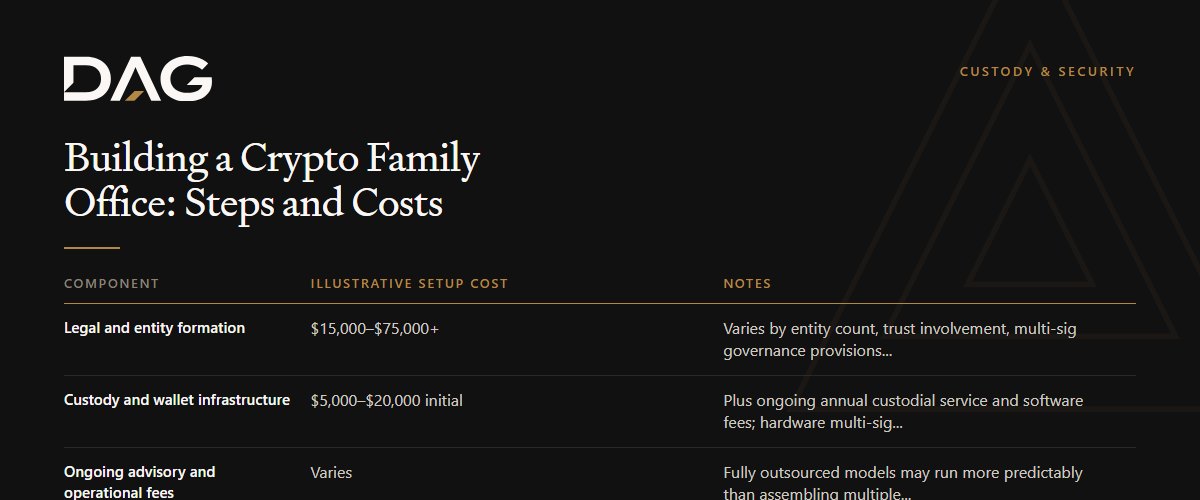
What Does a Crypto Family Office Cost?
Cost ranges below are illustrative, based on publicly available professional service rate ranges as of 2026, verify current figures with your service providers before budgeting.
| Component | Illustrative Setup Cost | Notes |
|---|---|---|
| Legal and entity formation | $15,000–$75,000+ | Varies by entity count, trust involvement, multi-sig governance provisions, succession planning scope |
| Custody and wallet infrastructure | $5,000–$20,000 initial | Plus ongoing annual custodial service and software fees; hardware multi-sig vs. institutional custodian affects range significantly |
| Ongoing advisory and operational fees | Varies | Fully outsourced models may run more predictably than assembling multiple vendors; coordination costs and coverage gaps add up with fragmented vendors |
Scale thresholds (illustrative): A full crypto family office structure may make financial sense for families with roughly $10M–$20M or more in digital assets. Below that threshold, the overhead may outweigh the benefit. Above approximately $50M, the cost of not having a proper structure can exceed the cost of building one. These are rough orientation points; the actual breakeven depends on complexity, governance needs, and what simpler alternatives can realistically cover. Verify current figures with qualified professionals before relying on them.
Operational support, managing day-to-day administration, compliance deadlines, reporting, and vendor coordination, is consistently underweighted in early planning and often becomes the pressure point once the structure is running. Budget for it explicitly.
The Custody Layer: Where Crypto Family Offices Differ Most
The custody question for a crypto family office is not simply "where are the assets held" but "who controls access, under what conditions, and what happens if something goes wrong."
Multi-sig architecture prevents unilateral movement of funds, protecting against both external theft and internal disputes. Cold storage, hardware devices kept offline, in some cases distributed across physical locations, handles the bulk of assets not being actively deployed. The split between cold and accessible custody should be deliberate, documented, and reviewed regularly.
Insurance coverage for institutional-grade crypto custody has become more available, but coverage terms vary significantly. Confirm what your custodian actually covers, and what it explicitly does not, before relying on it. See crypto insurance and custody for what to evaluate.
Is a Full Family Office the Right Structure for Your Situation?
A full crypto family office makes the most sense for families with substantial digital asset holdings, complex governance needs, multiple stakeholders, or significant estate planning considerations.
A single individual with a simpler situation may find that a single LLC with a well-drafted operating agreement and proper custody setup covers most of what is needed at a fraction of the cost. See how much crypto is enough to need a family office? for a framework to evaluate this decision.
For a direct comparison with the alternatives, see crypto family office vs traditional family office.
Related Questions
Does the entity structure really matter before setting up custody?
Yes, and the sequence constraint is practical, not procedural. Custodians, institutional or otherwise, open accounts in the name of the holding entity. If you establish custody under a personal account and later transfer it to an LLC or trust, that transfer is itself a taxable event for most digital assets. Setting up the entity first avoids that problem.
What makes crypto family office tax complexity different from regular family office tax work?
Standard family office tax work deals with securities, real estate, and business interests, asset classes with decades of settled treatment. Crypto adds staking and yield income classification (still partially unsettled), cost basis tracking across self-custodied wallets and multiple exchanges, potential issues with wash-sale rules (currently not applicable to crypto, but under periodic legislative review), and cross-border complications where family members or structures span jurisdictions. The technical requirements for accurate digital asset tax reporting are materially higher than for a conventional portfolio of similar size.
Can a family office use both self-custody and a qualified custodian?
Yes, and many do. The practical split is typically: qualified institutional custody for the portion of assets subject to formal investment management or regulatory oversight, and hardware-based self-custody (often multi-sig) for a reserve or legacy portion the family prefers to hold directly. The governance documentation must cover both, and the custody policy should specify which assets sit where and why. See qualified custody vs self-custody for crypto wealth for a direct comparison.
Sources
- IRS Notice 2014-21; Rev. Rul. 2023-14 (staking income)
- IRS Virtual Currency FAQ (updated periodically, verify current version at irs.gov)
- SEC Staff Bulletin 2022-01 (crypto asset custody guidance)
- Wyoming Stat. § 17-29 (Wyoming LLC Act, digital asset provisions)
Compliance Note
This page is for educational purposes only and does not constitute legal, tax, investment, or financial advice. Cost figures, scale thresholds, and tax treatment descriptions are illustrative and subject to change, verify current figures and rules with qualified legal, tax, and investment professionals before making any decisions. Digital asset structures involve material risks, including regulatory uncertainty, custody loss, tax complexity, and market volatility. Advisory services are provided by DAG Wealth, an SEC-registered investment adviser. Registration does not imply a certain level of skill or training. DAG coordinates with qualified legal and tax professionals; it does not itself provide legal or tax advice. Entity formation, trust and estate drafting, and operating-agreement drafting are legal services that the firm coordinates rather than provides.