
To insure personal crypto holdings is harder than most expect. Standard homeowner and property policies generally exclude self-custodied cryptocurrency, and the few personal crypto insurance products usually exclude key loss, user error, and self-wallet theft. Meaningful coverage exists mainly at the institutional crypto custody level, not for individual hardware wallets, and none of it is FDIC- or SIPC-insured.
What Does "Crypto Insurance" Actually Mean?
The term is used for at least three different things:
- Custodial crime insurance, carried by regulated institutional custodians to cover theft or fraud within their infrastructure. This is the most substantive form of crypto coverage available.
- Exchange-loss policies, narrow products that cover exchange hacks or custodial failures; generally not applicable to assets you hold yourself.
- Recovery services marketed as insurance, these help locate or reconstruct access to lost wallets; they are not indemnity insurance policies.
Understanding which category a product falls into is the first step before evaluating any coverage claim.
Why Standard Insurance Doesn't Cover Self-Custodied Crypto
Personal property and homeowner policies are built around verifiable loss. An insurer can confirm a car was stolen, a house burned, or jewelry disappeared from a documented inventory. Self-custodied cryptocurrency loss does not offer the same verification pathway.
If a seed phrase is compromised or lost, an insurer has no way to confirm whether it was stolen, misplaced, or simply forgotten. There is no chain of custody, no documented security audit, no independent verification of what happened. Without that, the risk is not structurally insurable at standard premiums.
Some insurers have explored personal crypto policies, but the premiums quoted for meaningful self-custody coverage have generally been prohibitive relative to the coverage provided. The economics haven't worked for most individual holders.
What Coverage Exists at the Institutional Level
Institutional crypto custody operates differently. A regulated custodian, a qualified trust company or similar licensed entity, carries crime insurance covering theft or fraud within its systems. The insurer can audit the custodian's security controls, verify HSM-grade key management infrastructure, review SOC reports, and assess whether proper procedures were followed. That auditability is what makes institutional custody insurable.
Key features that support insurability at the institutional level:
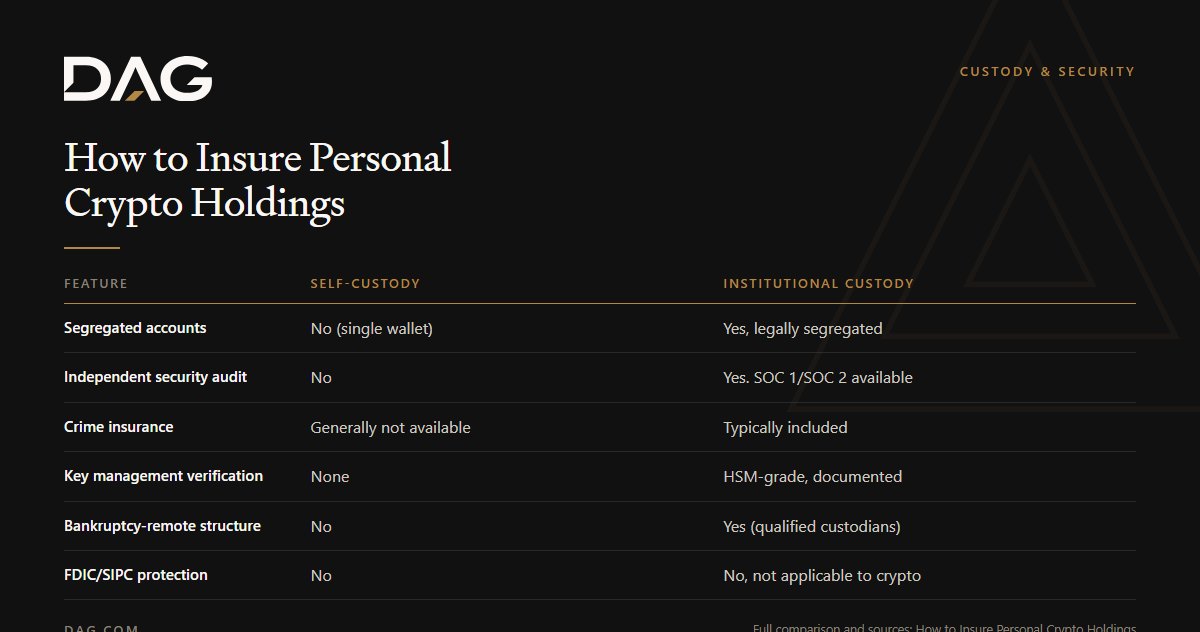
| Feature | Self-Custody | Institutional Custody |
|---|---|---|
| Segregated accounts | No (single wallet) | Yes, legally segregated |
| Independent security audit | No | Yes. SOC 1/SOC 2 available |
| Crime insurance | Generally not available | Typically included |
| Key management verification | None | HSM-grade, documented |
| Bankruptcy-remote structure | No | Yes (qualified custodians) |
| FDIC/SIPC protection | No | No, not applicable to crypto |
Important: institutional crime insurance covers losses within the custodian's infrastructure. It does not cover market losses, and the custodian's coverage limits, scope, and exclusions vary. "Fully insured" is not an accurate characterization of any crypto custody arrangement. Ask any custodian for its current coverage terms and verify them directly, figures and limits change.
What Actually Protects Self-Custodied Holdings
For assets held in personal wallets, protection comes from structure and operational security, not insurance policies.
Entity structure. Holding significant cryptocurrency through an LLC rather than personally creates liability separation between your personal assets and your digital holdings. See should I put my crypto in a Wyoming LLC? for the structural considerations. This does not create insurance coverage, but it does affect what is reachable in a legal claim.
Hardware storage. Purpose-built hardware wallets use secure element chips and tamper-resistant designs for cryptographic key management. Consumer USB storage devices are not equivalent.
Recovery phrase storage. Physical storage in a secure, durable location, not a desk drawer, cloud document, email, password manager, or phone photo. Some holders split phrases across multiple locations when the holdings justify it. See seed phrase storage for estate planning for durable storage approaches.
Operational discipline. Never store keys digitally unless encrypted with a strong passphrase committed to memory. The weakest point in personal custody is almost always the human process, not the hardware.
When to Evaluate a Move to Institutional Custody
There is a holding size and complexity level at which self-custody stops being the right risk-reward trade-off. The threshold is personal, but the factors include:
- The operational burden of maintaining key security yourself
- Whether the loss of access would be financially catastrophic
- Whether your estate plan can work around self-custodied keys (see what happens if I die with crypto in a hardware wallet?)
- Whether your security practices are actually maintained or just intended
At that point, qualified custody vs self-custody for crypto wealth becomes a genuine decision rather than a cost-cutting question. Institutional custody through a regulated custodian brings crime insurance, professional key management, SOC-audited infrastructure, and legal segregation, at the cost of direct control.
For families managing wealth across multiple asset types and entity structures, custody is one piece of a coordinated picture. DAG Wealth coordinates custody arrangements across traditional and digital holdings and works alongside your attorney and tax advisor on planning that accounts for how assets are held and protected. Entity formation and trust or estate drafting are legal services; the firm coordinates them and does not provide legal advice.
Related Questions
Does homeowner's insurance cover stolen crypto?
Standard homeowner and personal property policies generally do not cover cryptocurrency. A few specialty insurers have offered endorsements, but coverage is narrow and often excludes the most common loss scenarios, key loss, user error, and theft from personal wallets without independent verification of the theft. Check the exact policy language with a licensed insurance agent; do not assume coverage exists.
Is crypto on an exchange insured?
Exchanges vary significantly. Some carry commercial crime policies covering losses from exchange-level hacks; others do not. These policies generally cover exchange infrastructure losses, not individual account balances in all scenarios. Crypto held on any exchange is not FDIC- or SIPC-insured. Review the specific exchange's terms, insurance disclosures, and coverage limits, and treat exchange-held crypto as uninsured until you have verified otherwise from the exchange directly.
What is the difference between a custodian's insurance and FDIC/SIPC coverage?
FDIC insurance covers bank deposits (cash) at FDIC-member banks, up to statutory limits. SIPC covers certain brokerage account assets in the event of broker-dealer failure. Neither program applies to cryptocurrency. Custodial crime insurance at a qualified crypto custodian is a private commercial policy covering theft or fraud within the custodian's systems, it is not a government guarantee program and does not protect against market losses or all loss scenarios.
Can an LLC provide any insurance benefit for crypto?
An LLC does not create insurance coverage. It creates liability separation, a legal structure that can limit personal exposure to claims arising from LLC activities. Cryptocurrency held inside a properly maintained LLC is an LLC asset, not a personal asset. This is a structural protection, not an indemnity product. Consult a licensed attorney and insurance professional to understand what protections apply to your specific situation.
Sources
- FDIC: "Deposit Insurance. What's Covered", https://www.fdic.gov/resources/deposit-insurance/ (verify current at fdic.gov)
- SIPC: "What SIPC Protects", https://www.sipc.org/for-investors/what-sipc-protects
- SEC: "Investor Bulletin: Bitcoin and Other Virtual Currency-Related Investments", https://www.sec.gov/oiea/investor-alerts-and-bulletins/ib_bitcoin
- NAIC (National Association of Insurance Commissioners): Cryptocurrency coverage guidance, https://content.naic.org (verify current)
Compliance Note
This page is educational only and does not constitute legal, tax, insurance, or investment advice. Insurance availability, coverage terms, and policy exclusions for cryptocurrency vary by insurer, jurisdiction, and individual circumstances. Coverage figures referenced by any custodian or insurer should be verified directly and treated as current only when confirmed. Cryptocurrency is not FDIC- or SIPC-insured under any custody arrangement. Consult a licensed insurance agent for personal coverage questions, a licensed attorney for entity structuring, and a qualified financial professional for investment decisions.
Advisory services are provided by DAG Wealth, an SEC-registered investment adviser. Registration does not imply a certain level of skill or training.