
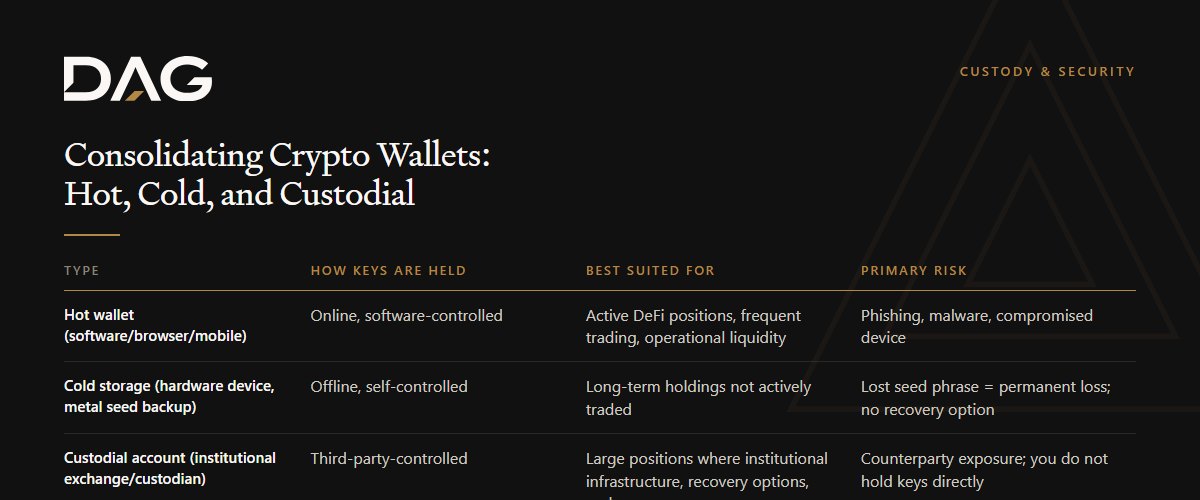
Consolidating crypto wallets means auditing every hot wallet, cold storage device, and custodial account you hold, then reorganizing them into a deliberate structure where each asset has a clear reason to sit where it does, a process grounded in institutional crypto custody principles. A structured approach can reduce security exposure, simplify tax records, and improve the odds that heirs can access what you own.
What is wallet consolidation, and why does it matter?
Most portfolios fragment gradually. Bitcoin on one exchange, ETH in a browser extension, hardware wallets acquired at different times, exchange balances left over from trades. Each additional location is another attack surface, another set of seed phrases to secure, and another gap in your cost-basis trail.
Consolidation does not mean collapsing everything into a single wallet. It means applying a deliberate framework so you know exactly what goes where and why. Fragmented custody almost guarantees reporting gaps; a structured custody arrangement makes clean records possible.
See crypto custody options compared for a broader look at the custody landscape.
What are the three wallet types, and what is each actually for?
| Type | How keys are held | Best suited for | Primary risk |
|---|---|---|---|
| Hot wallet (software/browser/mobile) | Online, software-controlled | Active DeFi positions, frequent trading, operational liquidity | Phishing, malware, compromised device |
| Cold storage (hardware device, metal seed backup) | Offline, self-controlled | Long-term holdings not actively traded | Lost seed phrase = permanent loss; no recovery option |
| Custodial account (institutional exchange/custodian) | Third-party-controlled | Large positions where institutional infrastructure, recovery options, and reporting matter | Counterparty exposure; you do not hold keys directly |
A well-designed custody framework uses all three, with explicit rules about what belongs in each tier. See cold storage vs qualified custody for a direct comparison of the tradeoffs at scale.
How do you conduct a wallet audit before consolidating?
Before any asset moves, build a complete inventory.
- List every location, wallet addresses, exchange accounts, hardware devices, and any private key storage you have access to, including accounts you haven't checked recently.
- Assess each entry. Are seed phrase backups current and stored securely? Is two-factor authentication active and up to date? Are any exchange accounts at platforms with unresolved KYC or uncertain regulatory status?
- Flag dormant balances. Small balances on inactive accounts still represent tax obligations and security exposure.
- Document findings. Record the audit in a format your tax professionals can use. Every transfer you subsequently make needs a timestamp, transaction ID, and the asset's fair market value at time of transfer.
This step surfaces problems that would otherwise surface at the worst possible moment. Inactive accounts with outdated security and hardware wallets with no tested backup are common, and fixable before they cause loss. The crypto wallet inventory template provides a structured format for this step.
How do you build a custody structure after the audit?
Three questions drive the design:
- What do you need to access within days or weeks? → Hot wallet or regulated exchange with fast withdrawal access. Keep this amount as small as your actual activity requires.
- What are you holding long-term? → Cold storage, with tested backups, a documented recovery procedure, and at least one backup copy stored physically separate from the primary device.
- How much do you want to self-custody versus delegate to an institution? → For large positions, institutional custody can add multi-signature authorization, professional operational security, and, where offered, insurance coverage. Insurance terms, coverage limits, and exclusions vary by custodian and should be reviewed directly; no custody arrangement is risk-free.
On the third question: the right mix varies by situation. Some hold the majority in institutional custody with a small operational hot wallet. Others prefer a multi-sig cold storage setup as the primary arrangement. The one wrong answer is no deliberate structure at all.
For a structured decision framework, see the crypto custody decision tree.
How do you move assets safely during consolidation?
Asset migration is where mistakes happen. These rules apply regardless of transfer type or amount:
- Send a test transaction first. Always send a small amount before moving a full balance.
- Verify the receiving address character by character before confirming, not just the first and last few characters.
- Do not copy-paste addresses in environments where clipboard-hijacking malware may be active. Type or use a QR code with visual confirmation.
- Document every transfer with timestamp, transaction ID, sending address, receiving address, and the asset's fair market value at the time of transfer.
- Test cold storage recovery before transferring into it. Restore from seed phrase on a clean device, confirm the derived address matches, then move funds. Not after.
If moving to cold storage for the first time, the recovery test in step 5 is not optional, it is the only way to confirm your backup is valid. See what happens if I transfer crypto to the wrong address for the downstream consequences of skipping verification.
What are the tax record implications of wallet consolidation?
Transferring assets between wallets you own is generally not a taxable event, moving your own crypto does not itself trigger a gain or loss. However, consolidation does not erase transaction history, and cost basis travels with the asset regardless of where it moves.
What matters for your records:
- Every transfer needs a timestamp and the asset's fair market value at time of transfer, even if the transfer itself is not taxable.
- Cost basis and acquisition date must be tracked per lot, not per wallet.
- The IRS expects accurate per-transaction reporting. Form 1099-DA broker reporting for digital assets is being phased in, with gross-proceeds reporting by certain custodial brokers beginning for the 2025 tax year and cost-basis reporting following in later years (rollout is staged and scope varies by broker type; verify current IRS guidance before relying on it).
- Reconstructing cost basis across multiple wallets and exchanges after the fact is difficult and error-prone. A clean custody structure makes clean records possible going forward.
See are crypto wallet transfers taxable and how to reconstruct crypto cost basis for detail on both issues.
How does custody structure affect estate access and inheritance?
Self-custody assets with no documented recovery procedure are effectively inaccessible to heirs. Hardware wallets in a drawer with no seed phrase backup and no written instructions are a recurring cause of permanent asset loss and estate disputes.
As part of any custody review, access continuity planning should cover:
- Documented recovery procedures for every cold storage device and wallet
- Delegated authorities for specific incapacity or death scenarios
- Alignment between the custody structure and the broader estate plan (trust ownership, LLC layering, letter of instruction)
This requires coordination with an estate planning attorney. It is not complicated, but it does not happen by default. See hardware wallet estate planning and seed phrase storage for estate planning for the operational specifics.
Related Questions
Does moving crypto between my own wallets trigger taxes?
Transferring crypto between wallets you own is generally not a taxable event, no gain or loss is recognized at the time of transfer. However, you must track the fair market value at the time of each transfer for cost-basis continuity, and the transfer must be between wallets you actually own (not a disposal to a third party). Consult a qualified tax professional for your specific situation.
What happens if I lose the seed phrase for a hardware wallet I just consolidated into?
The assets are permanently inaccessible. There is no password reset, no customer support line, and no recovery mechanism for a lost seed phrase on a non-custodial hardware wallet. This is why testing the recovery process, restoring the seed phrase on a clean device and confirming the address matches, is required before transferring significant value into cold storage.
How many custodians or wallets should a large portfolio use?
There is no universal number. The risk of too few is concentration, one failure point for a large portion of assets. The risk of too many is operational complexity and fragmented records. A structured framework typically uses one or two regulated institutional custodians for the bulk of long-term holdings, cold storage for assets you want direct control over, and a minimal hot wallet for active positions. See should a family office use more than one crypto custodian for considerations at higher asset levels.
Sources
- IRS Notice 2014-21 (virtual currency general tax treatment): https://www.irs.gov/pub/irs-drop/n-14-21.pdf
- IRS Revenue Ruling 2023-14 (staking income): https://www.irs.gov/pub/irs-rulings/rr-2023-14.pdf
- IRS Form 1099-DA guidance (broker reporting for digital assets): https://www.irs.gov/forms-pubs/about-form-1099-da
- IRS Publication 551 (Basis of Assets): https://www.irs.gov/publications/p551
Compliance Note
This page is educational only and does not constitute legal, tax, investment, or financial advice. Custody and security practices described here are general in nature; individual circumstances vary. Consult a qualified attorney, CPA, or registered investment adviser before making custody, tax, or estate planning decisions.
DAG Wealth coordinates custody review and consolidation as an administrative service. Advisory services are provided by DAG Wealth, an SEC-registered investment adviser. Registration does not imply a certain level of skill or training. DAG coordinates with qualified legal and tax professionals and does not itself provide legal or tax advice.