
Transferring crypto from a retail exchange or trading app to secure custody, a self-custody wallet or an institutional custodian, moves your own assets between your own accounts and is generally not a taxable event. For a guide to all custody models, see the crypto custody hub. It is a wallet transfer, not a sale. It does require careful preparation: verified destination addresses, a small test transaction, and staged withdrawals to avoid irreversible mistakes.
What does "secure custody" mean for crypto?
Retail platforms like major crypto exchanges and trading apps hold crypto in pooled custodial wallets they manage. You do not control the private keys; the platform does. Secure custody means your assets are held in accounts where the private keys are either yours (self-custody) or held by a regulated institutional custodian on your behalf in segregated accounts, rather than pooled with other users' assets.
The difference matters because exchange-held assets are subject to platform withdrawal limits, account freezes during compliance reviews, and counterparty risk if the platform encounters operational or regulatory problems. Cold storage, hardware wallets, and institutional crypto custody address these exposures.
Is transferring crypto from a retail exchange taxable?
Moving your own crypto between your own accounts, from an exchange wallet to a hardware wallet or custodian, is generally not treated as a taxable disposal by the IRS. No sale occurs; cost basis and holding period carry over to the destination wallet.
Important nuances:
- The transfer itself is not taxable, but it can create record-keeping complexity. You must track the original cost basis and acquisition date at the new custodian. Poor records are one of the most common crypto tax record mistakes.
- Some retail trading apps have historically restricted crypto withdrawals and have rolled out withdrawal capability gradually. Confirm current withdrawal availability for your specific assets directly with the source platform before planning a transfer.
- Some platforms charge network fees on withdrawals. These fees do not create a taxable gain, but they affect cost basis tracking. See are crypto wallet transfers taxable? for more detail.
- If you move crypto into a trust, LLC, or other legal entity rather than a personal wallet, the tax treatment may differ. Consult a qualified tax professional before transferring to an entity-owned account.
How to transfer crypto from a retail exchange to secure custody
Step-by-step transfer process
Choose and set up your custody destination. Options include a hardware wallet, a software wallet where you control the seed phrase, or onboarding with an institutional crypto custodian. Have the destination fully configured before initiating any withdrawal.
Record your seed phrase or custody credentials offline. Write the seed phrase on paper and store physical copies in separate secure locations. Never photograph it or store it in a cloud app. If using a custodian, confirm how credentials and access recovery work before you move assets in.
Verify withdrawal availability on the source platform. Some retail platforms have platform-specific constraints on crypto withdrawals, confirm which assets are eligible and whether your account has withdrawal enabled, and confirm network support and any account-level restrictions.
Check withdrawal limits. Most retail platforms cap daily or weekly withdrawal amounts. A large portfolio may require transfers staged over multiple days or weeks. Plan this before you start.
Enable address whitelisting if available. Pre-approving a destination address reduces error risk and may shorten the review period the platform applies to new withdrawal destinations.
Send a test transaction first. Send a small amount, a few dollars' worth is enough (the dollar figure is illustrative; choose an amount small enough that a mistake is not costly), to the destination address. Confirm it arrives in the correct wallet and check the network and processing time. Do not proceed with the full amount until the test confirms the address is correct.
Verify the destination address character by character. Do not copy-paste blindly. Clipboard-hijacking malware exists that silently swaps crypto addresses. Visually confirm the first and last several characters. See what happens if I transfer crypto to the wrong address?, blockchain transactions cannot be reversed.
Send the remaining balance in staged withdrawals. Monitor network confirmations for each transaction. Check network fee levels before sending; high congestion can make transfers slow or expensive.
Save all transfer records. Export transaction history from the source platform. Record the date, asset, amount, sending address, destination address, and transaction hash for each transfer. This documentation supports accurate cost basis tracking and future tax reporting.
Common mistakes that cause permanent loss
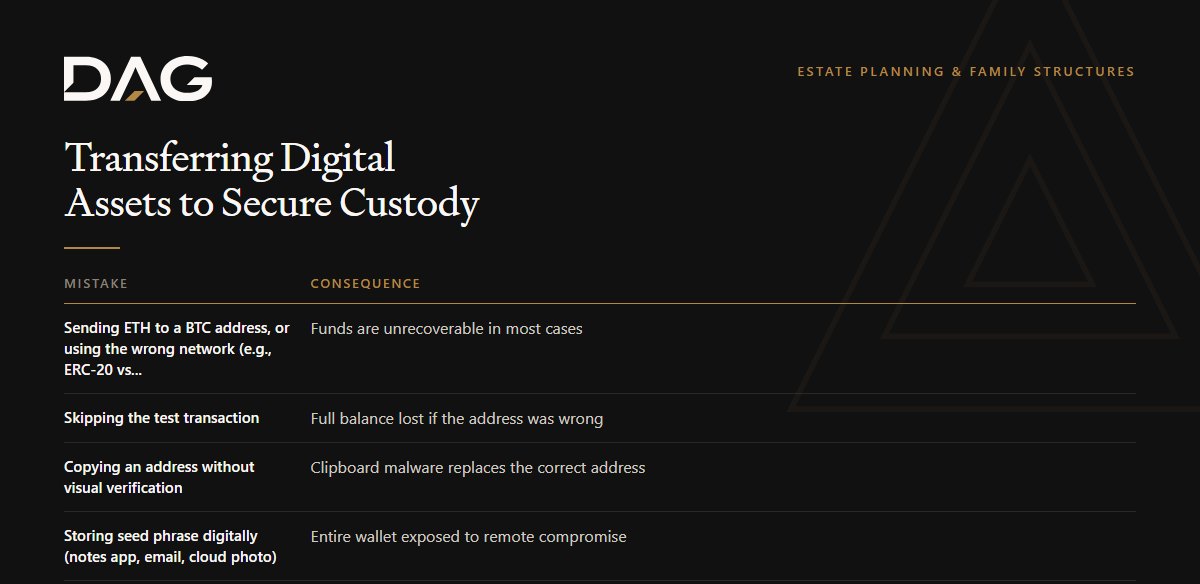
| Mistake | Consequence |
|---|---|
| Sending ETH to a BTC address, or using the wrong network (e.g., ERC-20 vs. BEP-20) | Funds are unrecoverable in most cases |
| Skipping the test transaction | Full balance lost if the address was wrong |
| Copying an address without visual verification | Clipboard malware replaces the correct address |
| Storing seed phrase digitally (notes app, email, cloud photo) | Entire wallet exposed to remote compromise |
| Ignoring withdrawal limits and trying to move everything at once | Transfer rejected or delayed; forces re-planning |
When does institutional custody make sense instead of self-custody?
Self-custody works for investors who are comfortable managing private keys, seed phrase storage, and the operational security required to protect access. The tradeoff is that every mistake falls on you, no customer support, no recovery.
Institutional custody is worth considering when:
- Holdings are large enough that a key-management error would be materially damaging
- The assets need to be held in an entity (trust, LLC, family office) with formal governance
- Compliance reporting, SOC audits, or insurance coverage are required
- Estate and succession planning require a custodian that heirs can access through a defined legal process
Qualified custody versus self-custody covers the tradeoffs in detail. For estate planning considerations, including what happens if you die with crypto in a hardware wallet, see hardware wallet estate planning.
Related Questions
Does a retail trading app allow crypto withdrawals?
Retail trading apps vary in their crypto withdrawal availability; constraints vary by asset and account status. Check your account directly for current withdrawal eligibility before planning a transfer. Availability and limits can change. This page does not guarantee current platform withdrawal capabilities.
What if I transfer crypto into a trust or LLC instead of a personal wallet?
Transferring crypto into a trust or LLC is not the same as moving between your own personal wallets. The tax and legal treatment depends on the entity type and transfer structure. For example, funding a revocable trust may be treated differently from transferring to an irrevocable trust or a separate legal entity. Consult a qualified tax and estate attorney before proceeding. See how to fund a trust with crypto for planning context.
How do I keep cost basis records after a transfer?
After transferring to self-custody or a new custodian, you need to carry the original acquisition date, cost basis, and holding period to the new location. Export transaction history from the source platform before transferring. Use crypto tax software or a CPA familiar with digital assets to map the records. See how to separate crypto transfers from taxable sales for guidance on keeping transfer records distinct from disposal records.
What security steps should I take after moving to self-custody?
Once assets leave an exchange, security is your responsibility. Key steps: store your seed phrase offline in multiple physical locations; use a hardware wallet rather than a software-only wallet for significant holdings; consider multi-signature setups for large balances (multiple approvals required to move funds); review access controls regularly; and plan for inheritance so heirs can access the wallet if you are incapacitated or die. See seed phrase storage for estate planning and private key succession planning.
Sources
- IRS Notice 2014-21 (virtual currency as property for federal tax purposes): https://www.irs.gov/pub/irs-drop/n-14-21.pdf
- IRS Rev. Rul. 2023-14 (staking income treatment): https://www.irs.gov/pub/irs-rulings/rr-2023-14.pdf
- IRS FAQ on virtual currency: https://www.irs.gov/individuals/international-taxpayers/frequently-asked-questions-on-virtual-currency-transactions
- IRS Form 8949 Instructions (capital assets, cost basis reporting): https://www.irs.gov/forms-pubs/about-form-8949
Compliance Note
This page is for educational purposes only. It does not constitute legal, tax, investment, or financial advice. Tax treatment of crypto transfers depends on individual facts and circumstances and applicable law, which changes frequently. The general statement that same-owner wallet transfers are "not taxable" reflects current IRS guidance (Notice 2014-21) but may not apply to transfers into trusts, LLCs, or other entities, or to assets subject to specific regulatory treatment. Entity formation and trust or estate structuring are legal services; DAG coordinates with qualified attorneys and tax professionals and does not provide legal advice. Verify current IRS guidance and platform withdrawal availability, and consult a qualified CPA, tax attorney, and financial advisor before transferring digital assets. DAG Wealth does not guarantee outcomes. Past regulatory or platform conditions are not indicative of future availability or treatment.