
A Self-Directed IRA for digital assets lets you hold actual Bitcoin or other crypto inside a tax-advantaged retirement account through a qualified custodian who holds the assets for the IRA. Setting one up correctly means using a qualified custodian, avoiding IRS prohibited transactions under §4975, and funding properly, and it is one holding structure to consider alongside the trust and entity options covered in crypto estate planning.
What is a Self-Directed IRA for digital assets?
A standard IRA at a traditional brokerage limits you to stocks, bonds, and mutual funds. A Self-Directed IRA removes most of those restrictions. You can invest in real estate, private companies, precious metals, and digital assets, including actual Bitcoin or Ethereum rather than a fund that tracks them.
The IRS still treats it as a retirement account. Traditional SDIRA contributions may be tax-deductible; you pay ordinary income tax on withdrawals. Roth SDIRA contributions are after-tax; qualified withdrawals after age 59½ (and after a five-year holding period) can be tax-free. Same annual contribution limits and distribution rules as conventional IRAs.
Contribution limits (verify current figures with IRS.gov): As of the 2024 tax year, the annual IRA contribution limit was $7,000 for taxpayers under age 50 and $8,000 for those 50 and older. These limits are indexed for inflation, confirm the current year's figure before contributing.
Why use an SDIRA for crypto?
The tax-advantaged angle is the main draw. If you hold digital assets you expect to appreciate over decades, sheltering that growth inside a Roth SDIRA means qualifying withdrawals can be taken free of federal income tax on the gains. A Traditional SDIRA defers taxation to withdrawal, which may make sense if you expect a lower tax rate in retirement.
SDIRAs also provide exposure to an asset class that doesn't correlate closely with conventional equities, a diversification argument separate from any return expectation.
No return outcome is guaranteed. Digital assets are volatile and may lose value. The SDIRA structure does not protect against investment loss.
How to set up a Self-Directed IRA for digital assets: step by step
Find a qualified custodian that actually supports crypto. Not all SDIRA custodians handle digital assets directly. Some that claim to only offer crypto-linked funds, not actual on-chain holdings. Before committing, verify: Can I hold actual Bitcoin, not a fund? What custody solution do you use? How do I submit buy/sell directions? What assets are supported? If a custodian cannot answer clearly, keep looking. See how to choose a crypto custodian for a full due-diligence framework.
Choose Traditional or Roth. This is a tax-bracket decision. Traditional IRA makes sense if you want a deduction now and expect a lower rate at withdrawal. Roth makes sense if you expect significant appreciation and want qualifying withdrawals to be tax-free. Consult a tax professional before deciding, your bracket, timeline, and existing retirement assets all affect which structure is optimal for your situation.
Open the account and complete KYC. The custodian will provide account-opening paperwork and identity verification. This step is straightforward.
Fund the account properly.
- Direct contribution: Subject to annual IRA limits (see above; verify current figures). Clean and simple.
- Trustee-to-trustee transfer: Moving funds from an existing IRA. No taxes, no penalties, but typically takes two to four weeks. This is the preferred method.
- Rollover from a 401(k): Only available if you left the employer or the plan allows in-service withdrawals. Rollovers carry timing rules and deadlines; errors trigger taxes and penalties on the full amount.
- Do not take a 60-day rollover, withdrawing from your current IRA with the intent to redeposit within 60 days leaves you fully exposed if anything goes wrong. Use trustee-to-trustee transfers.
Confirm custody arrangements. Your custodian holds the digital assets on behalf of the IRA, through proprietary cold storage or a third-party qualified custodian. Ask how assets are stored, whether insurance against theft or operational loss is in place, and which specific tokens are supported. See crypto custody options compared for a comparative overview.
Direct investment purchases. Once funded, you submit investment directions to the custodian, you do not log in to an exchange and execute trades yourself. Some custodians offer online portals; others use phone or email. Execution is slower than consumer exchanges. Watch for per-transaction fees, which compound significantly if you are dollar-cost averaging frequently.
IRS prohibited transaction rules: what you cannot do
IRC §4975 governs prohibited transactions between an IRA and "disqualified persons" (you, your spouse, parents, children, and others). Violations can cause the IRS to deem the entire IRA distributed, triggering income tax on the full account value, plus a 10% early-withdrawal penalty if you are under age 59½.
Prohibited actions include:
- Storing the crypto yourself on a hardware wallet you personally control
- Using IRA assets as collateral for a personal loan
- Transferring IRA crypto to your personal wallet (treated as a distribution)
- Buying crypto personally and selling it to your IRA (transaction with a disqualified person)
- Allowing a spouse, parent, or child to benefit from IRA assets before qualifying distributions
- Any arrangement where you or a disqualified person derives personal benefit from IRA assets
The custodian holds title to the assets on behalf of the IRA. You direct investments but do not personally control anything. If you are uncertain whether a planned action is a prohibited transaction, consult a tax attorney or CPA before acting.
Checkbook-LLC IRA structures: additional risk
Some SDIRA providers offer a "checkbook LLC" or "IRA LLC" arrangement that gives you direct signing authority over a bank or brokerage account owned by the IRA. These structures carry heightened scrutiny from the IRS and greater self-dealing risk. If the LLC structure is not maintained correctly, a single disqualifying transaction can unwind the entire IRA. They require a qualified tax attorney and ongoing compliance discipline. They are not appropriate for all investors, get qualified counsel before using one.
Staking, yield, and DeFi: not straightforward
Earning staking rewards, yield from lending protocols, or participating in DeFi through an SDIRA raises unsettled legal and compliance questions. Some custodians do not support these activities at all. Others support limited staking but treat rewards as IRA income. Whether specific activities constitute prohibited transactions depends on the structure and is not uniformly settled. Ask your custodian specifically, and verify with a qualified tax professional before directing any yield-generating activity through an SDIRA.
Common mistakes
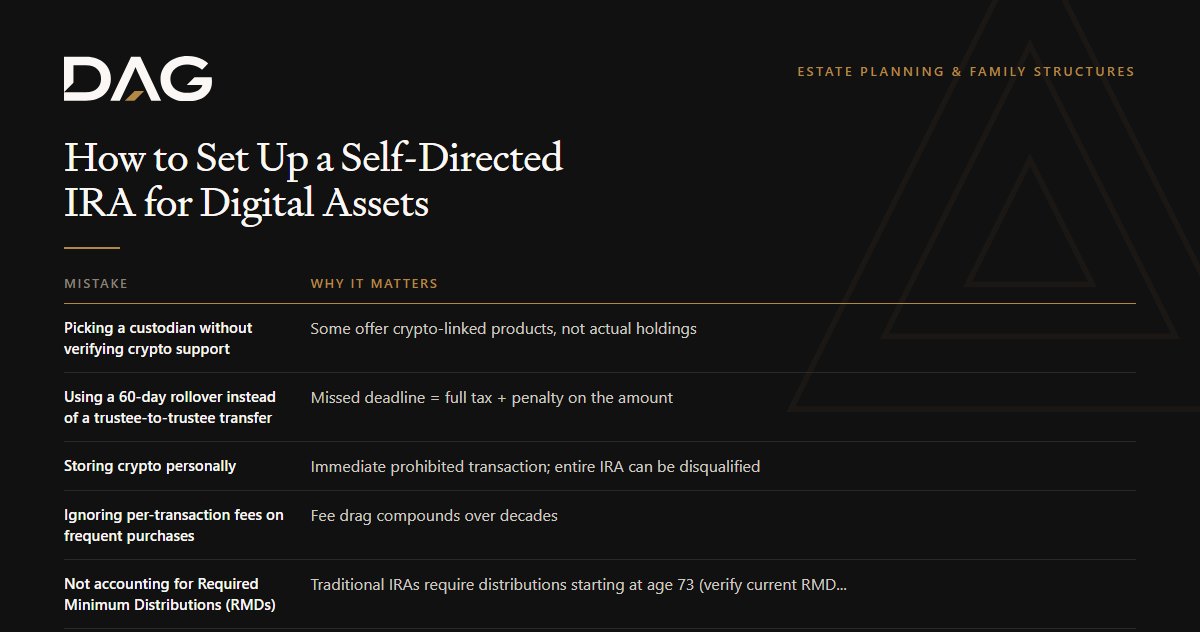
| Mistake | Why it matters |
|---|---|
| Picking a custodian without verifying crypto support | Some offer crypto-linked products, not actual holdings |
| Using a 60-day rollover instead of a trustee-to-trustee transfer | Missed deadline = full tax + penalty on the amount |
| Storing crypto personally | Immediate prohibited transaction; entire IRA can be disqualified |
| Ignoring per-transaction fees on frequent purchases | Fee drag compounds over decades |
| Not accounting for Required Minimum Distributions (RMDs) | Traditional IRAs require distributions starting at age 73 (verify current RMD age with IRS.gov); volatile crypto may force a sale at an inopportune time |
| Poor recordkeeping | Custodian statements are not a substitute for your own transaction records; the IRS will ask for documentation |
Related Questions
Can I hold any cryptocurrency in a Self-Directed IRA?
You can hold any digital asset your custodian supports. Most crypto-capable custodians support Bitcoin and Ethereum. Support for smaller-cap tokens, DeFi tokens, or NFTs varies significantly. Confirm asset support before funding, you cannot direct the custodian to hold an asset they do not have custody infrastructure for.
What happens if my SDIRA custodian goes out of business?
Crypto custodians have failed. If your custodian becomes insolvent, your ability to recover assets depends on the custody structure (whether assets are held in segregated accounts vs. commingled), applicable state law, and any insurance coverage in place. Ask the custodian about their business continuity and transfer process before funding. See what happens if a crypto custodian fails for a detailed breakdown.
Is a Crypto IRA better than a Bitcoin ETF inside a regular IRA?
A Bitcoin ETF in a standard brokerage IRA is simpler, lower-cost, and avoids the prohibited-transaction complexity of an SDIRA. If the goal is retirement exposure to Bitcoin price performance, a spot Bitcoin ETF may accomplish that with less operational risk. An SDIRA becomes more valuable if you want to hold actual on-chain assets, access tokens unavailable via ETF, or pursue other alternative investments the same account can hold. See should I use a Bitcoin ETF or hold Bitcoin directly for a comparison of the two approaches. The right answer depends on your specific goals, timeline, and cost sensitivity, consult a qualified advisor.
How does an SDIRA fit into broader estate and wealth planning?
An SDIRA is one piece of a larger structure. For investors with substantial digital asset holdings, it typically works alongside trust structures, entity holding, and a broader crypto estate planning for high-net-worth families plan. Beneficiary designations on the SDIRA control who inherits the account and must be coordinated with your estate documents. See also crypto IRA vs crypto family office structure if you are evaluating whether a family office structure better fits your situation.
Sources
- IRS Publication 590-A (Contributions to Individual Retirement Arrangements): https://www.irs.gov/publications/p590a
- IRS Publication 590-B (Distributions from Individual Retirement Arrangements): https://www.irs.gov/publications/p590b
- IRC §4975 (Tax on Prohibited Transactions): https://www.law.cornell.edu/uscode/text/26/4975
- IRS Notice 2014-21 (Virtual Currency Guidance): https://www.irs.gov/irb/2014-16_IRB#NOT-2014-21
- IRS Topic No. 451 (Individual Retirement Arrangements): https://www.irs.gov/taxtopics/tc451
Compliance Note
This page is for educational purposes only and does not constitute legal, tax, or investment advice. Self-Directed IRAs involve complex IRS rules, including strict prohibited-transaction and self-dealing restrictions under IRC §4975, that can result in full IRA disqualification and significant tax liability if violated. Contribution limits, RMD ages, and other figures change with IRS guidance and legislation; verify all figures at IRS.gov before acting. Checkbook-LLC IRA structures carry additional risk and require qualified legal counsel. No investment return is guaranteed; digital assets are volatile and may lose value. Consult a qualified tax attorney, CPA, and/or registered investment adviser before establishing or funding a Self-Directed IRA. Registration does not imply a certain level of skill or training.