
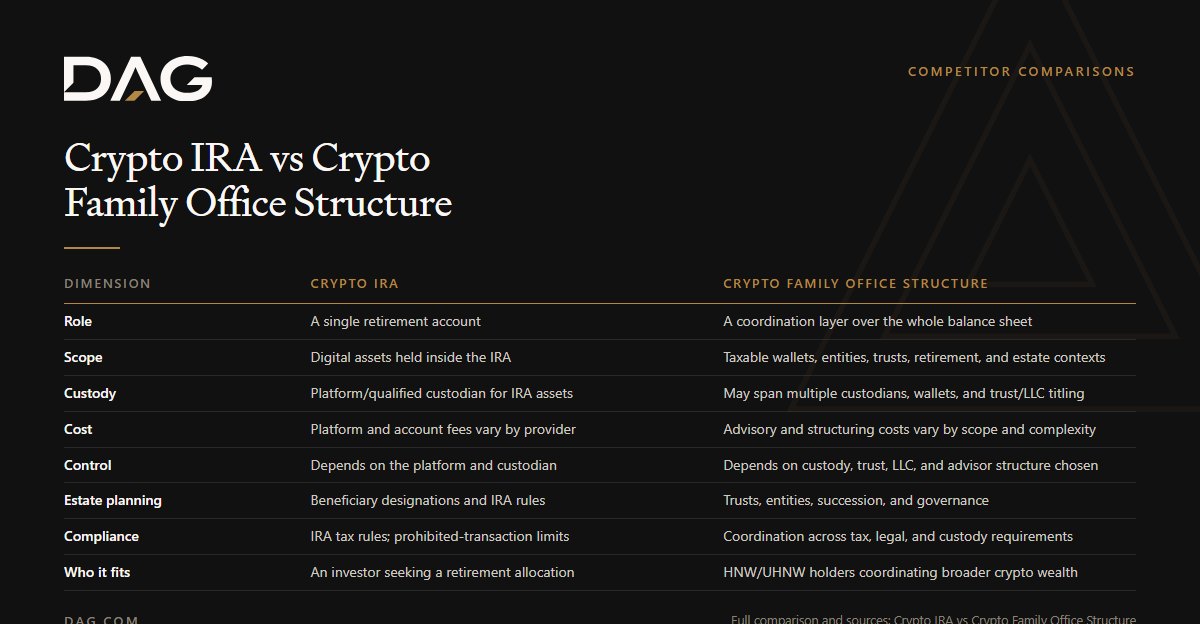
A crypto IRA and a crypto family office structure solve different problems. A crypto IRA is a retirement-account wrapper that may allow digital asset exposure inside a tax-advantaged account. A crypto family office structure coordinates the wider balance sheet, taxable wallets, trusts, entities, custody, tax reporting, and estate planning. The IRA can sit inside that structure, but it is not the structure itself.
Short Answer
A crypto IRA is a retirement-account structure that may allow digital asset exposure inside a tax-advantaged account. A crypto family office structure coordinates the broader wealth picture: taxable wallets, trusts, LLCs, custody, tax reporting, estate planning, liquidity, and family governance. A crypto IRA can be one account type inside a larger plan, but on its own it is not a complete wealth structure.
What Each One Is
A crypto IRA is a self-directed individual retirement account that holds digital assets, typically through a specialized platform and qualified custodian, under IRA contribution, rollover, distribution, and prohibited-transaction rules.
A crypto family office structure is a coordination approach for a household's full crypto and traditional holdings. It addresses how assets are titled, custodied, governed, reported for tax, and transferred across generations, often spanning taxable wallets, trusts, LLCs, retirement accounts, and estate documents. The distinction matters: the same idea separates a crypto custodian from a crypto wealth manager, where one holds the keys and the other coordinates the plan.
Why This Matters
Many investors search for crypto IRAs because they want tax-advantaged exposure. That is a reasonable question. But wealthy crypto holders often hold far more than a retirement account: taxable wallets, exchange accounts, entity holdings, fund investments, business interests, and estate-planning needs.
The IRA wrapper does not answer how the rest of the family's crypto wealth should be titled, custodied, governed, or transferred. Those questions tend to surface in crypto family office planning rather than in any single account.
How They Compare
| Dimension | Crypto IRA | Crypto Family Office Structure |
|---|---|---|
| Role | A single retirement account | A coordination layer over the whole balance sheet |
| Scope | Digital assets held inside the IRA | Taxable wallets, entities, trusts, retirement, and estate contexts |
| Custody | Platform/qualified custodian for IRA assets | May span multiple custodians, wallets, and trust/LLC titling |
| Cost | Platform and account fees vary by provider | Advisory and structuring costs vary by scope and complexity |
| Control | Depends on the platform and custodian | Depends on custody, trust, LLC, and advisor structure chosen |
| Estate planning | Beneficiary designations and IRA rules | Trusts, entities, succession, and governance |
| Compliance | IRA tax rules; prohibited-transaction limits | Coordination across tax, legal, and custody requirements |
| Who it fits | An investor seeking a retirement allocation | HNW/UHNW holders coordinating broader crypto wealth |
Evidence Standard
This article compares structures using public IRA and provider materials. It does not recommend any specific provider, and it does not claim any provider is better or worse than another.
When a Crypto IRA May Help
- The investor wants crypto exposure inside an IRA.
- Retirement-account tax treatment is the main objective.
- The investor understands IRA contribution, rollover, distribution, and prohibited-transaction rules.
When a Crypto IRA May Not Be Enough
A crypto IRA generally will not hold personal-wallet assets directly, and it does not address taxable wallets, trust-owned assets, LLC structures, family office reporting, or private-key succession. IRA rules are specialized and depend on the facts, so they warrant qualified guidance. For holders weighing how a retirement wrapper sits next to a broader plan, the trade-offs resemble those in crypto IRA vs crypto family office structure and family office vs crypto wealth manager discussions.
Related Questions
Can I hold IRA crypto in a personal wallet?
Some crypto IRA platforms do not permit personal-wallet custody for IRA digital assets, because IRA assets generally must stay with a qualified custodian. Rules vary by provider, so verify current terms and consult a tax professional.
Is a crypto IRA good for HNW crypto holders?
It can be one useful tool. High-net-worth holders usually also need planning across taxable, entity, trust, custody, and estate contexts, which a single account does not cover. The right mix depends on the facts.
Can a trust own an IRA?
Trusts can sometimes be named as IRA beneficiaries, but trust and IRA rules interact in complex ways. This is an area where qualified legal and tax advice matters before acting.
How does a crypto IRA fit inside a broader wealth plan?
Often as one account among several. A coordination layer decides where the IRA sits relative to taxable wallets, trusts, and entities, a question that overlaps with crypto family office vs crypto fund planning. Treat it as a component, not the whole plan.
Bottom Line
A crypto IRA is an account wrapper. A crypto family office structure is a wealth system. Wealthy crypto holders benefit from understanding where the IRA fits, and what it does not solve.
Sources
Compliance Note
This article is for general educational purposes and is not tax, legal, retirement, or investment advice. Digital assets are volatile and can lose value; nothing here implies guaranteed returns, yield, a stable value, or any FDIC or SIPC protection. Registration with a regulator does not guarantee skill or a particular outcome. IRA rules are complex and should be reviewed with qualified professionals.
Terms used in this article
Related articles
- Crypto in Retirement Accounts: Pros, Cons, and Transfers
- Crypto Wealth Manager vs Financial Advisor
- Crypto Wealth Manager vs Crypto Broker
- Crypto Family Office vs Traditional Family Office
- How to Pay Custody Fees Without Creating Taxable Events
- Crypto IRA Strategy: Digital Assets in Tax-Advantaged Retirement Accounts