
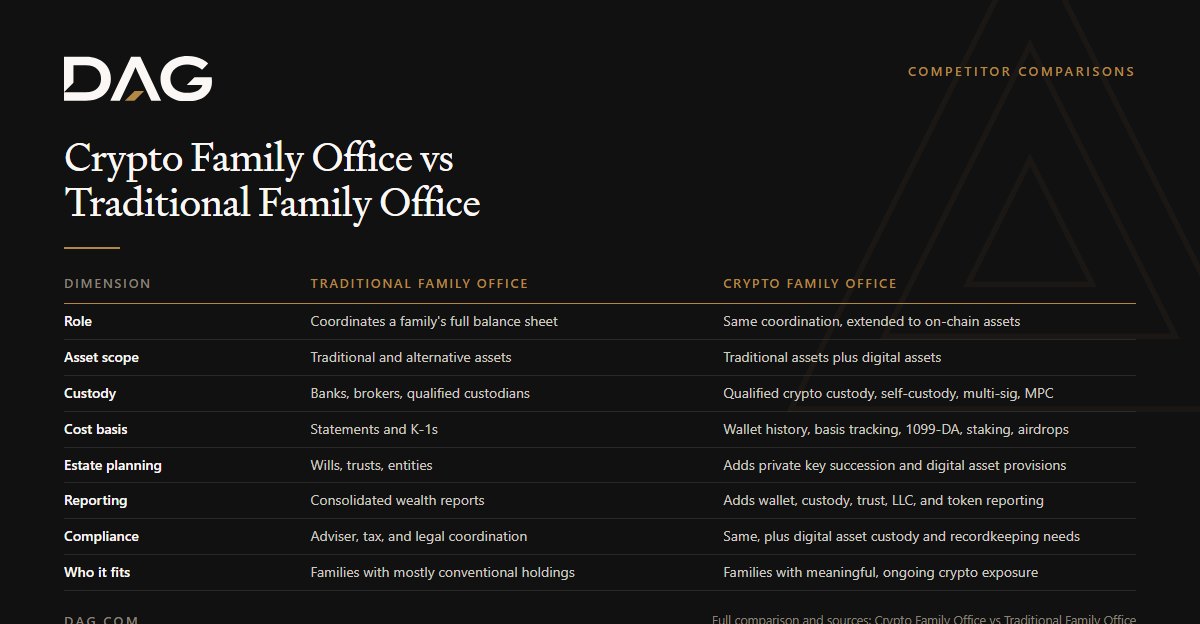
A crypto family office vs traditional family office comparison comes down to scope. A traditional family office coordinates investment, tax, estate, philanthropy, reporting, and governance for a wealthy family. A crypto family office keeps that discipline and adds digital asset fluency around custody, wallets, staking, token tax records, and private key succession.
Definitions
A traditional family office is the team or entity that coordinates a family's wealth: investment oversight, tax planning, estate structuring, philanthropy, consolidated reporting, and family governance. It is generally built around banks, brokers, and qualified custodians holding traditional and alternative assets.
A crypto family office keeps that same coordination role but extends it to assets that live on-chain. That means handling qualified crypto custody and self-custody, multi-sig and MPC wallet setups, staking, basis tracking across wallets, trust-owned LLCs, and succession planning for private keys. It is one model within the broader crypto family office and crypto wealth management landscape, not a separate asset class.
Why This Matters
Traditional family offices can be very good at complex wealth. Digital assets, though, raise operational questions that many legacy systems were not designed to answer: who holds the keys, how basis is tracked across dozens of wallets, and how a trustee accesses a wallet if the principal is gone. A crypto family office is meant to bridge family office discipline with that infrastructure rather than replace the existing office.
Comparison Table
| Dimension | Traditional Family Office | Crypto Family Office |
|---|---|---|
| Role | Coordinates a family's full balance sheet | Same coordination, extended to on-chain assets |
| Asset scope | Traditional and alternative assets | Traditional assets plus digital assets |
| Custody | Banks, brokers, qualified custodians | Qualified crypto custody, self-custody, multi-sig, MPC |
| Cost basis | Statements and K-1s | Wallet history, basis tracking, 1099-DA, staking, airdrops |
| Estate planning | Wills, trusts, entities | Adds private key succession and digital asset provisions |
| Reporting | Consolidated wealth reports | Adds wallet, custody, trust, LLC, and token reporting |
| Compliance | Adviser, tax, and legal coordination | Same, plus digital asset custody and recordkeeping needs |
| Who it fits | Families with mostly conventional holdings | Families with meaningful, ongoing crypto exposure |
For families weighing where digital assets sit relative to other vehicles, it can help to read this alongside crypto family office vs crypto fund and family office vs crypto wealth manager, which separate the structure question from the day-to-day management question.
Evidence Standard
This article compares categories and does not claim that any specific family office lacks capability. Differences described here are general and depend on how a given office is staffed and run.
When It May Help
- A family office has inherited crypto complexity it was not built for.
- Principals hold assets outside the office's reporting.
- Trustees or heirs lack wallet knowledge.
- The family wants coordinated custody and governance for on-chain assets.
- Tax records are fragmented across exchanges and wallets.
When It May Not Be Enough
Some traditional family offices can build digital asset capability in-house. Others may prefer specialist partners over standing up a separate crypto family office. The right answer depends on the family's facts, the size and activity of the crypto position, and the appetite to manage custody operationally. Comparing the firm's role against a crypto custodian can clarify where coordination ends and where pure custody begins.
Related Questions
Does a crypto family office replace a traditional one?
Not necessarily. In many cases it supplements or integrates with the existing office rather than displacing it. The right fit depends on the family's structure and goals; consider reviewing the arrangement with your own advisers.
What is the biggest difference between the two?
Generally, operational fluency around digital assets: custody and key control, basis tracking across wallets, token-level tax records, and succession for on-chain holdings. The traditional coordination role itself is largely the same.
Do all crypto holders need a family office?
No. The need tends to track complexity rather than dollar amount alone. A family with concentrated, active, or multi-wallet exposure may benefit more than one with a small, static position. A professional can help assess whether the structure fits your situation.
How does custody differ between the two models?
A traditional office generally relies on banks, brokers, and qualified custodians. A crypto family office may combine qualified crypto custody with self-custody arrangements such as multi-sig or MPC. Custody choices carry their own trade-offs and should be evaluated against your security and access needs.
Bottom Line
A crypto family office is not a label for a family that happens to like crypto. It is a family office model organized for assets that live on-chain and require specialized control, custody, and recordkeeping. Whether it adds value depends on the family's facts rather than on any single feature.
Sources
- SEC: Family Office Rule (17 CFR 275.202(a)(11)(G)-1)(11)(G)-1)
- SEC: Investment Adviser Public Disclosure (IAPD)
Compliance Note
This article is for general educational purposes and is not legal, tax, custody, or investment advice. Digital assets can be volatile and may lose value; crypto holdings are generally not covered by FDIC or SIPC insurance, and no yield, price stability, or outcome is guaranteed. Registration with a securities regulator does not imply a particular level of skill or guarantee results. Consult qualified legal, tax, and investment professionals about your specific situation.