
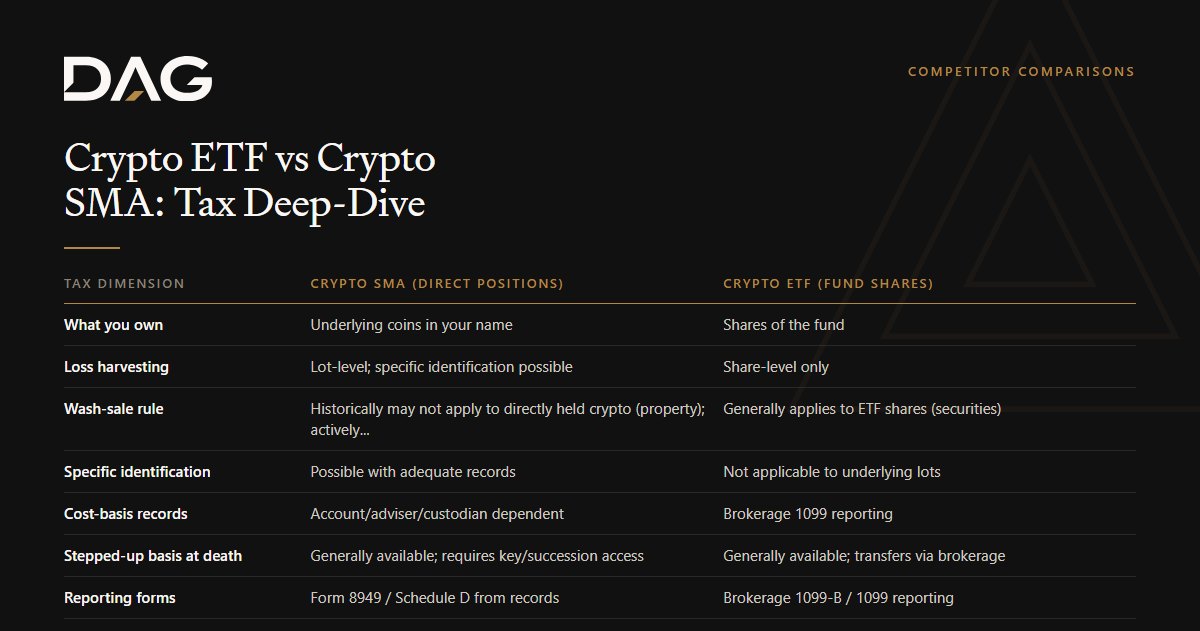
On taxes, a crypto SMA and a crypto ETF behave differently in three places that matter to high-net-worth investors: tax-loss harvesting, the wash-sale rules, and basis treatment at death. In a crypto ETF you own fund shares and the fund controls the lots; in a crypto SMA you own the underlying positions directly, which can allow lot-level harvesting and specific identification. The wash-sale question and stepped-up basis turn on what you actually hold. This page is a tax deep-dive; for the high-level structural comparison, see crypto SMA vs crypto ETF.
What Each One Is, for Tax Purposes
A crypto SMA (separately managed account) holds digital assets in the investor's own name. Because positions sit at the account level, an adviser can generally select specific tax lots, harvest individual losing lots, and apply specific identification, subject to recordkeeping and the platform's capabilities.
A crypto ETF is a pooled fund whose shares you buy and sell through a brokerage account. You own fund shares, not the underlying coins. Your taxable events are generally the purchase and sale of those shares, and you do not control the lots inside the fund.
The tax differences below flow from that one fact: direct ownership of positions versus ownership of fund shares.
Tax-Loss Harvesting: Lot-Level vs Share-Level
In a crypto SMA, an adviser can potentially harvest losses lot by lot, selling specific losing tax lots to realize losses while keeping the overall position close to target. This is the same lot-level discipline described in crypto tax-loss harvesting for high-net-worth investors, and it depends on the platform supporting specific identification for crypto with adequate records.
In a crypto ETF, you can only harvest at the share level: you sell ETF shares at a loss. You cannot reach inside the fund to harvest individual underlying lots, and the fund's own internal activity is governed by fund rules, not your tax plan. For a concentrated or appreciated direct position, an SMA's lot-level control may allow more granular harvesting; for simple exposure, share-level harvesting may be all that is needed.
The Wash-Sale Question: Different for Coins vs Securities
The wash-sale rule under Internal Revenue Code Section 1091 disallows a loss when you sell a security at a loss and buy a substantially identical security within 30 days before or after. By its terms, the rule applies to "stock or securities."
For crypto held directly, as in many crypto SMAs holding the coins themselves, a widely discussed position has been that the wash-sale rule may not apply, because the IRS has generally treated convertible virtual currency as property rather than as stock or securities (see IRS Notice 2014-21). That treatment is illustrative of current understanding, not a guarantee: it is an actively debated area, legislative proposals have repeatedly sought to extend wash-sale treatment to digital assets, and the facts of a specific transaction control. Verify the current rule and your situation with a qualified tax professional.
For a crypto ETF, you hold fund shares, which are securities. Losses on ETF shares are generally subject to the wash-sale rule, including the substantially-identical analysis if you repurchase the same or a substantially identical fund within the window. So the wash-sale exposure can differ between the two structures precisely because one holds property directly and the other holds a security.
This is a high-stakes, moving-target area. Treat the description here as general and dated, not as advice, and confirm before acting.
Stepped-Up Basis at Death
Under Internal Revenue Code Section 1014, property included in a decedent's estate generally receives a basis adjustment to fair market value at the date of death (a "step-up" when the asset has appreciated). This can apply to appreciated crypto held directly and to ETF shares held at death, subject to the estate's facts and the usual exceptions.
The structural nuance: directly held crypto in an SMA and ETF shares can both be eligible for a date-of-death basis adjustment, but how the asset is titled and how heirs access it differs sharply. ETF shares transfer through a brokerage account with familiar mechanics; directly held crypto requires key access and succession planning. The basis benefit is little use if heirs cannot reach the assets, which is why this sits alongside crypto estate planning for high-net-worth families. Estate inclusion, exemptions, and basis rules are fact-specific; confirm with an estate-tax professional.
Crypto ETF vs Crypto SMA Tax: Comparison Table
The following is illustrative and dated to 2026-06-02. Tax rules change and apply to specific facts; verify current law with a qualified professional.
| Tax dimension | Crypto SMA (direct positions) | Crypto ETF (fund shares) |
|---|---|---|
| What you own | Underlying coins in your name | Shares of the fund |
| Loss harvesting | Lot-level; specific identification possible | Share-level only |
| Wash-sale rule | Historically may not apply to directly held crypto (property); actively debated, verify | Generally applies to ETF shares (securities) |
| Specific identification | Possible with adequate records | Not applicable to underlying lots |
| Cost-basis records | Account/adviser/custodian dependent | Brokerage 1099 reporting |
| Stepped-up basis at death | Generally available; requires key/succession access | Generally available; transfers via brokerage |
| Reporting forms | Form 8949 / Schedule D from records | Brokerage 1099-B / 1099 reporting |
Specific figures, rates, and the wash-sale treatment of digital assets vary by facts and can change with new legislation or guidance. Treat the table as a framework, not advice.
When the Tax Differences May Favor an SMA
- You hold large or appreciated direct positions where lot-level harvesting matters.
- You want specific identification to manage which lots are sold.
- You value potential wash-sale flexibility on directly held crypto, accepting that this is debated and may change.
When the Tax Differences May Not Matter Much
- Your exposure is small or simple, and share-level harvesting is sufficient.
- You prefer the clean 1099 reporting and familiar mechanics of a brokerage account.
- You are not in a position to use lot-level harvesting because of how you trade or hold.
Tax structure is only one input. An RIA implementing either for a client should also weigh suitability, custody, and documentation, covered in the crypto services for RIAs hub. How the SMA or ETF is custodied is its own decision, sitting alongside the broader crypto custody options compared review.
Related Questions
Does the wash-sale rule apply to a crypto SMA?
For crypto held directly, a widely discussed position has been that the wash-sale rule may not apply, because the IRS has generally treated convertible virtual currency as property rather than stock or securities. This is actively debated, legislative proposals have sought to change it, and the facts control. Confirm the current rule and your situation with a qualified tax professional before relying on it.
Are crypto ETF losses subject to the wash-sale rule?
Generally yes. ETF shares are securities, so a loss on ETF shares can be disallowed if you buy the same or a substantially identical fund within 30 days before or after the sale. The substantially-identical analysis is fact-specific; verify with a tax professional.
Do crypto ETFs and SMAs both get a stepped-up basis at death?
Both can be eligible for a date-of-death basis adjustment under the general rule for property included in an estate, subject to the estate's facts and exceptions. The practical difference is access: ETF shares transfer through a brokerage account, while directly held crypto requires key and succession planning. Confirm with an estate-tax professional.
Which structure is more tax-efficient?
There is no universal answer. An SMA's lot-level harvesting and specific identification can help with large or appreciated direct positions; an ETF's simplicity and 1099 reporting can be enough for straightforward exposure. The wash-sale treatment of directly held crypto is debated and may change. The right choice depends on your facts and current law.
Bottom Line
The tax gap between a crypto SMA and a crypto ETF comes down to control of the lots. An SMA's direct ownership can enable lot-level harvesting, specific identification, and a historically debated wash-sale position; an ETF's share ownership means share-level harvesting and likely wash-sale application, with simpler reporting. Both can be eligible for a stepped-up basis at death, but access differs. These rules are fact-specific and change; confirm current law with qualified tax and estate professionals before acting.
Sources
- IRS Notice 2014-21 (virtual currency treated as property). https://www.irs.gov/pub/irs-drop/n-14-21.pdf
- IRS, "Digital Assets" (frequently asked questions and guidance). https://www.irs.gov/filing/digital-assets
- 26 U.S.C. Section 1091 (wash sales of stock or securities). https://www.law.cornell.edu/uscode/text/26/1091
- 26 U.S.C. Section 1014 (basis of property acquired from a decedent). https://www.law.cornell.edu/uscode/text/26/1014
- IRS Publication 551, Basis of Assets.
Compliance Note
This article is for educational purposes only and does not constitute tax, legal, investment, fiduciary, or accounting advice. Tax rules, including the application of the wash-sale rule to digital assets and the basis rules at death, are fact-specific, are an actively debated and moving target, and can change with new legislation or IRS guidance; figures and rules are illustrative and dated, and you should verify current law. The firm coordinates with qualified tax and legal professionals and does not itself provide tax or legal advice. Digital assets carry risk, including the potential loss of principal; nothing here implies guaranteed returns, tax savings, a stable value, or protection by FDIC or SIPC insurance. Advisory services are provided by DAG Wealth, an SEC-registered investment adviser. Consult qualified tax and estate professionals about your specific facts. Registration does not imply a certain level of skill or training.