
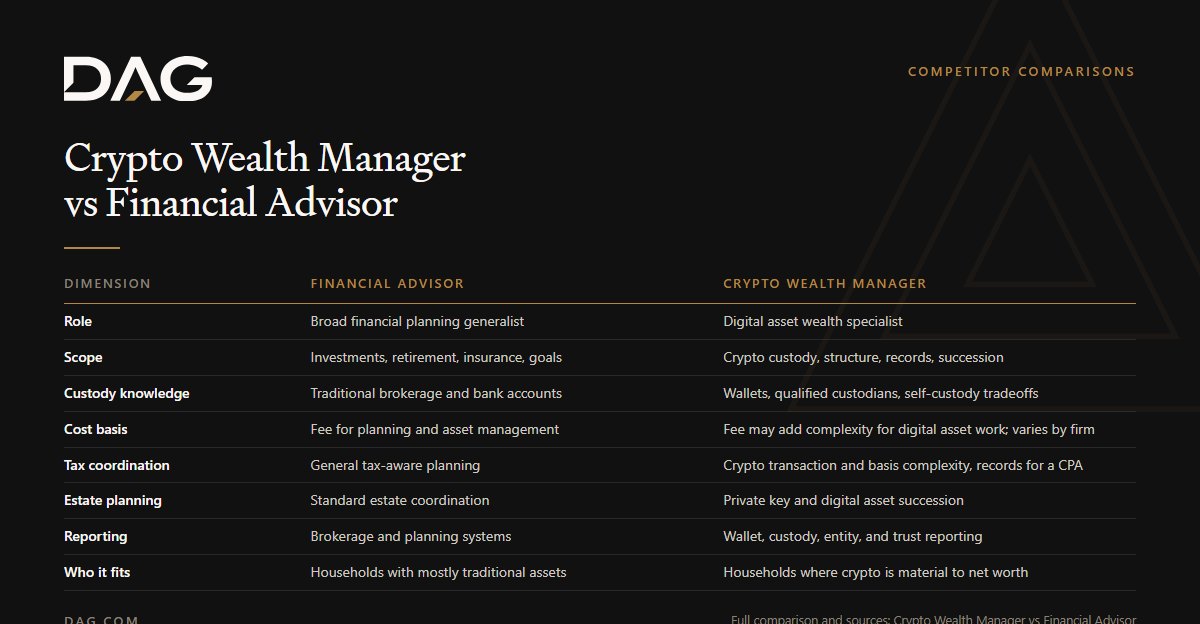
A crypto wealth manager vs financial advisor comparison comes down to scope. A financial advisor may coordinate the full financial plan: investments, retirement, insurance, and goals. A crypto wealth manager adds specialization in digital assets, including custody, wallets, crypto tax records, token exposure, and private key succession. Many households with meaningful crypto use both, working as one coordinated team.
What Each One Is
A financial advisor is a generalist who helps build and maintain a broad financial plan. The role typically spans investments, retirement, insurance, cash flow, and long-term goals, often across a household's full balance sheet.
A crypto wealth manager focuses on the issues that surface when digital assets become a real part of net worth: custody and wallet decisions, qualified custodian selection, crypto transaction and basis records, token concentration, private key succession, and trust or LLC coordination. The two roles overlap on planning but diverge sharply on operational fluency with crypto. For a fuller picture of how that specialization fits a household, the Crypto Wealth Management Hub maps the surrounding services.
Why This Matters
Many crypto holders already have a financial advisor, but the advisor may not be comfortable with direct digital assets, self-custody, staking, DeFi, custody providers, or crypto tax records. The gap is often not investment advice at all. It is operational fluency with how crypto is held, moved, recorded, and passed on.
How They Compare
| Dimension | Financial Advisor | Crypto Wealth Manager |
|---|---|---|
| Role | Broad financial planning generalist | Digital asset wealth specialist |
| Scope | Investments, retirement, insurance, goals | Crypto custody, structure, records, succession |
| Custody knowledge | Traditional brokerage and bank accounts | Wallets, qualified custodians, self-custody tradeoffs |
| Cost basis | Fee for planning and asset management | Fee may add complexity for digital asset work; varies by firm |
| Tax coordination | General tax-aware planning | Crypto transaction and basis complexity, records for a CPA |
| Estate planning | Standard estate coordination | Private key and digital asset succession |
| Reporting | Brokerage and planning systems | Wallet, custody, entity, and trust reporting |
| Who it fits | Households with mostly traditional assets | Households where crypto is material to net worth |
| Compliance | Subject to applicable advisory rules | Advisory work subject to the same rules; coordination roles differ |
A useful contrast sits next door: a custodian holds the asset, while a wealth manager helps structure and plan around it. The Crypto Custodian vs Crypto Wealth Manager comparison draws that line in more detail. Households weighing a generalist relationship against an in-house team may also find the Family Office vs Crypto Wealth Manager page relevant.
Evidence Standard
This article compares service categories and does not make claims about any specific advisor or firm. Neither role is inherently better; the right fit depends on the facts of a household's holdings and goals.
When It May Help
- Crypto is meaningful to net worth.
- Existing advisors are not set up for custody or wallets.
- A CPA or attorney needs digital asset records.
- Trusts or LLCs are involved.
- The family needs continuity beyond one crypto-native person.
When It May Not Be Enough
A crypto wealth manager does not replace every professional. Legal, tax, custody, and investment services must be provided through the appropriate professionals and entities. Where the question is mainly tax record-keeping rather than portfolio structure, the Crypto Wealth Manager vs Crypto Tax CPA comparison may be the better starting point.
Related Questions
Can a traditional advisor manage crypto?
Possibly, if the firm has the expertise, platform, custody arrangements, disclosures, and compliance process to support it. Many can; some choose not to hold digital assets directly. The answer depends on the individual firm, so ask about it directly.
Should crypto be part of the financial plan?
If material, generally yes. Even held-away crypto can affect risk, tax, liquidity, and estate planning, so leaving it out of the plan can create blind spots. Confirm with your own advisers how it fits your situation.
Is crypto wealth management regulated?
Investment advisory services may be regulated, and registration is required for many advisers. Registration alone does not guarantee skill or results. Non-advisory coordination, legal, tax, and custody services fall under separate rules and provider responsibilities.
Do I need both an advisor and a crypto wealth manager?
It depends on the facts. Some households consolidate into one coordinated team; others keep a generalist advisor and add crypto specialization alongside. The goal is coverage without gaps, not a fixed number of providers.
Bottom Line
A crypto wealth manager tends to earn its keep when digital assets have outgrown ordinary financial planning. The aim is to make crypto wealth fit the whole financial life, rather than sit beside it unmanaged.
Sources
- SEC investment adviser public disclosure search
- SEC custody rule compliance guide
- IRS digital assets guidance
Compliance Note
This article is for general educational purposes and is not legal, tax, custody, or investment advice.