
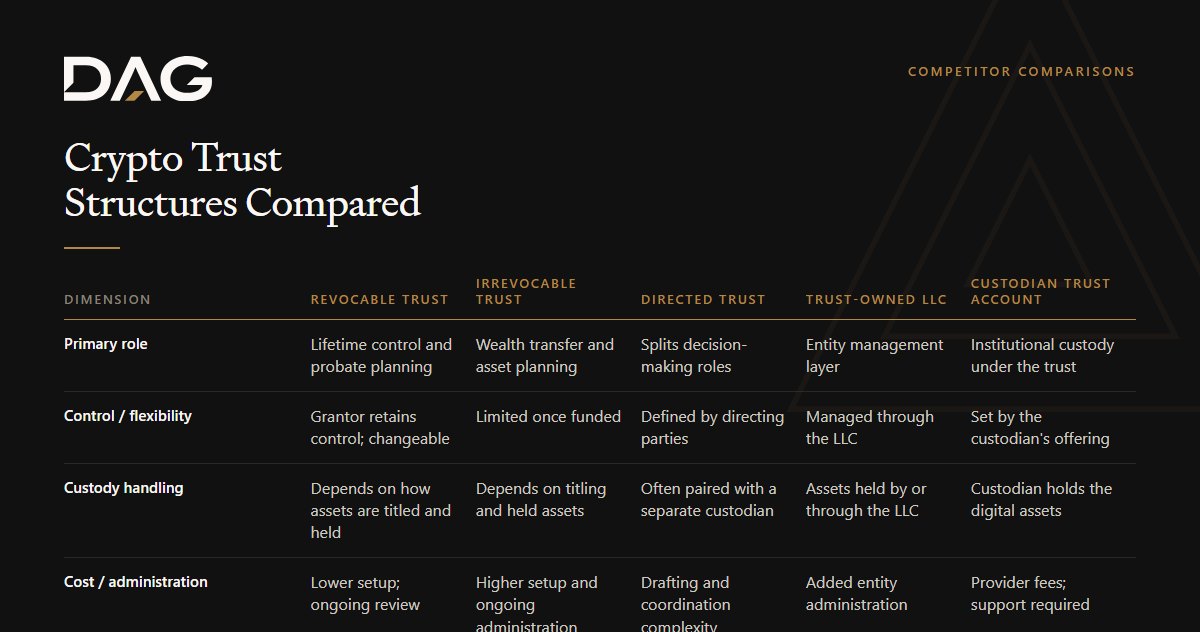
When crypto trust structures are compared, the common options are revocable trusts, irrevocable trusts, directed trusts, trust-owned LLCs, and custodian-supported trust accounts. Each handles ownership, control, custody, and tax records differently, so the right fit generally depends on your estate goals, fiduciary duties, and family facts rather than on any single structure being best.
What Each Structure Means
Before comparing, it helps to define the terms. A revocable trust can be changed or undone during your lifetime, which keeps flexibility but usually does not complete a transfer for estate or creditor purposes. An irrevocable trust generally cannot be altered once funded, trading flexibility for transfer and planning benefits. A directed trust splits fiduciary roles, separating, for example, the party who directs investments from the party who administers the trust. A trust-owned LLC places assets inside an entity the trust owns, adding a management and liability layer. A custodian-supported trust account holds digital assets through an institutional custodian under the trust's name, and the available features depend on what the provider supports.
How these structures fit together with custody and governance is covered in more depth across our Crypto Trust Structures Hub, while the underlying holding question is addressed in Crypto Custody Options Compared.
Comparison Table
| Dimension | Revocable trust | Irrevocable trust | Directed trust | Trust-owned LLC | Custodian trust account |
|---|---|---|---|---|---|
| Primary role | Lifetime control and probate planning | Wealth transfer and asset planning | Splits decision-making roles | Entity management layer | Institutional custody under the trust |
| Control / flexibility | Grantor retains control; changeable | Limited once funded | Defined by directing parties | Managed through the LLC | Set by the custodian's offering |
| Custody handling | Depends on how assets are titled and held | Depends on titling and held assets | Often paired with a separate custodian | Assets held by or through the LLC | Custodian holds the digital assets |
| Cost / administration | Lower setup; ongoing review | Higher setup and ongoing administration | Drafting and coordination complexity | Added entity administration | Provider fees; support required |
| Compliance / records | Records maintained by grantor or trustee | Trustee maintains records | Records shared across roles | LLC and trust records both apply | Custodian statements plus trust records |
| Who it may fit | Those wanting lifetime flexibility | Those prioritizing transfer goals | Families wanting specialized roles | Those needing a management layer | Those preferring institutional custody |
A structure is rarely chosen on its own. Many families combine, for example, a trust with a custodian or an LLC, and the comparison between a holder of assets and a coordinator of advice is explored in Crypto Custodian vs Crypto Wealth Manager.
Key Questions
- Who can approve transfers?
- Who manages custody?
- How are tax records maintained?
- What happens if the trustee changes?
- Are beneficiaries protected and informed appropriately?
Related Questions
Which crypto trust structure is best?
There is no single best structure. The fit generally depends on your estate goals, tax facts, fiduciary duties, and how the digital assets are custodied. A revocable trust may suit lifetime flexibility, while an irrevocable trust may suit transfer goals. Review the options with qualified legal and tax professionals.
Can a trust hold crypto directly?
A trust can be set up to hold digital assets, but the practical mechanics, such as who controls keys and how custody is arranged, depend on the structure and the custodian. Confirm with counsel how the trust will take title and how access is managed.
Do I still need a custodian if I use a trust?
Often yes. A trust defines ownership and decision rights, while custody of the underlying digital assets is a separate question. Many trusts pair with an institutional custodian or hold assets through an entity. The right pairing depends on your facts and the provider's supported features.
How are crypto trust structures taxed?
Tax treatment varies by structure and jurisdiction, and revocable versus irrevocable trusts can be treated very differently. This page does not provide tax advice; consult a qualified tax professional about your situation.
Sources
Compliance Note
This comparison is educational and does not provide legal, tax, fiduciary, estate, investment, or custody advice. Trust structures should be reviewed with qualified professionals. Digital assets can lose value, are not FDIC- or SIPC-insured, and carry no guaranteed yield, peg, or protection from loss; any registration of an adviser does not by itself guarantee a particular result or level of skill.