
A trust-owned LLC for crypto assets places an LLC between a trust and its digital assets: the trust owns the LLC membership interest, and the LLC holds or manages the crypto. Families use this two-layer structure to separate beneficial ownership from operational control, define signing authority, and plan succession without probate. Whether it fits depends on goals, state law, and the assets involved.
What a Trust-Owned LLC Is
In this structure, a trust is the member (owner) of an LLC, and the LLC is the entity that opens custody accounts, holds wallets, signs transactions, and keeps entity-level records. Beneficial ownership stays with the trust and its beneficiaries; operational authority sits in the LLC's operating agreement, which names a manager who can act for the entity day to day.
This is distinct from simply holding crypto directly in a trust (where the trustee administers everything under the trust document) or holding it personally (where the individual owns it outright). The choice across those three options is covered at length in should crypto be held personally, in an LLC, or in a trust.
Should a Trust Own Crypto Directly or Through an LLC?
This is the threshold question. Neither approach is universally better.
Direct trust ownership, the trust itself holds the digital assets, and the trustee administers them under the trust document, can be simpler when a custodian supports trust accounts and when a single governing document is preferred. The trustee carries fiduciary responsibility either way, and simplicity does not remove market, custody, or tax risk.
A trust-owned LLC adds a separate management layer with an operating agreement, defined manager authority, and a distinct account structure. Families consider it when they want:
- A documented chain of manager authority separate from the trustee's role
- An operating agreement that spells out signing thresholds and governance (for example, multi-sig approval rules)
- Potential charging-order protection at the entity level, depending on formation state and facts
- Entity-level books that separate crypto operations from trust accounting
These benefits come with added cost and complexity: a second governing document, entity-level tax filings, and ongoing administrative requirements.
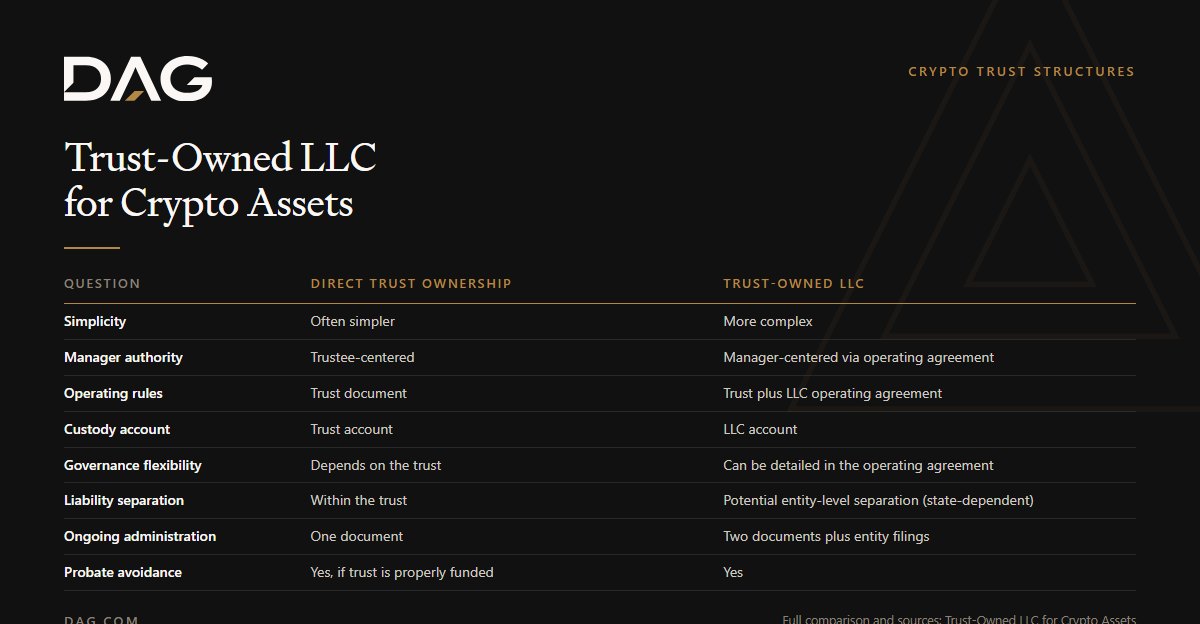
Comparison Table
| Question | Direct Trust Ownership | Trust-Owned LLC |
|---|---|---|
| Simplicity | Often simpler | More complex |
| Manager authority | Trustee-centered | Manager-centered via operating agreement |
| Operating rules | Trust document | Trust plus LLC operating agreement |
| Custody account | Trust account | LLC account |
| Governance flexibility | Depends on the trust | Can be detailed in the operating agreement |
| Liability separation | Within the trust | Potential entity-level separation (state-dependent) |
| Ongoing administration | One document | Two documents plus entity filings |
| Probate avoidance | Yes, if trust is properly funded | Yes |
| Privacy | Trust terms may be private | LLC adds a layer of name separation |
Why Wyoming for the LLC?
Wyoming is a common choice for the LLC layer for several reasons:
- Wyoming Limited Liability Company Act makes the charging order the exclusive remedy for a judgment creditor of an LLC member (W.S. 17-29-503), and Wyoming applies that exclusivity even to single-member LLCs, meaning a creditor generally cannot foreclose on the membership interest itself. It limits, but does not eliminate, creditor exposure.
- Wyoming digital asset statutes (Title 34, Chapter 29) explicitly recognize digital assets as property that an LLC can hold, and address control agreements for custodied assets.
- Low ongoing cost: Wyoming's annual LLC report fee is $60 minimum, among the lowest of any asset-protection jurisdiction.
- Dynasty trust compatibility: Wyoming allows trusts to last up to 1,000 years, enabling multi-generational structures.
- Privacy: Wyoming does not require member names on the public LLC filing.
South Dakota and Nevada also have favorable trust and LLC laws. Delaware has strong LLC protections but a less developed digital-asset statutory framework. The right state depends on the family's facts, tax situation, and where the assets are custodied.
Can a Trust Own a Crypto LLC? (Legal Answer)
Yes. A trust can own the membership interest in an LLC in every U.S. jurisdiction that recognizes both entity types, which is all of them. The trust document must authorize the trustee to hold and manage entity interests, and the LLC's operating agreement must confirm the trust (or its trustee acting for the trust) as the member.
The type of trust that owns the LLC matters:
- Revocable living trust: The grantor retains control during life. The LLC passes to beneficiaries without probate at death. Creditors can still reach assets in a revocable trust, so the LLC layer provides the primary liability separation during life.
- Irrevocable trust: Once the LLC interest is transferred in, the grantor generally does not control it directly. Creditors face a harder time reaching it. Flexibility is reduced in exchange for stronger protection.
- Asset protection trust (self-settled): A specific type of irrevocable trust, permitted in a limited set of states including South Dakota, Nevada, Delaware, and Wyoming, that may allow the grantor to remain a beneficiary while still shielding assets from certain future creditors. It is designed to offer broader protection than a standard irrevocable trust, but only if it is funded before any creditor claim arises and the applicable seasoning period has run. Results vary by state and by facts.
Fraudulent transfer caveat: Transferring assets to a trust after a creditor dispute has already arisen, or after the grantor knows one is coming, can be unwound by courts. Asset protection requires advance planning.
Asset Protection: How the Two Layers Work
The dual structure creates two legal barriers for a judgment creditor:
- LLC charging-order protection: A creditor who wins a judgment against the member (the trust) typically cannot seize the LLC's assets or force a liquidation. In Wyoming, the charging order is the exclusive remedy.
- Trust protection: If the trust is irrevocable and properly structured, a creditor of the grantor generally cannot reach trust assets to satisfy a judgment against the grantor personally.
Neither layer is impenetrable. Courts can disregard either if the LLC is treated as a personal account (commingling, failure to follow formalities) or if the transfer to the trust is treated as fraudulent. The structure is most likely to hold up when it is set up correctly, maintained consistently, and established well before any dispute arises, but no structure guarantees protection against every claim.
Setup: What the Structure Requires
Forming the structure requires two coordinated documents working together.
1. The LLC Operating Agreement
The operating agreement should address:
- Authority to hold digital assets, explicit power to own crypto, open custody accounts, and hold private keys.
- Manager appointment and removal, who acts, how they are replaced, and who approves.
- Custody standard, qualified custodian versus self-custody, signer count, and key-handling rules.
- Transfer controls, approval thresholds and documentation requirements for large movements.
- Recordkeeping, entity-level books that coordinate with trust accounting and tax reporting.
2. The Trust Instrument
The trust must:
- Authorize the trustee to hold and manage LLC membership interests and digital assets.
- Define successor trustee authority so it passes cleanly at incapacity or death.
- Name beneficiaries and distribution rules (amount, timing, discretion).
- Coordinate with the operating agreement so authority is unambiguous, gaps between the two documents are where succession fails.
3. Funding
The structure only works once assets are actually inside it. "The LLC owns my Bitcoin" is not true until the custody account, wallet, or exchange account is legally retitled to the LLC. Similarly, "the trust owns the LLC" is not true until the membership interest is formally transferred. Funding errors are one of the most common reasons this structure fails in practice. See how to fund a trust with crypto for the mechanics.
4. Ongoing Administration
- Corporate formalities: Keep separate accounts, document LLC decisions, and follow the operating agreement. Commingling or ignoring formalities gives courts grounds to pierce the liability shield.
- Annual filings: Wyoming requires an annual report and fee. Missing it risks losing good standing.
- Trust administration: The trustee must act consistently with the trust instrument and applicable fiduciary law.
Custody Questions Before Funding
Before transferring assets, confirm with the prospective custodian and counsel:
- Will the custodian open an account titled to the LLC, and what entity documents does it require?
- Who is authorized to act for the LLC, and is that authority signed into the operating agreement?
- Does the operating agreement permit the planned custody arrangement (self-custody, multi-sig, qualified custodian)?
- Are trust and LLC records coordinated so valuation and tax data reconcile for reporting?
- Are personal assets fully separated from entity assets to preserve the liability shield?
A qualified custodian arrangement can shift key-handling and SOC-reported controls to a regulated third party; self-custody keeps multi-sig and cold-storage duties inside the entity. Both carry custody risk. For more on the mechanics, see whether a trustee can manage a crypto wallet.
Common Ways This Structure Fails
- Commingling: Using the LLC account to pay personal expenses destroys the liability shield. Courts call this "piercing the corporate veil."
- Not funding the trust: Creating a trust and never transferring the LLC interest means the grantor still personally owns the LLC.
- Sloppy documentation: No operating agreement, no trust amendments as circumstances change, no records of LLC decisions.
- Transferring after a dispute arises: Fraudulent transfer law can unwind the structure.
- DIY documents: Generic templates often fail to address digital asset custody, multi-state issues, or succession of signing authority for crypto-specific accounts.
- Ignoring annual filings: Loss of good standing weakens or eliminates asset protection.
Who May Benefit
This structure tends to make sense when:
- The crypto position is meaningful enough to need formal governance and succession planning.
- The family wants probate avoidance and privacy.
- Assets span multiple wallets, custodians, exchanges, or protocols.
- There is real lawsuit exposure (business owners, professionals, DeFi developers) that makes asset protection worth the cost.
- The family wants a structure a professional advisor, CPA, or custodian can evaluate against documented procedures.
It is generally not warranted when net worth is modest, when simpler estate planning (revocable trust, direct title) achieves the goals, or when ongoing administrative costs outweigh the protection benefit.
Related Questions
Can a revocable trust own an LLC?
Generally yes. The trustee acts as the LLC member. During the grantor's life, the grantor often acts as trustee and retains practical control. At death, the successor trustee steps in and the LLC interest passes without probate. The revocable trust does not protect against the grantor's creditors during life, that protection comes from the LLC layer or from converting to an irrevocable structure.
Does this structure reduce taxes?
Not directly. Wyoming LLC formation does not change federal tax treatment. The IRS treats digital assets as property regardless of entity structure. A single-member LLC owned by a revocable trust is typically disregarded for tax purposes and taxed on the grantor's return. An irrevocable trust or certain multi-member LLCs may change the tax picture. Tax consequences depend on the specific facts; consult a qualified tax professional before acting.
Who controls the crypto in a trust-owned LLC?
Generally the LLC manager named in the operating agreement holds operational control, while the trust (through its trustee) holds the membership interest. Aligning the trust instrument and operating agreement so authority is unambiguous at every transition point, incapacity, death, manager change, is the central drafting task.
Does a Wyoming LLC protect crypto from lawsuits?
Wyoming's charging-order statute provides meaningful protection for a properly maintained LLC, but it is not absolute. Courts have pierced the LLC veil where formalities were ignored. The charging-order remedy limits what a creditor can do, but does not eliminate litigation risk. See does a Wyoming LLC protect crypto from lawsuits for the fuller analysis.
When is an irrevocable trust the right choice over a revocable trust?
When creditor protection from the grantor's own creditors is a priority. A revocable trust is fully reachable by the grantor's creditors. An irrevocable trust, especially an asset protection trust, is not, provided it was funded before any claim arose and meets the applicable seasoning period (typically two to four years depending on state).
Can the structure be changed later?
In many cases a trust can contribute crypto to a newly formed LLC, or wind an LLC down, but doing so can have tax and titling consequences. The mechanics depend on trust terms and applicable law. Review any change with a qualified tax and legal professional before acting.
Sources
- Wyoming Limited Liability Company Act
- Wyoming Digital Asset Statutes, Title 34, Chapter 29
- Kiplinger: What Is a Living Trust?
- IRS Notice 2014-21 (treatment of virtual currency as property)
Compliance Note
This article is educational and does not provide legal, tax, fiduciary, investment, entity, or custody advice. Trust-owned LLC structures involve complex legal and tax considerations that vary by jurisdiction and individual facts. No structure eliminates market, custody, or tax risk. All planning decisions should be reviewed with qualified legal, tax, and financial professionals before implementation.