
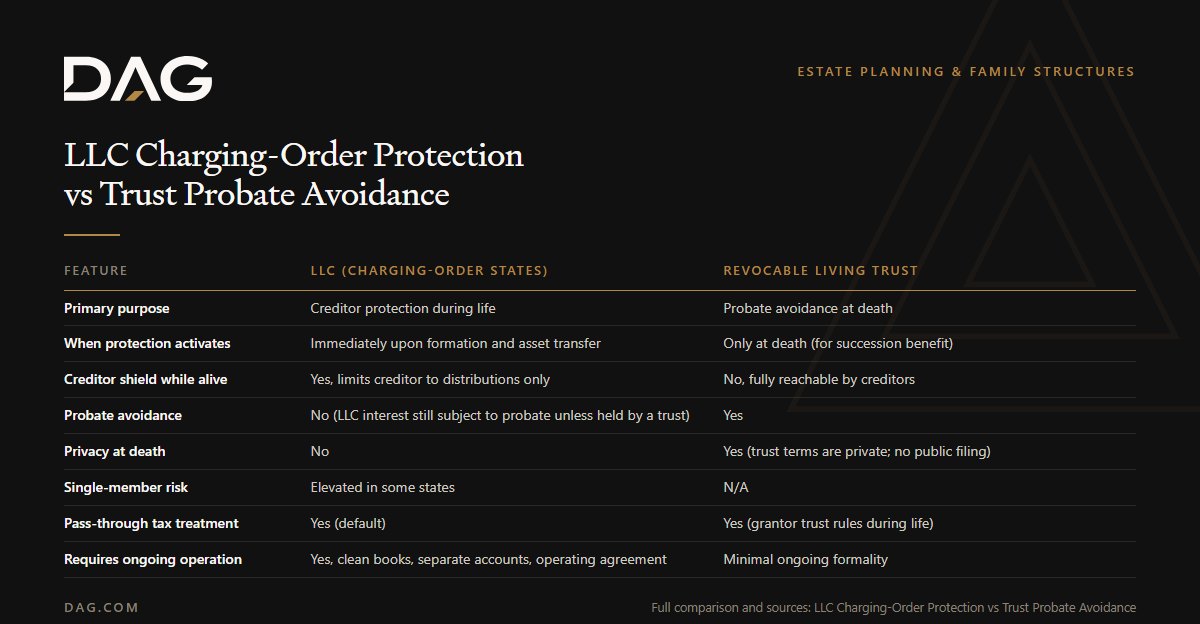
LLC charging-order protection vs trust probate avoidance is a question of timeline, and understanding both is central to crypto estate planning for digital asset holders. An LLC's charging-order rules limit what a judgment creditor can reach during your lifetime, though this protection is state-dependent and weaker for single-member LLCs. A revocable living trust avoids probate at death but offers no creditor protection. Different problems, different timelines.
What Is LLC Charging-Order Protection?
A charging order is the primary remedy most states give a judgment creditor who wins a lawsuit against an LLC member personally. Rather than seizing LLC assets directly, the creditor receives only the right to collect distributions, if and when the LLC makes them.
Practically, this means the creditor cannot:
- Force distributions from the LLC
- Vote on LLC decisions
- Access or liquidate LLC assets (including digital assets held in the LLC)
- Take over management
If the manager, typically the member, chooses not to make distributions, the creditor waits indefinitely. The creditor has a claim against the ownership interest, not the assets themselves.
Protection is not absolute. Key limitations:
| Factor | How It Affects Protection |
|---|---|
| Single-member LLC | Some courts allow creditors to foreclose on the entire interest (no co-members to protect); varies by state |
| State statute strength | Some states make charging orders the exclusive remedy; others allow eventual foreclosure of the interest after sustained non-payment |
| Adequate structure/operation | Piercing the veil remains possible if the LLC is not operated as a separate entity (commingled funds, no operating agreement, etc.) |
| Fraudulent transfer | Transferring assets into an LLC after a judgment or known claim can be unwound |
States with the strongest charging-order statutes (Wyoming, Nevada, Delaware, South Dakota) typically make it the exclusive remedy for multi-member LLCs. Single-member treatment varies more.
What Does a Revocable Living Trust Do, and Not Do?
A revocable living trust holds title to assets during your lifetime and transfers them to named beneficiaries after death according to the trust terms, without probate.
Probate avoidance benefits:
- Heirs gain access faster (no court timeline, typically months avoided)
- No public record of assets or beneficiary identities
- Lower estate administration cost in many states
- Continuous management: a successor trustee steps in immediately
What a revocable trust does NOT do:
Because you retain full control of a revocable trust during your lifetime, creditors can reach trust assets exactly as they could reach your personal assets. The trust creates no barrier between you and a judgment creditor while you are alive. This is the core distinction, creditor protection operates on a living timeline; probate avoidance operates on a death timeline.
Side-by-Side Comparison
| Feature | LLC (Charging-Order States) | Revocable Living Trust |
|---|---|---|
| Primary purpose | Creditor protection during life | Probate avoidance at death |
| When protection activates | Immediately upon formation and asset transfer | Only at death (for succession benefit) |
| Creditor shield while alive | Yes, limits creditor to distributions only | No, fully reachable by creditors |
| Probate avoidance | No (LLC interest still subject to probate unless held by a trust) | Yes |
| Privacy at death | No | Yes (trust terms are private; no public filing) |
| Single-member risk | Elevated in some states | N/A |
| Pass-through tax treatment | Yes (default) | Yes (grantor trust rules during life) |
| Requires ongoing operation | Yes, clean books, separate accounts, operating agreement | Minimal ongoing formality |
Why Serious Holders Use Both Together
The layered structure solves both problems:
- Form an LLC to hold crypto, real estate, or operating assets. The LLC provides immediate charging-order protection.
- Transfer your LLC membership interest into a revocable living trust. The trust owns the LLC interest, so it passes to the successor trustee at death without probate, no court delay, no public exposure of private keys or holdings.
- The successor trustee steps into the manager role per the operating agreement and controls the assets directly.
This structure means the LLC handles creditor risk during life; the trust handles succession at death. Neither structure alone covers both timelines.
For digital assets specifically, custody protocols remain separate from the legal structure. The LLC and trust determine legal authority over the assets. Hardware wallet access and key management determine operational access. Both layers must be addressed in a complete plan, see crypto estate planning for high-net-worth families and private key succession planning.
Should a Trust Own the LLC, or Hold Crypto Directly?
A trust can hold crypto directly, but doing so sacrifices the charging-order protection available through an LLC. The question is whether creditor protection during life is a material concern.
If it is, the LLC-in-trust structure, trust-owned LLC for crypto assets, is the more complete approach. If the only goal is succession, holding crypto directly in a trust (with robust digital asset trust provisions) may be simpler. See should a trust own crypto directly or through an LLC? for the full trade-off analysis.
The right answer depends on individual circumstances, asset size, state of formation, nature of liability exposure, and existing entity structure. Drafting either structure is a legal service that DAG coordinates alongside your attorney.
Related Questions
Does a single-member Wyoming LLC protect crypto from lawsuits?
Wyoming's charging-order statute is among the strongest in the country and applies to single-member LLCs as well as multi-member ones. However, some federal bankruptcy courts and courts in other jurisdictions have declined to honor single-member charging-order exclusivity. Wyoming-formed LLCs generally provide strong protection for Wyoming-resident members, but out-of-state judgment creditors may attempt to apply their own state's rules. See does a Wyoming LLC protect crypto from lawsuits? for jurisdiction-specific detail.
Can an irrevocable trust provide creditor protection that a revocable trust cannot?
Yes. An irrevocable trust, properly structured and funded before any claim arises, can place assets beyond the reach of the grantor's creditors because the grantor gives up control. Self-settled asset-protection trusts in certain states (South Dakota, Nevada, Wyoming, Delaware) can provide protection even when the grantor is a discretionary beneficiary. A revocable trust cannot do this because retained control means retained creditor exposure. See revocable vs irrevocable trusts for crypto assets.
What happens to LLC membership interests at death if they are not held in a trust?
LLC membership interests not titled in a trust pass through probate like other personal property, subject to court oversight, public record, and potential delays of six months to two or more years depending on state and estate complexity. For digital assets, this can create serious access problems: private keys may be unreachable during probate, exchanges may freeze accounts, and heirs may lack legal authority to operate the LLC until the court appoints a personal representative. Holding the LLC interest in a trust eliminates this exposure. See what happens to crypto when you die? and how to fund a trust with crypto.
How do LLC tax treatment and trust tax treatment compare?
Both default to pass-through taxation. A single-member LLC is a disregarded entity, income reports on the member's personal return. A revocable living trust is a grantor trust during the grantor's lifetime, income also reports on the grantor's personal return. The creditor protection and probate consequences differ sharply, but the tax treatment is structurally similar. Multi-member LLCs default to partnership taxation (Form 1065). See crypto tax reporting for LLCs and crypto tax reporting for trusts.
Sources
- Uniform Limited Liability Company Act (ULLCA) § 503, charging order as exclusive remedy language (National Conference of Commissioners on Uniform State Laws)
- Wyoming Stat. § 17-29-503, charging order provisions for Wyoming LLCs
- Internal Revenue Service, Publication 541 (Partnerships), pass-through taxation of LLCs treated as partnerships
- Internal Revenue Code § 676, grantor trust rules for revocable trusts
- Restatement (Third) of Trusts, creditor access to revocable trust assets
- Uniform Trust Code § 505(a)(3), revocable trust assets reachable by settlor's creditors
Verify current statutes in your state of formation and domicile; charging-order protections vary and are subject to legislative change.
Compliance Note
This page is educational only and does not constitute legal, tax, or investment advice. Charging-order protection is not absolute and varies significantly by state, by whether the LLC has one member or multiple members, and by the specific facts of any legal proceeding. A revocable living trust does not shield assets from creditors during the grantor's lifetime. Neither structure eliminates all risk. Drafting, forming, and funding LLCs and trusts are legal services; DAG coordinates these with qualified attorneys but does not provide legal advice directly. Consult a licensed attorney and a qualified tax professional before implementing any structure described here. Advisory services are provided by DAG Wealth, an SEC-registered investment adviser. Registration does not imply a certain level of skill or training.