
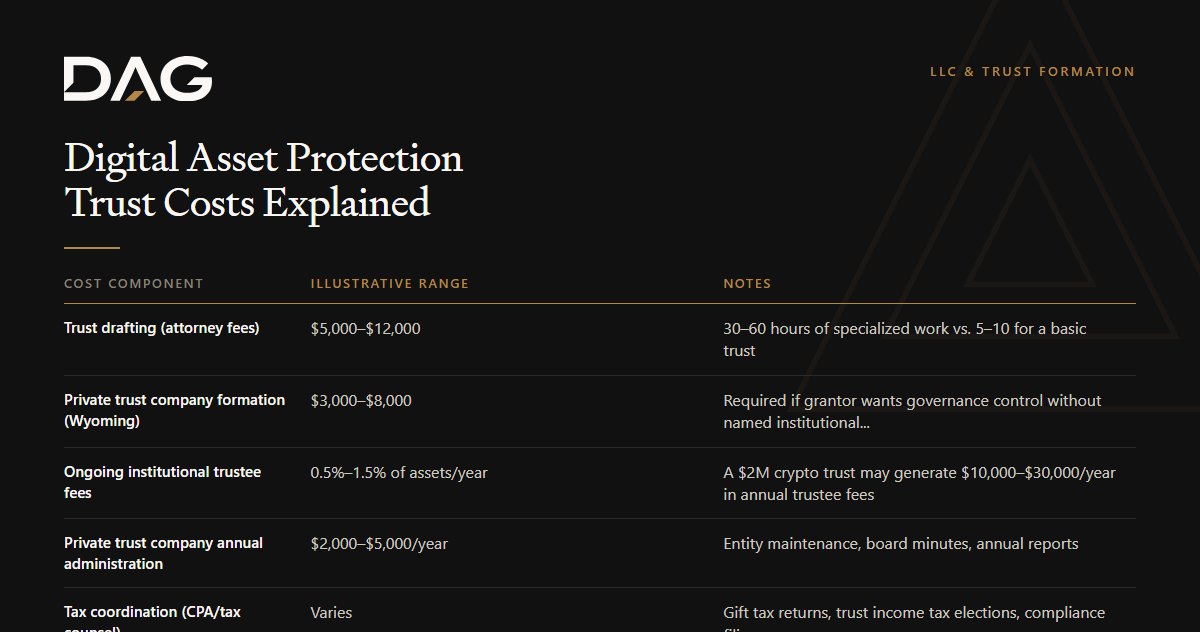
Digital asset protection trust costs typically run higher than a basic revocable trust because the legal work is different in kind, not just degree. A DAPT must survive creditor challenges, satisfy state statutory requirements, and coordinate tax treatment, making it a more complex step beyond standard crypto LLC formation. Illustrative ranges below vary by provider, state, and complexity, so treat them as directional and verify current rates.
What Is a Digital Asset Protection Trust?
A digital asset protection trust is an irrevocable trust structured to shield assets, including cryptocurrency held through a Wyoming LLC for crypto assets, from future creditors while preserving some level of beneficial access for the grantor. Unlike a revocable living trust, which offers no creditor protection (you can revoke it, so creditors can compel you to), a DAPT places assets beyond the easy reach of judgment creditors.
Domestic DAPTs are authorized in a limited number of states; Wyoming, Nevada, Delaware, and South Dakota are the most commonly used. Offshore variants in jurisdictions such as the Cook Islands provide additional insulation but at higher cost and complexity.
Asset protection trusts are not absolute. Fraudulent-transfer law can unwind transfers made with intent to defraud existing creditors. Most states impose a seasoning period (typically two to four years) before statutory protection fully attaches. Jurisdiction matters: a DAPT formed in Wyoming may face challenges if the grantor, assets, or creditor litigation are centered in another state. A court retains discretion over whether a given structure is respected, so no asset protection trust should be treated as a guarantee against future claims.
What Drives DAPT Costs?
The ranges below are illustrative and dated. Actual fees vary by provider, state, complexity, and attorney; confirm current practitioner rates before relying on them.
| Cost Component | Illustrative Range | Notes |
|---|---|---|
| Trust drafting (attorney fees) | $5,000–$12,000 | 30–60 hours of specialized work vs. 5–10 for a basic trust |
| Private trust company formation (Wyoming) | $3,000–$8,000 | Required if grantor wants governance control without named institutional trustee |
| Ongoing institutional trustee fees | 0.5%–1.5% of assets/year | A $2M crypto trust may generate $10,000–$30,000/year in annual trustee fees |
| Private trust company annual administration | $2,000–$5,000/year | Entity maintenance, board minutes, annual reports |
| Tax coordination (CPA/tax counsel) | Varies | Gift tax returns, trust income tax elections, compliance filings |
| Ongoing compliance/legal review | Varies | Some states require periodic affidavits; evolving crypto law may require annual review |
Why attorney fees are higher than for a basic trust. A DAPT attorney researches current case law in your jurisdiction, drafts custom creditor-protection provisions and spendthrift clauses, coordinates with tax counsel to avoid triggering unintended gift taxes, and structures trustee independence in a way courts will respect. Poorly drafted DAPTs are routinely disregarded by judges who find them to be shams. You are paying for work that survives judicial scrutiny, not template completion.
Why digital assets add cost. Standard trust templates have no provisions for cryptocurrency custody, private key succession, fork handling, or wallet governance. An attorney drafting a DAPT for digital assets is writing custom provisions from scratch for a crypto trust structure that most general-practice attorneys have never encountered. That combination of asset-protection expertise and digital asset knowledge commands a premium.
How Does a DAPT Compare to Simpler Options?
Does a basic revocable trust offer any creditor protection?
No. A revocable trust is transparent to creditors because you can revoke it at any time. Courts can order you to revoke the trust to satisfy a judgment. A revocable trust is useful for probate avoidance and transfer-on-death planning, it is not an asset-protection tool. See Revocable vs. Irrevocable Trusts for Crypto Assets for a side-by-side comparison.
Does a Wyoming LLC by itself protect crypto from lawsuits?
An LLC provides charging-order protection, a creditor who wins a judgment against you personally may be limited to distributions from the LLC rather than seizing the LLC's assets directly. However, a single-member LLC may receive less protection in some states, and the LLC does not remove assets from your personal estate in the way a DAPT does. Does a Wyoming LLC protect crypto from lawsuits? covers that question in depth.
What does the combined LLC-plus-DAPT structure look like?
The most common high-net-worth structure layers ownership: a Wyoming LLC holds the cryptocurrency wallet and accounts; the DAPT owns the LLC membership interests. The trustee has authority over the LLC, but day-to-day asset management can be delegated. See Should a Trust Own a Wyoming LLC for Crypto Assets? for how the layers connect.
When is a DAPT probably not worth the cost?
The cost-benefit calculus depends on your exposure and asset level. A $10,000–$15,000 setup cost plus $10,000–$30,000 in annual trustee fees may be reasonable insurance for a physician or business owner with $5M in digital assets and meaningful liability exposure. For someone with $200,000 in crypto and minimal professional liability risk, a simpler LLC and revocable trust structure may accomplish the primary goals at a fraction of the cost. DAG Wealth helps clients think through this right-sizing analysis and coordinates with independent legal and tax counsel; the trust itself is drafted by a qualified attorney, not by DAG Wealth.
What should I know about Wyoming-specific DAPT requirements?
Wyoming's qualified-spendthrift-trust statute (Wyo. Stat. § 4-10-510 et seq.) generally requires that at least one trustee be a qualified Wyoming resident or Wyoming trust company. If you want governance involvement, forming a Wyoming private trust company is common, though it adds to both formation and annual maintenance costs (illustrative ranges above). Wyoming also applies a statutory seasoning period before protection fully attaches to transfers made without fraudulent intent. Statutory citation, the seasoning period, and these requirements should be confirmed against current Wyoming law with counsel.
Related Questions
Can I fund a DAPT with crypto held in an LLC without triggering gift taxes?
Potentially, depending on the structure. Transferring LLC membership interests into an irrevocable DAPT is generally treated as a completed gift for federal gift tax purposes. If the value exceeds your available annual gift tax exclusion (the IRS indexes this amount annually, so confirm the current figure) or your lifetime exemption, a gift tax return (Form 709) is required. Discounts for lack of control or marketability on the LLC interest may reduce the taxable value. Tax counsel should be involved before any transfer. See Crypto Tax Reporting for Trusts for related tax treatment.
Are there ongoing reporting requirements for a DAPT holding crypto?
Yes. The trust likely files as a grantor trust or non-grantor trust depending on how retained interests are structured, each with different income tax treatment. Some state DAPT statutes require annual affidavits of solvency or similar filings to maintain protection. Crypto positions inside the trust generate their own tax events on disposal. Annual coordination between the trustee, the trust's CPA, and legal counsel is standard.
How does a trust protector fit into a DAPT for digital assets?
A trust protector is an independent party with limited powers, often the ability to modify trust terms to adapt to changes in law, change trustees, or address situations the original document did not anticipate. For crypto DAPTs, a trust protector clause is valuable because digital asset law is still evolving. See Trust Protector for a Crypto Trust for what those powers typically cover.
What happens to the private keys when assets are in a DAPT?
The trustee has legal authority over the LLC that holds the wallet, but physical key custody must be documented carefully. The trust and LLC operating agreement should specify how private keys are held, who has access, and what happens if the trustee changes. Private Key Succession Planning covers the operational details.
Sources
- Wyoming Uniform Trust Code, including DAPT provisions: Wyo. Stat. §§ 4-10-501 through 4-10-523 (verify current codification at wyoleg.gov
- IRS Form 709 (United States Gift and Generation-Skipping Transfer Tax Return): irs.gov/form709
- IRS Revenue Ruling 2004-64 (grantor trust reimbursement): irs.gov
- Nevada Revised Statutes §§ 166.010–166.170 (Nevada Spendthrift Trust Act), for comparison with Wyoming statute
- Delaware Qualified Dispositions in Trust Act, 12 Del. C. § 3570 et seq.
Compliance Note
This page is for educational purposes only. It is not legal, tax, investment, or financial advice, and nothing here creates an attorney-client relationship. Digital asset protection trust structures involve complex legal, tax, and regulatory considerations that vary by state, jurisdiction, and individual circumstances. Asset protection trusts are not absolute, fraudulent-transfer laws, seasoning periods, and jurisdictional limitations can affect their enforceability.
All cost figures on this page are illustrative ranges based on market data available at time of drafting. Actual costs vary materially based on attorney, state, trust complexity, asset type, and trustee selection. Consult a qualified trust and estate attorney and a CPA before establishing any asset protection structure.
Investment advisory services are offered through DAG Wealth, a registered investment adviser. Trust drafting, entity formation, and legal structuring services are provided by independent legal counsel, not by DAG Wealth. Registration does not imply a certain level of skill or training.