
In the Articles of Incorporation vs Articles of Organization question, the answer is the entity type: Articles of Incorporation create a corporation, while an LLC is created by filing Articles of Organization (called a Certificate of Formation in some states). You never saw "Articles of Incorporation" because your LLC used a different document, one filed as part of crypto LLC formation.
What Are Articles of Incorporation?
Articles of Incorporation is a public document filed with a state agency, typically the Secretary of State, that legally creates a corporation. Some states call it a Certificate of Incorporation or Corporate Charter, but the function is the same: it establishes the corporation as a separate legal entity distinct from its owners (shareholders).
A standard Articles of Incorporation filing covers:
- Corporate name, the legal name under which the entity operates
- Purpose, a statement of business purpose (often broad, such as "any lawful purpose")
- Registered agent and office, the person or service that receives legal notices
- Authorized stock, the number and classes of shares the corporation may issue
- Incorporators, the individuals who signed and filed the document
- Board of directors, sometimes named in the initial filing, depending on the state
Once filed and accepted, the corporation can open accounts, enter contracts, and issue shares in its own name.
Why Haven't I Seen "Articles of Incorporation" for My LLC?
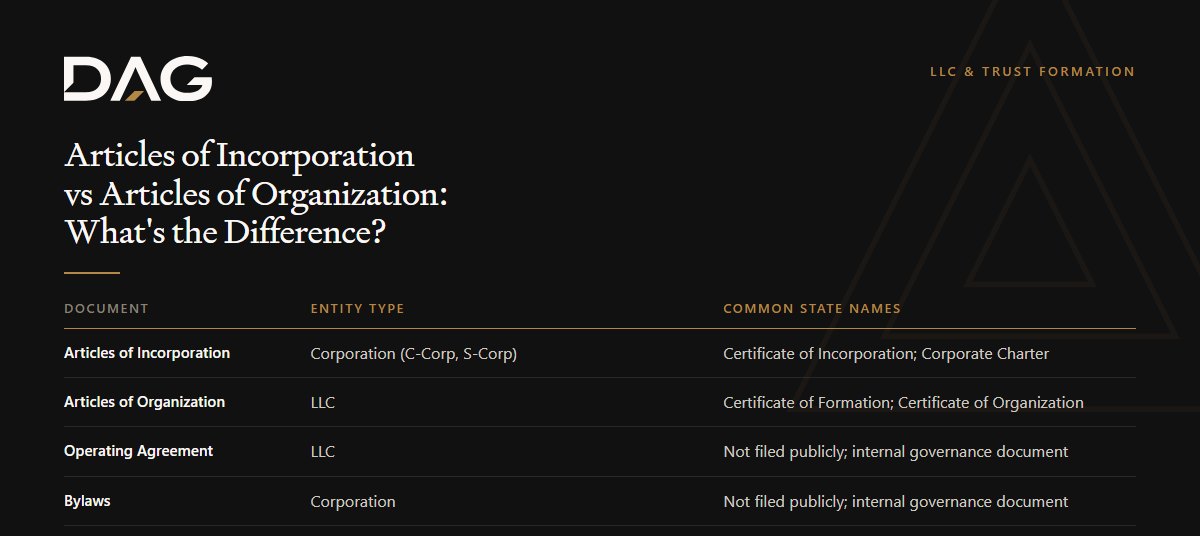
Because LLCs are not corporations. When you formed an LLC, you filed Articles of Organization (or, in some states, a Certificate of Formation or Certificate of Organization). The terminology differs by state and entity type:
| Document | Entity Type | Common State Names |
|---|---|---|
| Articles of Incorporation | Corporation (C-Corp, S-Corp) | Certificate of Incorporation; Corporate Charter |
| Articles of Organization | LLC | Certificate of Formation; Certificate of Organization |
| Operating Agreement | LLC | Not filed publicly; internal governance document |
| Bylaws | Corporation | Not filed publicly; internal governance document |
Wyoming, which is popular for LLCs holding digital assets, uses "Articles of Organization" under Wyo. Stat. § 17-29-201. If you formed a Wyoming Digital Asset LLC, you should have received those Articles, not Articles of Incorporation.
Quick Comparison: Four Common Formation Documents
| Document | Filed Publicly? | Governs | Who Signs |
|---|---|---|---|
| Articles of Incorporation | Yes | Corporate existence | Incorporator(s) |
| Articles of Organization | Yes | LLC existence | Organizer(s) |
| Operating Agreement | No (usually) | LLC internal rules, ownership, manager powers | Members/Manager |
| Bylaws | No | Corporate internal rules, board procedures | Directors/Officers |
The Articles create the entity at the state level. The Operating Agreement or Bylaws govern how it operates internally, neither is filed with the Secretary of State in most states.
Does My LLC Need an Operating Agreement?
Most states do not require an LLC to have a written Operating Agreement, but running an LLC without one is a significant gap. The Operating Agreement documents LLC manager duties, ownership percentages, voting rights, and what happens when a member exits. For LLCs holding crypto, a Crypto LLC Operating Agreement Checklist can help confirm the document covers digital asset-specific provisions such as wallet access and transfer authority.
What Records Should My LLC Keep Alongside the Articles?
Your Articles of Organization are a public record, but running your LLC compliantly requires additional internal records. State what records should a crypto LLC keep for the full list, which typically includes your Operating Agreement, member ledger, resolutions, and contribution records.
Related Questions
Can I Use My Articles of Organization to Open a Bank or Custodial Account?
Generally, yes. Most financial institutions and custodians accept Articles of Organization (along with the Operating Agreement and EIN) as formation documentation for an LLC. If you're opening an account for a Wyoming LLC, some custodians may also require a Certificate of Good Standing from the Wyoming Secretary of State.
What Is the Difference Between a Registered Agent and an Organizer?
The organizer is the person who signs and files the Articles of Organization to create the LLC, this can be an attorney, a formation service, or the business owner. The registered agent is the ongoing point of contact for legal service of process; they receive lawsuits and government notices on behalf of the LLC. These may be the same person but often are not, especially when using a registered agent service.
Can a Trust Own an LLC?
Yes. A trust can be listed as a member of an LLC. This structure, a trust owning an LLC, can provide both asset protection (from the LLC) and succession planning (through the trust). See Should a Trust Own a Wyoming LLC for Crypto Assets? for how that structure works with digital assets.
What Happens If I Formed a Corporation by Mistake Instead of an LLC?
The formation document you filed determines your entity type. If you filed Articles of Incorporation, you have a corporation, not an LLC. Converting requires a formal state-level conversion or dissolution and reformation process. The procedures and fees vary by state. Consult a formation attorney before acting. If you hold crypto assets inside the entity, consider the tax and custody implications of any structural change, crypto tax reporting for LLCs differs from corporate tax treatment.
Sources
- Wyoming Statutes § 17-29-201, Articles of Organization. LLC Act. Wyoming Legislature, https://law.justia.com/codes/wyoming/title-17/chapter-29/article-2/section-17-29-201/
- Wyoming Statutes § 17-16-202, Articles of Incorporation. Business Corporation Act. Wyoming Legislature, https://law.justia.com/codes/wyoming/title-17/chapter-16/article-2/section-17-16-202/
- Wyoming Secretary of State, Business Entity Types and Filings, https://sos.wyo.gov/Business/ (accessed 2026-06-02)
Compliance Note
This page is for educational purposes only. It does not constitute legal, tax, or investment advice. Formation rules, naming conventions, and filing requirements vary by state and change over time. Consult a qualified attorney or CPA for guidance specific to your situation and jurisdiction.