
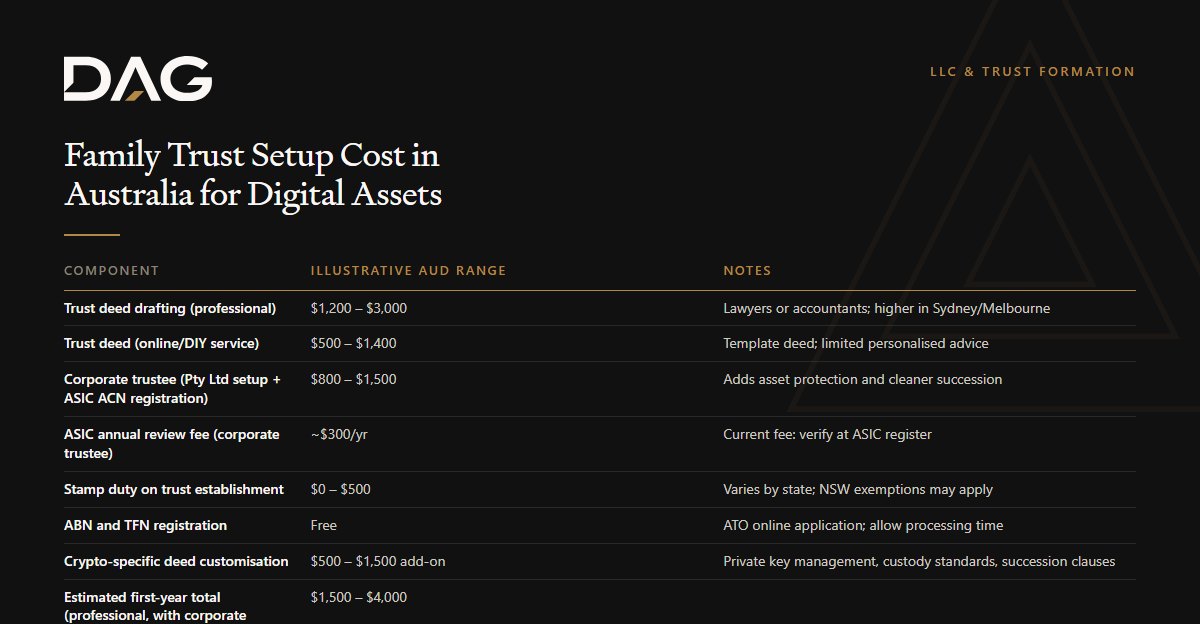
The family trust setup cost in Australia for digital assets generally runs an illustrative AUD 1,500–4,000 in the first year and AUD 1,000–3,500 annually thereafter, varying by state, service provider, and portfolio complexity. Australian structures differ from US approaches, but the entity-selection logic parallels crypto LLC formation considerations. These figures are illustrative as of early 2026; verify with a licensed Australian solicitor and accountant before proceeding.
What Is an Australian Discretionary (Family) Trust?
An Australian discretionary trust, commonly called a family trust, is a legal structure in which a trustee holds assets for the benefit of a defined class of beneficiaries (typically family members). The trustee retains full discretion each year to decide who receives income or capital and how much, which enables annual tax planning across the family group. Most standard Australian trust deeds predated cryptocurrency and contain no digital-asset-specific provisions; customised clauses are advisable for crypto holdings.
How Much Does It Cost to Set Up a Family Trust in Australia?
What are the main setup components and their AUD cost ranges?
All AUD figures below are illustrative as of early 2026 and may have changed; verify current pricing with licensed Australian providers and ASIC.
| Component | Illustrative AUD range | Notes |
|---|---|---|
| Trust deed drafting (professional) | $1,200 - $3,000 | Lawyers or accountants; higher in Sydney/Melbourne |
| Trust deed (online/DIY service) | $500 - $1,400 | Template deed; limited personalised advice |
| Corporate trustee (Pty Ltd setup + ASIC ACN registration) | $800 - $1,500 | Adds asset protection and cleaner succession |
| ASIC annual review fee (corporate trustee) | ~$300/yr | Current fee: verify at ASIC register |
| Stamp duty on trust establishment | $0 - $500 | Varies by state; NSW exemptions may apply |
| ABN and TFN registration | Free | ATO online application; allow processing time |
| Crypto-specific deed customisation | $500 - $1,500 add-on | Private key management, custody standards, succession clauses |
| Estimated first-year total (professional, with corporate trustee) | $1,500 - $4,000 |
Annual ongoing costs
| Ongoing item | Illustrative AUD range |
|---|---|
| Annual trust tax return and financial statements | $1,000 - $3,500+ |
| Trustee distribution minutes and resolutions | Included or $300 - $600 |
| Corporate trustee annual ASIC review fee | ~$300 |
| Complex portfolio (active trading + crypto) | $2,500 - $5,000+ |
Tax treatment is stated generally based on publicly available ATO guidance as of early 2026; verify applicable rates and rules with a registered Australian tax agent.
Why Use a Corporate Trustee?
Setting up a proprietary limited company to act as trustee, rather than an individual, adds cost upfront but provides cleaner succession when trustees change and separates individual trustees from personal liability. Most professional advisers recommend a corporate trustee for any trust expected to hold significant assets. The ASIC fee for company registration and the ongoing annual review fee are the primary additional costs.
How Is Cryptocurrency Taxed Inside an Australian Family Trust?
Australian discretionary trusts are generally treated as flow-through entities for tax purposes. The following is a general summary as of early 2026; verify with ATO guidance current at the time of filing and a registered tax agent.
- Income distributions: beneficiaries include distributed trust income in their own assessable income at marginal rates; undistributed income is taxed at the top marginal rate within the trust.
- Capital gains: the trust can pass capital gains to beneficiaries, who may access the CGT discount if the trust held the asset for more than 12 months (subject to ATO rules on trust CGT, confirm with an Australian tax agent).
- Cryptocurrency: the ATO treats cryptocurrency as a CGT asset (see ATO guidance, last updated 2024). Gains are distributed to beneficiaries at trustee discretion, following the same CGT flow-through rules.
Annual trustee resolutions documenting distribution decisions are required and form part of the ongoing accounting cost.
Do Standard Trust Deeds Cover Digital Assets?
Most existing Australian trust deeds do not include cryptocurrency-specific clauses because they were drafted before digital assets became significant. A well-drafted deed for digital asset holdings should address:
- how the trustee manages and controls cryptocurrency wallets
- who holds private keys and under what custody standards
- how digital assets transfer to beneficiaries on succession
This customisation typically adds AUD 500–1,500 to standard deed drafting costs. See what trust provisions should cover digital assets for a clause-by-clause checklist.
How Do Australian Family Trusts Compare to US Crypto Trust Structures?
Australian discretionary trusts are broadly analogous in purpose to US revocable living trusts, both provide succession flexibility and income distribution planning, but differ in formation law, stamp duty exposure, and trustee liability rules. For a side-by-side comparison of trust types for crypto holdings, see crypto trust structures compared and revocable vs irrevocable trusts for crypto assets.
Australian family trusts provide some asset protection because discretionary beneficiaries have no fixed entitlement creditors can directly attack. However, they are not purpose-built asset protection vehicles. For context on how trusts interact with cryptocurrency custody, see crypto custody for trusts.
Can the Trust Hold Exchange Accounts and Hardware Wallets?
The trust, via the corporate trustee, can hold cold-storage hardware wallets provided the trust deed assigns custody responsibilities clearly. Exchange accounts are a practical challenge: some Australian exchanges accept trust-structured accounts; others deal more readily with companies. A common workaround is for a separate company owned by the trust to hold exchange accounts while the trust holds the underlying assets.
For succession-specific issues around hardware wallets and seed phrases, see hardware wallet estate planning and private key succession planning.
Related Questions
Does stamp duty apply when setting up a family trust in Australia?
State rules differ materially. NSW historically charged stamp duty on trust deeds but exemptions now apply in many circumstances; Victoria, Queensland, and other states have their own regimes. Budget an illustrative AUD 0–500 and confirm current state rules with an Australian solicitor and the relevant state revenue authority before establishment.
Can an Australian family trust hold overseas cryptocurrency exchanges?
Holding cryptocurrency on non-Australian exchanges through a trust does not, by itself, change the trust's Australian tax residency or reporting obligations. Australian tax residents, including resident trusts, remain subject to ATO reporting on worldwide income and capital gains. Cross-border custody arrangements add operational complexity; verify current ATO foreign income reporting requirements with a registered tax agent.
How does a family trust affect cryptocurrency inheritance in Australia?
Unlike individually held assets, trust assets do not form part of a deceased trustee's estate and do not flow through a will. Succession of trust control depends on the deed's trustee succession provisions and the corporate trustee's shareholder structure. Without clear provisions, successor trustees may struggle to access wallets or demonstrate authority to exchanges. See how to fund a trust with crypto and crypto inheritance planning for high-net-worth families.
Is an online DIY trust deed adequate for digital asset holdings?
Potentially not. Generic trust deeds typically lack private-key custody clauses, succession procedures for wallets, and trustee liability guidance specific to digital assets. The cost saving (roughly AUD 700–1,600 vs. professional drafting) can be outweighed by documentation gaps that complicate inheritance, exchange onboarding, and tax reporting.
Sources
- Australian Taxation Office, Tax treatment of cryptocurrencies, ATO website, updated 2024. https://www.ato.gov.au/individuals-and-families/investments-and-assets/crypto-asset-investments
- Australian Taxation Office, Trusts, tax guide, ATO website. https://www.ato.gov.au/businesses-and-organisations/trusts
- Australian Securities and Investments Commission, Company registration fees (current), ASIC website. https://asic.gov.au/for-business/registering-a-company/steps-to-register-a-company/fees-for-company-registration/
- Australian Business Register, Apply for an ABN, ABR website. https://www.abr.business.gov.au/HelpAndFaq/ABNAndTax/ApplyForAnABN
Compliance Note
This page is educational only and does not constitute legal, tax, financial, or investment advice. DAG Wealth (Digital Ascension Group) is a US-based firm; its SEC-registered investment adviser is DAG Wealth. DAG Wealth does not hold an Australian Financial Services Licence (AFSL) and does not provide Australian financial, legal, or tax advice.
All AUD cost figures in this article are illustrative estimates based on publicly available information as of early 2026. Actual costs vary by state, service provider, and individual circumstances and may have changed. Verify current fees with ASIC, the ATO, and licensed Australian service providers before making any decisions.
Cryptocurrency regulations and tax treatment in Australia are subject to change. Consult a licensed Australian solicitor, registered tax agent, and/or AFSL-holder before establishing any trust structure or making decisions about digital asset ownership. Registration does not imply a certain level of skill or training.