
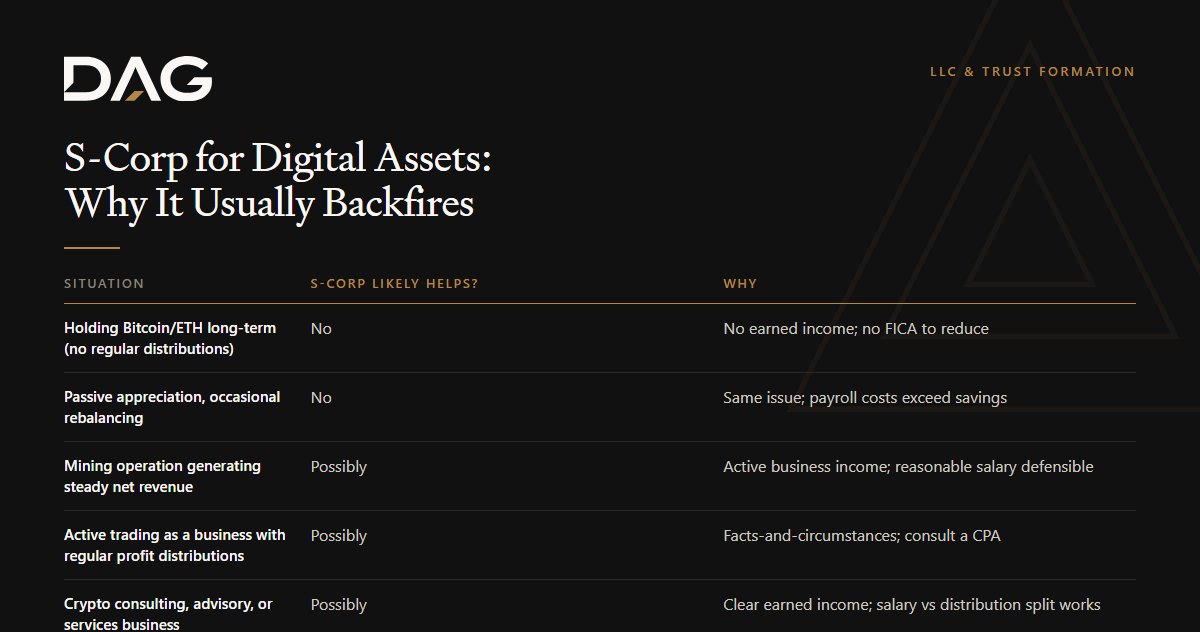
An S-corp for digital assets is usually a poor fit for a passive portfolio. S-corp tax savings come from reducing self-employment tax on earned income, but crypto appreciation is a capital gain, not wages. With no self-employment tax to cut, the election adds payroll, compliance, and shareholder-eligibility costs while delivering no offsetting benefit, a key tax-designation decision within crypto LLC formation.
What Is an S-Corp and Why Do People Elect It?
An S-corp (S-corporation) is a pass-through tax election available to eligible corporations and LLCs under IRC §1361. It allows owners to split business income between a W-2 salary and distributions. Only the salary portion is subject to self-employment (FICA) taxes; distributions are not. For an active service business with substantial profit, that split can produce meaningful FICA savings, but the size of any benefit depends entirely on the owner's facts and should be modeled with a CPA.
The election is made on IRS Form 2553 and takes effect for the current or following tax year, subject to filing deadlines.
That mechanism is the whole point. Remove earned income from the picture and the benefit disappears.
Why an S-Corp Usually Fails for Passive Crypto Holdings
The tax savings depend on earned income you may not have
Most digital asset holders are doing one thing: buying and holding. Appreciation sits unrealized until a sale, at which point it is taxed as a capital gain, not earned income, not wages, not subject to self-employment tax regardless of entity structure. There is no self-employment tax to reduce.
Electing S-corp status on a Wyoming LLC for crypto that holds Bitcoin in cold storage adds:
- Mandatory reasonable compensation. The IRS requires S-corp owner-employees performing services to pay themselves a salary that reflects comparable market rates (see IRS guidance on reasonable compensation and Rev. Rul. 74-44). Holding an asset is not a service; active management may be, depending on facts.
- Payroll overhead. Quarterly deposits, Forms 941, year-end W-2s, state unemployment filings. A payroll processor typically runs $1,500–$4,000 annually for a single-owner entity.
- Additional compliance. Separate S-corp tax return (Form 1120-S), stricter recordkeeping, corporate formalities.
- Shareholder restrictions. IRC §1361 limits S-corps to 100 shareholders, one class of stock, and eligible shareholders (U.S. citizens/residents; certain trusts; no partnerships, corporations, or nonresident aliens). This makes S-corp structures incompatible with many trust and multi-entity crypto wealth planning designs.
A built-in gains risk in conversions
One narrower trap: converting an existing C-corp to S-corp status can trigger the IRC §1374 built-in gains tax on pre-election appreciation. This rarely applies to a plain LLC holding crypto, but it can surface when restructuring existing entities, a reason to involve a CPA before any conversion.
Loss of step-up in basis at death
Assets held in an S-corp do not receive a step-up in income tax basis at the owner's death (IRC §1014 applies to assets owned directly or through certain trusts, not through S-corps). For crypto families building long-term wealth, this is a material cost that is easy to miss in a spreadsheet showing near-term FICA savings. See crypto estate planning for high-net-worth families for how basis step-up interacts with your overall structure.
When Does S-Corp Status Actually Make Sense for Digital Assets?
The S-corp structure fits a narrow set of fact patterns where real earned income exists and is large enough to offset the compliance burden.
| Situation | S-Corp Likely Helps? | Why |
|---|---|---|
| Holding Bitcoin/ETH long-term (no regular distributions) | No | No earned income; no FICA to reduce |
| Passive appreciation, occasional rebalancing | No | Same issue; payroll costs exceed savings |
| Mining operation generating steady net revenue | Possibly | Active business income; reasonable salary defensible |
| Active trading as a business with regular profit distributions | Possibly | Facts-and-circumstances; consult a CPA |
| Crypto consulting, advisory, or services business | Possibly | Clear earned income; salary vs distribution split works |
| Single-asset HODLer with no cash flow | No | Compliance cost with zero benefit |
A common rule of thumb (illustrative only): some CPAs suggest that unless an entity has a meaningful level of active, earned income, often cited in the rough range of $60,000–$100,000 or more per year, and the owner performs genuine services, compliance cost tends to exceed FICA savings. Treat that range as an illustrative planning heuristic, not a fixed threshold or guarantee; the right answer is entirely facts-and-circumstances. Have a CPA who works with digital assets model your own numbers before making any election.
How Does This Differ From a Disregarded Entity?
A single-member LLC taxed as a disregarded entity (the default) has no separate return, no payroll, no reasonable-compensation requirement, and no shareholder restrictions. Gains flow through on Schedule D (capital gains) or Schedule C/E depending on activity characterization.
For a passive holding entity, the disregarded-entity path is simpler, cheaper, and compatible with trust ownership. The closely related question, does the tax designation of your LLC matter (S-corp vs disregarded entity), addresses the broader election decision in detail, including what happens for entities with active operations. See crypto tax reporting for LLCs for how different elections affect your annual filing.
Related Questions
Can I elect S-corp status on my Wyoming LLC that holds crypto?
Yes, technically. A Wyoming LLC can elect S-corp taxation by filing Form 2553 if it meets IRC §1361 eligibility requirements. Whether you should is a different question, the answer depends on whether the LLC generates earned income you are distributing regularly. For passive holdings, the election creates compliance overhead with no offsetting tax reduction. Confirm eligibility and timing with a CPA before filing.
Does the IRS require a salary if I am only "monitoring" my crypto portfolio?
The IRS reasonable-compensation rule applies when an owner-employee performs services for an S-corp. Passive monitoring of a crypto wallet is unlikely to constitute services justifying a salary. The risk cuts in both directions: if you do no real work, you arguably should not take a salary at all, in which case all income flows as a distribution, and the entire point of the S-corp election is lost.
What happens if I already made an S-corp election and want to undo it?
S-corp elections can be revoked by filing a revocation statement with the IRS. The revocation is generally prospective. Once revoked, the entity typically cannot re-elect for five years without IRS consent. An attorney or CPA familiar with crypto tax planning for high-net-worth investors should review implications before you file a revocation, including any state-level tax consequences.
Does holding crypto in a trust change the S-corp analysis?
Yes, and usually in the wrong direction. Trusts are not eligible S-corp shareholders unless they qualify as a Qualified Subchapter S Trust (QSST) or Electing Small Business Trust (ESBT), both of which require specific language and ongoing elections. If you are using a trust to own a Wyoming LLC for crypto assets, an S-corp election on the LLC may break the trust's ability to hold the interest. This is a common structural trap.
Sources
- IRS, S Corporations, https://www.irs.gov/businesses/small-businesses-self-employed/s-corporations (reviewed 2025)
- IRS, About Form 2553, Election by a Small Business Corporation, https://www.irs.gov/forms-pubs/about-form-2553 (reviewed 2025)
- IRC §1361, S Corporation Defined, eligibility, shareholder restrictions, one-class-of-stock rule
- IRC §1374, Tax Imposed on Certain Built-In Gains, recognition period, applicable tax
- IRS Rev. Rul. 74-44, reasonable compensation for owner-employees of S-corps
- IRS Topic No. 409, Capital Gains and Losses, https://www.irs.gov/taxtopics/tc409 (reviewed 2025)
Compliance Note
This page is educational only and does not constitute legal, tax, or investment advice. Tax treatment of digital assets is an evolving area of law. Entity structure decisions, including S-corp elections and revocations, depend on individual facts and circumstances, including your income type, distribution patterns, and existing entity design. Consult a qualified CPA and attorney before making or changing any entity election.
DAG Wealth (Digital Ascension Group) provides wealth management coordination and education for digital asset holders. The SEC-registered investment adviser in this organization is DAG Wealth, this legal entity name reflects current registration status; a Form ADV amendment is pending. Registration does not imply a certain level of skill or training.