
Crypto estate planning for high-net-worth families is the work an owner does during life so digital assets can be identified, accessed, valued, reported, and transferred if that owner dies or becomes incapacitated. A complete plan solves two problems at once: legal authority (who is permitted to act) and technical access (how they actually reach the keys). General principles follow; specifics depend on your facts.
What Crypto Estate Planning Means
Crypto estate planning is the set of legal documents, ownership structures, and access procedures that let a named fiduciary take control of digital assets without guessing where they are or how to reach them. It differs from heir-side recovery: this is the owner's lifetime plan, built before anyone needs it. If your question is what beneficiaries inherit and how they receive assets, see crypto inheritance planning for high-net-worth families, which covers the receiving side. This page covers the structures you set up while you are alive and able to direct them.
What the Plan Should Include
A working plan generally addresses each of these, documented and kept current:
- Digital asset inventory, chains, tokens, and where each position sits.
- Wallet and custodian list, self-custody wallets plus any qualified custodian accounts.
- Ownership review, whether a trust, LLC, or trust-owned LLC holds the assets.
- Private key and recovery procedure, seed phrase storage, multi-sig roles, and cold storage location, kept separate from the inventory itself.
- Fiduciary authority, trustee or executor powers written to cover digital assets explicitly.
- Incapacity authority, a durable power of attorney or trustee succession that works if you are alive but unable to act.
- Tax records and cost basis support, acquisition dates and basis to support later reporting (the IRS generally treats digital assets as property, and broker reporting on Form 1099-DA is phasing in).
- Transfer and liquidation policy, who may move or sell, and under what conditions.
- Beneficiary communication plan, what heirs are told, and when.
A standalone access document can carry the operational detail; see what a digital asset letter of instruction is for how that piece fits without exposing secrets in the will itself.
Why Traditional Estate Plans May Be Incomplete
A traditional estate plan may name property in general but never explain how a fiduciary finds or reaches crypto. Without the keys, account access, or custody procedure, self-custodied assets can be effectively unrecoverable, there is no help desk to reset a lost seed phrase. This is why listing assets and storing access detail are kept as separate steps; see common crypto estate planning mistakes for the failure patterns that recur, and should crypto be listed in a will for why a public probate document is the wrong place for keys.
Trust and LLC Structures
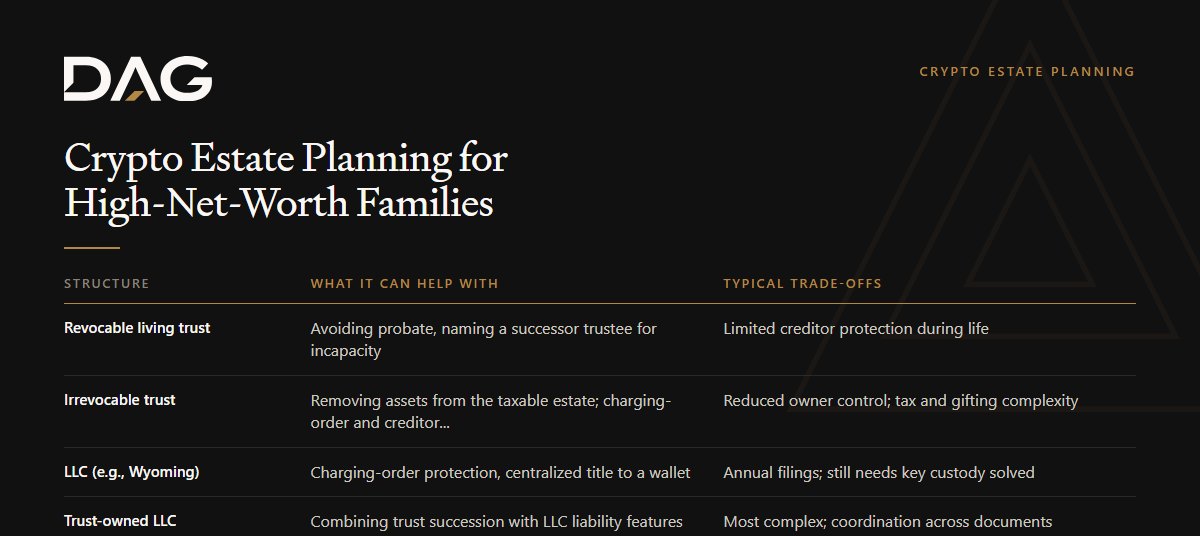
Some families hold digital assets through a revocable or irrevocable trust, an LLC, or a trust-owned LLC. The structures serve different goals, and none removes market, custody, or tax risk.
| Structure | What it can help with | Typical trade-offs |
|---|---|---|
| Revocable living trust | Avoiding probate, naming a successor trustee for incapacity | Limited creditor protection during life |
| Irrevocable trust | Removing assets from the taxable estate; charging-order and creditor considerations | Reduced owner control; tax and gifting complexity |
| LLC (e.g., Wyoming) | Charging-order protection, centralized title to a wallet | Annual filings; still needs key custody solved |
| Trust-owned LLC | Combining trust succession with LLC liability features | Most complex; coordination across documents |
Whether any of these fits depends on your estate planning goals, taxes, custody arrangements, fiduciary duties, and state law. Custody choice, self-custody, a qualified custodian, or multi-sig, sits alongside the legal wrapper; review the Digital Asset Custody Hub for how qualified custody, SOC 1 / SOC 2 reporting, and the SEC custody rule interact with these structures. Funding mechanics are covered in how to fund a trust with crypto. Consult qualified estate counsel and a tax professional before adopting any structure.
Related Questions
Does an LLC or trust remove the need to plan for private keys?
No. A legal wrapper assigns ownership and authority, but a fiduciary still needs the actual keys or custodian credentials to move assets. Key custody and the legal structure are separate problems, and both generally have to be solved.
Can a power of attorney cover crypto if I become incapacitated?
It can, but the document usually has to grant digital-asset authority explicitly, and a self-custody wallet still requires a workable key-access procedure. The right approach depends on your state law and facts; review it with qualified counsel.
Does working with a registered adviser guarantee my crypto plan is sound?
No. Registration with the SEC or a state reflects a regulatory status, not skill or a guarantee of outcome. It does not remove market, custody, or tax risk, and estate decisions should still be reviewed with qualified legal and tax professionals.
Sources
Compliance Note
This article is educational and does not provide legal, tax, fiduciary, investment, or custody advice. Estate planning should be reviewed with qualified estate counsel and tax professionals.