
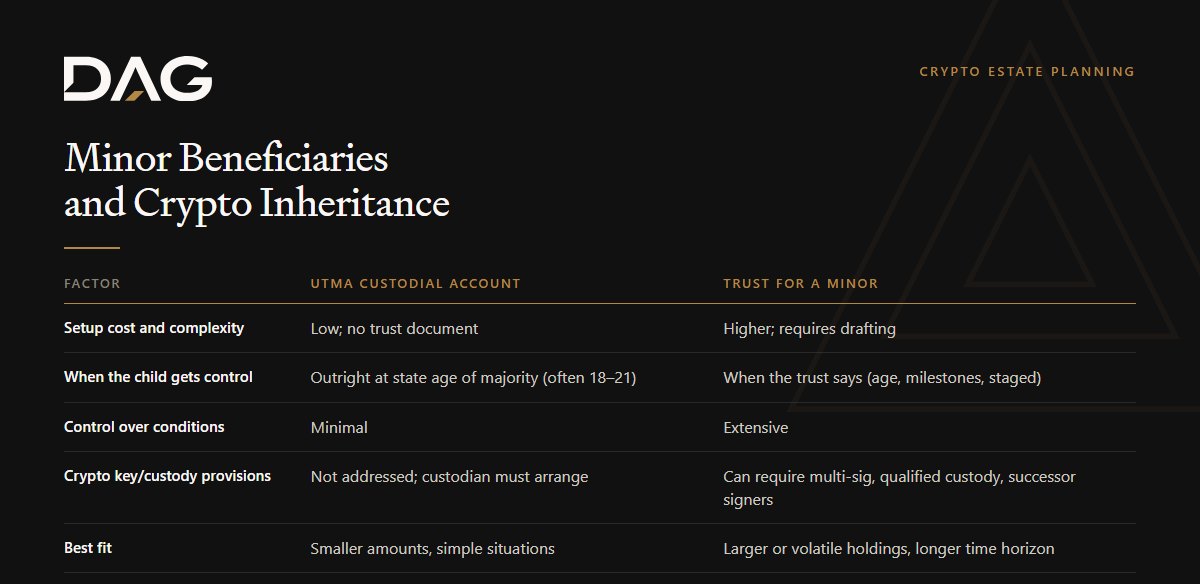
When a minor inherits crypto, they generally cannot take direct legal control of it, so the assets must pass through a structure that holds and manages them until the child is old enough. The two common vehicles are a UTMA custodial account, which is simple but hands full control to the child at the age of majority, and a trust for the minor, which costs more to set up but lets you control timing, conditions, and, critically for crypto, how the private keys are secured.
Why a Minor Cannot Just Inherit Crypto Directly
A minor generally lacks the legal capacity to own and manage significant property outright, and that is doubly true for crypto, where control means holding private keys. Leaving coins directly to a child usually forces a court to appoint a guardian or conservator, an expensive and public process. The estate plan should instead route the inheritance into a custodial account or a trust so a responsible adult controls the assets, and the keys, on the child's behalf. This sits alongside the broader basis and reporting issues in crypto inheritance and step-up in basis.
UTMA Custodial Accounts for Crypto
The Uniform Transfers to Minors Act (UTMA) lets an adult custodian hold property for a minor without a formal trust. It is simpler and cheaper than a trust, which is its main appeal. Two cautions apply to crypto. First, custody is still the hard part: the custodian must actually secure the keys, and not every platform supports a crypto-holding UTMA account, so practical custody often means a custodian-controlled wallet. Second, and most important, UTMA assets generally transfer to the child outright at the age of majority set by state law, often 18 or 21, with no strings. Handing a young adult full control of a volatile, irreversible asset is a real risk many families want to avoid.
Trusts for Minors
A trust for a minor gives up UTMA's simplicity in exchange for control. You can set the age or milestones at which the child gains access, spread distributions over years, name a trustee who manages the assets (and the key succession) responsibly, and add provisions specific to digital-asset custody. For crypto specifically, a trust can require multi-signature or qualified custody and document how the trustee controls the keys, something a bare custodial account does not address. The trade-offs between trust types and the mechanics of holding crypto in trust are covered in the crypto trust structures hub and how to fund a trust with crypto. Fit the choice into the overall plan via the crypto estate planning hub.
UTMA vs Trust for a Minor: Quick Comparison
| Factor | UTMA custodial account | Trust for a minor |
|---|---|---|
| Setup cost and complexity | Low; no trust document | Higher; requires drafting |
| When the child gets control | Outright at state age of majority (often 18–21) | When the trust says (age, milestones, staged) |
| Control over conditions | Minimal | Extensive |
| Crypto key/custody provisions | Not addressed; custodian must arrange | Can require multi-sig, qualified custody, successor signers |
| Best fit | Smaller amounts, simple situations | Larger or volatile holdings, longer time horizon |
Related Questions
Can I just name my minor child as the beneficiary of my crypto?
You can name them, but a minor generally cannot take direct control of the assets, so naming them without a structure can force a court-supervised guardianship. The better approach is to name a UTMA custodial account or a trust as the mechanism that holds the crypto for the child, so a responsible adult controls the assets and the keys until the child is ready.
At what age does a child get UTMA crypto?
It depends on state law, but UTMA assets generally pass to the beneficiary outright at the age of majority the state specifies, commonly 18 or 21. There is no ability to delay or condition that transfer under UTMA itself. Families who want control past that age usually use a trust instead.
Which is better for crypto, UTMA or a trust?
It depends on the amount, the child's age, and how much control you want. UTMA is simpler and cheaper but gives the child full control early and does not address key custody. A trust costs more but lets you set timing and conditions and build in crypto-specific custody provisions. Larger or more volatile holdings often favor a trust; review with a qualified estate attorney.
Sources
- Uniform Law Commission: Uniform Transfers to Minors Act, https://www.uniformlaws.org/committees/community-home?CommunityKey=4d2c0f6b-9ec3-4b6a-bb6a-9e1d6e2a0a3a
- IRS: Digital assets, https://www.irs.gov/filing/digital-assets
- IRS Topic No. 553, Tax on a child's investment income (Kiddie Tax), https://www.irs.gov/taxtopics/tc553
Compliance Note
This article is for general educational purposes and is not legal, tax, or custody advice. UTMA ages of majority, account availability, and tax treatment (including the kiddie tax) vary by state and by your facts. Trust and custodial-account drafting is the practice of law; Digital Ascension Group coordinates with qualified estate attorneys and tax professionals rather than drafting documents itself. Investment advisory services are provided through DAG Wealth. Review the choice between a UTMA account and a trust with qualified professionals before implementation. Registration does not imply a certain level of skill or training.