
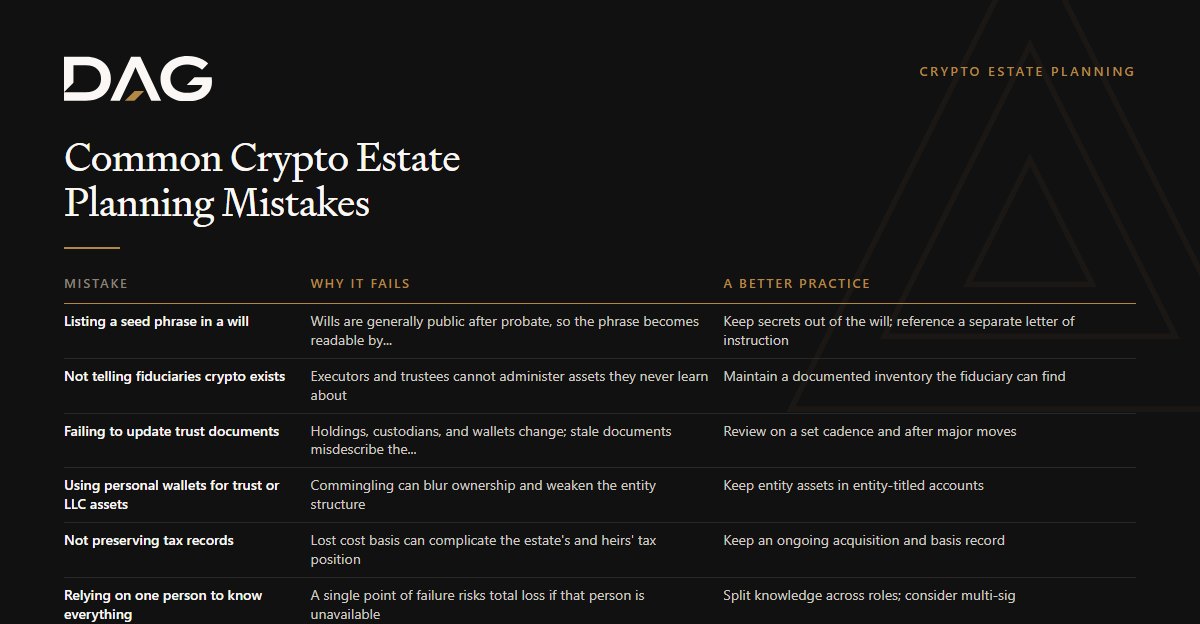
The most common crypto estate planning mistakes are failing to document what you hold, exposing seed phrases in places others can read, never telling fiduciaries the assets exist, mixing personal wallets with trust or entity assets, and leaving heirs legal authority but no secure way to actually reach the keys. Each gap can lock assets away permanently or expose them to theft.
Crypto estate planning is the work of making digital assets transferable on death or incapacity without making them stealable while you are alive. It depends on two layers that must agree: the legal documents (will, trust, powers of attorney) that say who inherits, and the operational instructions that let an authorized person locate and access the keys. A plan that has one layer but not the other tends to fail. For the wider context, see the Crypto Estate Planning hub.
Mistakes to Avoid
| Mistake | Why it fails | A better practice |
|---|---|---|
| Listing a seed phrase in a will | Wills are generally public after probate, so the phrase becomes readable by anyone | Keep secrets out of the will; reference a separate letter of instruction |
| Not telling fiduciaries crypto exists | Executors and trustees cannot administer assets they never learn about | Maintain a documented inventory the fiduciary can find |
| Failing to update trust documents | Holdings, custodians, and wallets change; stale documents misdescribe the estate | Review on a set cadence and after major moves |
| Using personal wallets for trust or LLC assets | Commingling can blur ownership and weaken the entity structure | Keep entity assets in entity-titled accounts |
| Not preserving tax records | Lost cost basis can complicate the estate's and heirs' tax position | Keep an ongoing acquisition and basis record |
| Relying on one person to know everything | A single point of failure risks total loss if that person is unavailable | Split knowledge across roles; consider multi-sig |
| Ignoring incapacity planning | Death is not the only trigger; incapacity can freeze access too | Address access under a durable power of attorney |
| Skipping custodian estate procedures | Each custodian or exchange has its own death-claim process | Review and document each provider's procedure in advance |
A Better Approach: An Evaluation Checklist
Use this checklist to pressure-test a plan. A plan that cannot answer each item generally has a gap.
- Inventory. Is there a current list of wallets, exchanges, and custodians, kept where a fiduciary can reach it?
- Access path. Can an authorized person locate keys without those keys sitting unprotected? A letter of instruction usually carries this.
- Document alignment. Do the will and any trust actually describe the crypto, and are they current?
- Entity hygiene. Are trust or LLC assets held in correctly titled accounts rather than personal wallets?
- Custody method. Is the storage approach (self-custody, multi-sig, or a qualified custodian) documented? See hardware wallet estate planning.
- Tax records. Is cost basis being preserved as you go, so the estate is not reconstructing it later?
- Incapacity. Does a durable power of attorney cover access if you are alive but unable to act?
- No single point of failure. Is critical knowledge split so no one person holds, or can lose, everything?
Why It Matters
Crypto can become permanently inaccessible when heirs hold clear legal authority but no technical path to the keys. It can also be stolen when access details sit too exposed. Estate planning for digital assets is the discipline of closing both gaps at once. Self-custody puts the access risk on your own process; using a qualified custodian shifts part of it but adds counterparty considerations and its own death-claim process. No structure removes market, custody, or tax risk, and registration of any adviser or custodian does not by itself guarantee skill or outcomes. These trade-offs are worth working through with an estate attorney familiar with crypto and a qualified tax professional.
Related Questions
What is the single most common crypto estate planning mistake?
There is no formal ranking, but the recurring failure is the access gap: heirs inherit the legal right to the assets but no secure, documented way to reach the keys. Closing it generally means pairing the legal documents with a separate, protected access instruction.
Should I put my seed phrase in my will?
Generally no. A will typically becomes a public record through probate, so a seed phrase written into it can be read by others. A common alternative is to keep secrets out of the will and point to a secured letter of instruction. Confirm the approach with a qualified estate attorney.
How do heirs actually access crypto after death?
It depends on how the assets are held. Self-custodied coins require the keys or seed phrase plus instructions, while assets at an exchange or custodian follow that provider's death-claim process. See how heirs access crypto after death for the general paths.
Does using a trust fix these mistakes on its own?
Not by itself. A trust can clarify ownership and succession, but it still needs to be funded correctly and paired with a working access plan; otherwise the same access and record gaps remain. Compare the structures in crypto will vs crypto trust.
Sources
Compliance Note
This article is educational and does not provide legal, tax, fiduciary, investment, security, or custody advice. Estate planning should be reviewed with qualified professionals.