
Seed phrase storage estate planning is the practice of recording and physically safeguarding a wallet's recovery words so heirs or fiduciaries can reach self-custodied crypto after death or incapacity, without exposing those words to theft, loss, fire, or public disclosure. It focuses on the mechanics of storage media, redundancy, and backup, generally coordinated with estate counsel.
A seed phrase is the ordered list of recovery words (commonly 12 or 24) that reconstructs a wallet's private keys. Anyone who holds it controls the assets; anyone who loses it generally loses access permanently. Because the words sit outside the banking and brokerage system, there is no custodian or help desk to reset, so storage decisions carry custody risk that no estate document can undo.
This page covers storage mechanics only. The separate question of who should be told the phrase, and how access authority is governed, belongs to who should know the seed phrase in an estate plan. For how storage fits a complete plan, see the Crypto Trust Structures Hub.
Storage Mechanics: The Core Decisions
How a recovery phrase is physically held usually matters more than where it is named in a document. Consider these mechanics:
- Durable media. Paper degrades and burns. Stamped or engraved metal backups resist fire, water, and corrosion, which is why many holders move long-term backups onto steel.
- Geographic redundancy. A single location is a single point of failure. Keeping more than one backup in separate places (for example a home safe and a bank safe deposit box) protects against fire, flood, and theft at any one site.
- Split storage (Shamir / SLIP-39). Schemes such as Shamir's Secret Sharing break the secret into shares where a defined threshold (say, 3 of 5) reconstructs it and no single share reveals anything. This removes the all-or-nothing weakness of one written phrase.
- Multi-signature setups. A multi-sig wallet requires several keys to move funds, so no one backup or one person is a complete point of compromise. It distributes both risk and recovery responsibility.
- Backup integrity. A backup nobody has test-verified may be wrong when it matters. The mechanics include confirming the words are legible, complete, and in order.
What Belongs in the Estate Document (and What Doesn't)
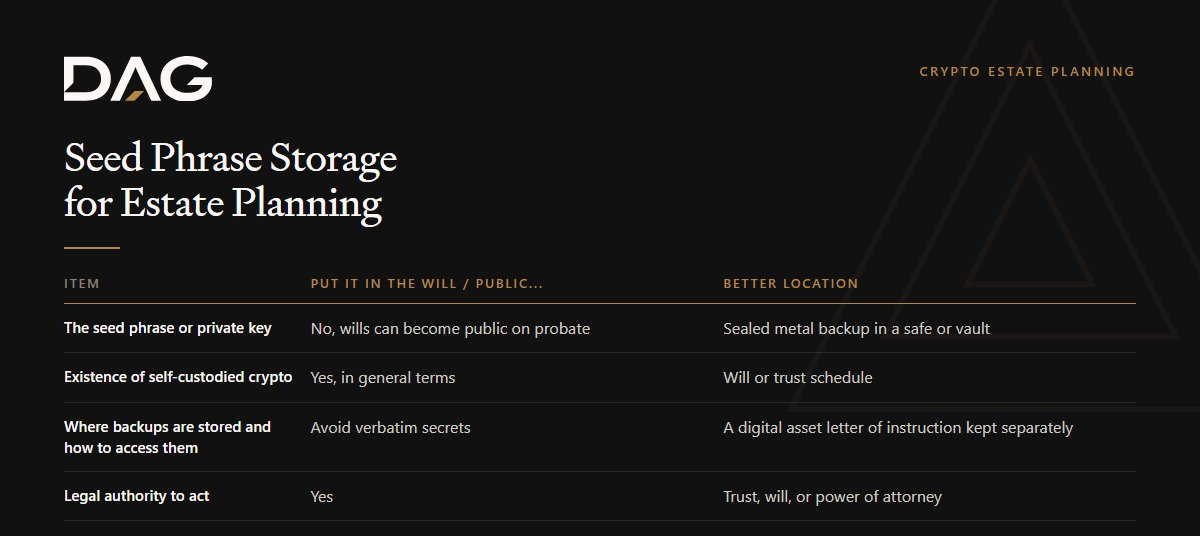
| Item | Put it in the will / public record? | Better location |
|---|---|---|
| The seed phrase or private key | No, wills can become public on probate | Sealed metal backup in a safe or vault |
| Existence of self-custodied crypto | Yes, in general terms | Will or trust schedule |
| Where backups are stored and how to access them | Avoid verbatim secrets | A digital asset letter of instruction kept separately |
| Legal authority to act | Yes | Trust, will, or power of attorney |
Separating legal authority (who is allowed to act) from technical access (the words themselves) is a recurring principle. A fiduciary can hold authority through a trust while the recovery material stays in a sealed, durable backup they do not read until needed.
A Storage Checklist
Use this to pressure-test a storage setup:
- Is the phrase on durable media (metal), not just paper?
- Is there geographic redundancy, at least two separated locations?
- Has each backup been verified word-for-word against the wallet?
- Are backups protected from fire, water, theft, and accidental discovery?
- Is a wallet inventory documented so a fiduciary can match each phrase to the wallet it controls?
- If using split or multi-sig storage, is the reconstruction threshold written down where the right people can find it?
- Does a separate instruction document point to the backups without printing the secret itself?
For the assets-and-documents side of this exercise, the digital asset estate planning checklist and crypto estate data room checklist cover what to inventory alongside the storage mechanics here.
Professional Coordination
Storage decisions sit at the intersection of estate law, tax, and operational security, so they should be reviewed with qualified professionals rather than handled in isolation. Estate counsel can align the storage approach with the governing documents; a custody or security professional can advise on media and split-storage mechanics. The shared goal is to prevent both permanent loss and unauthorized access. Specifics depend on the facts of each estate, and no storage method removes market, custody, or tax risk.
Related Questions
Should a seed phrase ever be written in a will?
Generally no. A will can become a public record during probate, so printing the recovery words there can expose the assets. The more common approach is to reference the existence of crypto and point to a sealed, separately stored backup. Confirm the right structure with estate counsel.
Is metal storage actually necessary for a seed phrase?
It depends on the holding period and value at stake. Paper is vulnerable to fire and water, so many long-term holders move backups onto stamped or engraved metal for durability. Metal does not protect against theft or discovery, so it is one layer among several, not a complete solution.
Does splitting a seed phrase make it safer?
Split-storage schemes such as Shamir's Secret Sharing can reduce single-point-of-failure risk because no one share reveals the secret and a defined threshold is needed to reconstruct it. They also add complexity, and a lost or misrecorded threshold can lock funds, so the mechanics should be documented and tested.
How many backup copies of a seed phrase should exist?
There is no universal number, but more than one backup in separate locations generally guards against fire, theft, and loss at any single site. The trade-off is that each additional copy is another thing to secure, which is part of why split and multi-sig setups exist.
Sources
Compliance Note
This article is educational and does not provide legal, tax, fiduciary, security, investment, or custody advice. Seed phrase storage plans should be reviewed with qualified professionals.