
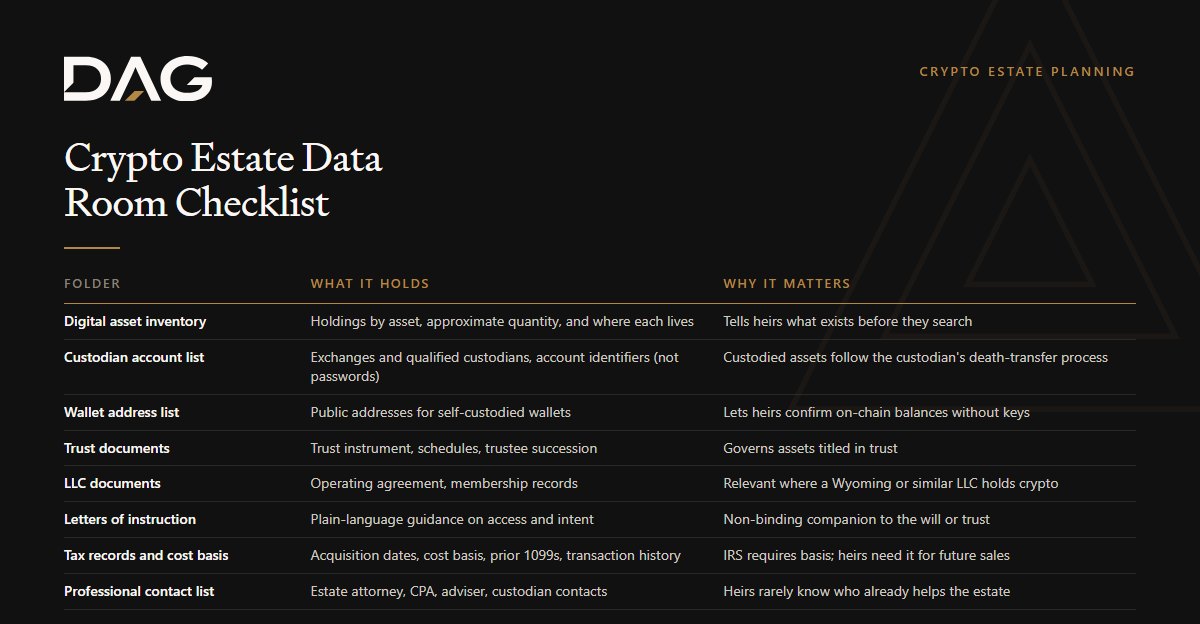
A crypto estate data room is an access-controlled set of documents mapping a holder's digital assets, ownership structure, and administration contacts so heirs, executors, and trustees can locate, value, and transfer those assets after death or incapacity. This checklist covers what to build and what to keep out.
What a Crypto Estate Data Room Is
A data room collects the map, not the keys to the vault. It tells fiduciaries what exists and who to call, without containing the seed phrases or private keys that would let anyone move funds unilaterally. The core challenge in crypto estate planning is that assets can be legally inherited yet practically unreachable: a will may name beneficiaries, but the plan still fails if nobody knows where the assets live, how accounts are titled, or how private keys are protected. A well-organized data room closes the gap between legal authority and operational access.
For the wider planning context, see Common Crypto Estate Planning Mistakes and the Crypto Estate Planning Playbook.
Step-by-Step: Building the Data Room
Work through these steps with qualified advisers; the right sequence depends on the facts of your estate.
- Inventory all holdings. List every wallet, exchange, custodian, and entity. Flag self-custodied wallets separately from qualified-custodian accounts, access procedures differ materially.
- Classify ownership. Identify which assets are personally owned, trust-owned, entity-owned, or account-based. Titling determines how each asset transfers at death.
- Confirm documents address digital assets. Verify that wills, trusts, and powers of attorney explicitly cover digital assets rather than relying on generic property language.
- Confirm fiduciary authority. Check that named fiduciaries hold legal authority to access and administer digital assets, including under applicable fiduciary-access statutes.
- Create secure access instructions separately. Document how heirs reach the assets without embedding seed phrases in the data room or in any document that could become public through probate. A digital asset letter of instruction is the standard vehicle.
- Coordinate trust and LLC agreements. Align trust instrument terms with any LLC operating agreement so the entity structure and the estate plan do not conflict. See How to Fund a Trust With Crypto.
- Document signing rules. Record multi-signature or MPC arrangements, including who holds each key share and the quorum required to transact.
- Compile tax and cost-basis records. Gather acquisition dates, cost basis, prior 1099s, and transaction history. The IRS treats digital assets as property; heirs may need basis data to report later dispositions.
- Confirm successor or beneficiary procedures. Check whether your custodian or exchange offers a formal successor or beneficiary process and complete any required forms.
- Review with qualified professionals. Have estate counsel, tax professionals, and custody providers verify the plan before relying on it.
Data Room Folder Structure
Organize the room so an executor or trustee can navigate it without guidance. Each folder below has a defined purpose.
| Folder | What it holds | Why it matters |
|---|---|---|
| Digital asset inventory | Holdings by asset, approximate quantity, and where each lives | Tells heirs what exists before they search |
| Custodian account list | Exchanges and qualified custodians, account identifiers (not passwords) | Custodied assets follow the custodian's death-transfer process |
| Wallet address list | Public addresses for self-custodied wallets | Lets heirs confirm on-chain balances without keys |
| Trust documents | Trust instrument, schedules, trustee succession | Governs assets titled in trust |
| LLC documents | Operating agreement, membership records | Relevant where a Wyoming or similar LLC holds crypto |
| Letters of instruction | Plain-language guidance on access and intent | Non-binding companion to the will or trust |
| Tax records and cost basis | Acquisition dates, cost basis, prior 1099s, transaction history | IRS requires basis; heirs need it for future sales |
| Professional contact list | Estate attorney, CPA, adviser, custodian contacts | Heirs rarely know who already helps the estate |
| Hardware wallet location notes | Where devices are stored (not the PIN or seed) | Helps heirs locate, not unlock, the device |
| Estate access procedure | Step-by-step of how access is intended to work | Connects the pieces without centralizing secrets |
| Insurance and custody documents | Custody agreements, SOC reports, any insurance terms | Clarifies what protections apply and their limits |
For deeper guidance on specific folders, see Hardware Wallet Estate Planning and Seed Phrase Storage for Estate Planning.
When a Crypto Estate Data Room Is Most Relevant
- Crypto represents a meaningful portion of net worth.
- Assets are held across multiple wallets, exchanges, or custodians.
- A spouse, child, trustee, or executor would not know where to start. See My Spouse Does Not Understand My Crypto.
- Existing legal documents do not mention digital assets.
- A trust or LLC owns or may inherit crypto.
When a Data Room Is Not Enough
A data room does not replace legal documents, secure custody procedures, or professional review. Use it to prepare for a real planning conversation, not as a substitute for one. No organized records system removes market, custody, or tax risk; it reduces only the chance that recoverable assets become unreachable.
Security Warning: What to Keep Out
Do not place seed phrases or raw private keys in the data room. Any person who reads the room would be able to move the funds. Sensitive access material belongs in a separate, secure process, split custody, a sealed instruction held by counsel, or a hardware-wallet plan. The data room should describe that such a process exists and how to initiate it, not contain the secret itself.
Related Questions
What goes in a crypto estate data room?
Generally: an asset inventory, custodian and wallet-address lists, trust and LLC documents, letters of instruction, tax and cost-basis records, and a professional contact list. Seed phrases and private keys are kept out and handled through a separate secure process. The appropriate contents depend on the facts of the estate.
Should seed phrases go in the data room?
No. Storing a seed phrase or private key alongside the inventory means whoever opens the room controls the assets. Keep secrets in a separate, dedicated secure process and reference its existence in the data room. Confirm the approach with qualified estate counsel and a security professional.
Who should have access to a crypto estate data room?
Typically the named executor or trustee, and often the estate attorney, with access scoped to their role. Some families stage access so the room opens only on death or incapacity. Coordinate access design with your attorney.
Should a trust own digital assets listed in the data room?
A trust may hold digital assets, but funding and custody must be coordinated, the trust instrument alone does not create practical access. See How to Fund a Trust With Crypto for the mechanics.
What happens if heirs cannot find the private keys?
Self-custodied crypto with no recoverable key access can be permanently lost regardless of what the will states. That is why the secure access procedure, documented separately and referenced in the data room, sits early in the checklist. See Can Heirs Recover Bitcoin Without a Seed Phrase? for what options may exist.
Who should review the completed plan?
Qualified estate counsel, tax professionals, custody providers, and any professional fiduciaries who may administer the assets. Registration or credentials alone do not guarantee a given outcome; the review should match the specific facts of the estate.
Sources
Compliance Note
This article is educational and does not provide legal, tax, fiduciary, security, investment, or custody advice. Digital assets carry market, custody, and tax risk, and no organizing method removes those risks. Estate data rooms and planning checklists should be reviewed with qualified professionals before being relied upon.