
If you die with crypto in a hardware wallet, the assets do not disappear, but no one can reach them until your heirs locate the device, recover its keys, prove legal authority, and follow clear instructions. A hardware wallet holds the private keys offline, so without the recovery seed and a plan, the crypto can become permanently inaccessible or exposed to theft.
A hardware wallet is a physical device that keeps the private keys controlling your crypto offline. It does not "contain" coins; it stores the cryptographic keys that authorize transactions on the blockchain. Whoever can unlock the device or restore its recovery seed controls the assets, which is exactly why an owner's plan, not the device alone, decides what your heirs inherit.
Why This Matters to You, the Owner
Your heirs cannot ask a customer-service line to reset a self-custodied wallet. There is no password recovery and no central institution to compel. If the only copy of the seed phrase dies with you, the assets are generally unrecoverable. The owner-facing question is therefore not "where is the device?" but "what will my heirs actually need, and can they get it without me in the room?" Planning ahead is the difference between a clean transfer and a stranded balance. If your heirs are the ones who have already found a device and need next steps, the operational walkthrough lives in what to do if heirs find a hardware wallet.
What Your Heirs Will Need
For your heirs or executor to administer a hardware wallet after your death, they generally need each of the following:
- Awareness the wallet exists, heirs cannot recover what they never knew about.
- The device location, where the hardware wallet is physically stored.
- A letter of instruction, plain-language steps separate from the will. See what is a digital asset letter of instruction.
- Recovery information, where the seed phrase (or its split shares) is stored, and how to reassemble it.
- Legal authority, an executor, trustee, or agent with documented authority to take control of the assets.
- Asset and address details, which coins and wallet addresses are in scope, so nothing is missed.
- Professional contacts, the attorney, tax adviser, or custodian who can help administer the estate.
How an Owner Can Prepare in Advance
- Inventory the holdings without exposing secrets, list the device, the assets, and the addresses, but not the seed phrase itself.
- Decide where recovery material lives, a sealed seed backup, a metal plate, or split shares held in separate secure locations.
- Write the letter of instruction, enough for a non-technical heir to act, stored where the right person can find it.
- Match the device to legal authority, confirm a will or trust gives a named fiduciary the power to take control. Compare structures in crypto will vs crypto trust.
- Review and update, re-check the plan when you change wallets, custodians, or beneficiaries.
What to Avoid
Do not place a seed phrase in a will, which generally becomes a public record through probate. Do not rely on a single person who knows the wallet but has no legal authority to act, and do not assume a relative will "figure it out." Splitting recovery material so no one person holds everything reduces theft risk, but it raises the chance heirs cannot reassemble it, balance the two deliberately. For broader pitfalls, see common crypto estate planning mistakes.
Device vs. Plan: Who Controls What
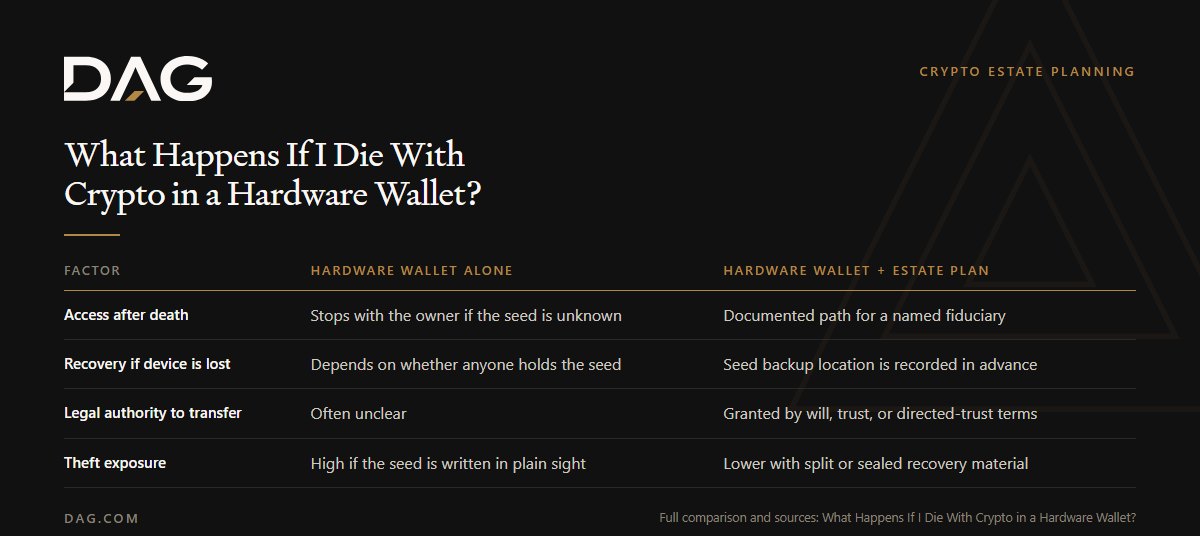
| Factor | Hardware wallet alone | Hardware wallet + estate plan |
|---|---|---|
| Access after death | Stops with the owner if the seed is unknown | Documented path for a named fiduciary |
| Recovery if device is lost | Depends on whether anyone holds the seed | Seed backup location is recorded in advance |
| Legal authority to transfer | Often unclear | Granted by will, trust, or directed-trust terms |
| Theft exposure | High if the seed is written in plain sight | Lower with split or sealed recovery material |
Related Questions
Does a hardware wallet pass to heirs automatically?
Not on its own. The device and its keys generally pass as part of your estate, but heirs still need the recovery seed and legal authority to take control. Whether assets transfer cleanly depends on the facts of your plan and applicable state law.
Can I just write my seed phrase in my will?
Generally no. A will often becomes public through probate, which would expose the seed to anyone who reads it. Most planning approaches keep recovery material out of public documents and reference it through a separate, secured instruction. Consult a qualified estate attorney.
What happens if no one knows the wallet exists?
If heirs never learn the device exists and no recovery copy survives you, the crypto is generally unrecoverable. There is no central administrator to restore self-custodied keys, which is why an inventory and instruction matter as much as the device itself.
Should the hardware wallet be owned by a trust?
It can be, depending on your goals. Holding crypto through a trust may help with continuity and probate avoidance, though it adds setup and administration. See how to fund a trust with crypto and discuss the trade-offs with a qualified professional.
This page is one piece of the broader Crypto Trust Structures Hub, which covers how estate and custody structures fit together.
Sources
Compliance Note
This article is educational and does not provide legal, tax, fiduciary, security, investment, or custody advice. Crypto assets carry market, custody, and tax risk; no estate plan removes those risks or guarantees that heirs can recover self-custodied assets. Hardware wallet estate planning should be reviewed with qualified professionals.