
Deciding who should know the seed phrase in an estate plan is a governance question, not a single name. In most cases no one should hold the raw phrase casually. Instead, define which roles, executor, trustee, trust protector, attorney, or custodian, get access, under what conditions, and through a secure process that preserves recovery without exposing assets prematurely.
A seed phrase (also called a recovery phrase) is the human-readable backup of the private keys that control a self-custodied crypto wallet. Anyone who reconstructs it can move the assets, regardless of what a will or trust says. That is why seed phrase access generally belongs inside a defined governance structure rather than with one trusted individual.
Define the Roles Before the Names
Estate governance works best when you separate legal authority from technical access. Several roles may touch a crypto estate, and each generally needs a different level of access:
- Executor / personal representative, holds legal authority to administer probate assets but does not necessarily need the live phrase; can act through instructions and custodial channels.
- Trustee, administers assets held in trust and may need a controlled path to access, not the raw words in a drawer.
- Trust protector, oversees the trustee and can hold an oversight or release role without custody of the phrase itself.
- Attorney, drafts the structure and may hold sealed instructions, but generally should not hold spendable keys.
- Qualified custodian, for assets moved off self-custody, a regulated custodian holds keys under the SEC custody framework, removing the single-phrase problem.
- Spouse or trusted family member, often the first responder; whether they should hold the phrase is its own decision, covered on Should My Spouse Know My Seed Phrase?.
This roles-first approach is part of broader crypto estate planning for high-net-worth families and connects to the wider Crypto Trust Structures Hub for how trustees and protectors are appointed.
Access Models: Who Sees What
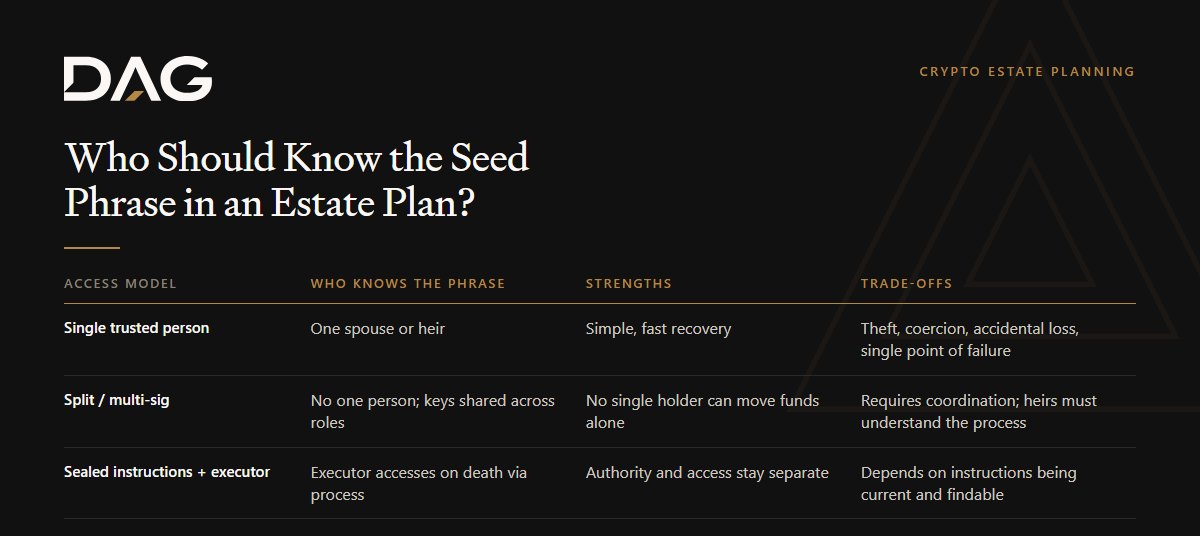
Different governance models distribute knowledge differently. None removes market, custody, or tax risk; each trades convenience against exposure.
| Access model | Who knows the phrase | Strengths | Trade-offs |
|---|---|---|---|
| Single trusted person | One spouse or heir | Simple, fast recovery | Theft, coercion, accidental loss, single point of failure |
| Split / multi-sig | No one person; keys shared across roles | No single holder can move funds alone | Requires coordination; heirs must understand the process |
| Sealed instructions + executor | Executor accesses on death via process | Authority and access stay separate | Depends on instructions being current and findable |
| Qualified custodian | Regulated custodian holds keys | Removes the lone-phrase problem; SOC reporting, named beneficiaries | Custody and counterparty considerations; not self-sovereign |
Registration of a custodian or adviser alone does not guarantee skill or outcomes, evaluate the structure on its facts, generally with a qualified professional.
How Fiduciaries Actually Get Access
A governance plan should answer, in writing, how each role moves from "named" to "able to act." A workable sequence generally looks like this:
- Inventory, record what wallets and keys exist and what each controls, without writing the phrase in plain text. A structured approach lives in the Crypto Estate Data Room Checklist.
- Separate authority from access, assign legal authority (executor, trustee) and technical access (the recovery path) deliberately, so no one role holds both unnecessarily.
- Store the recovery path securely, split storage, multi-sig, or custodian channels rather than a single copy; mechanics are covered in Seed Phrase Storage for Estate Planning.
- Document the trigger, define what event (death, incapacity) releases access and who confirms it.
- Tell the fiduciary what the phrase controls, a role that can access keys but does not know what they hold cannot administer the estate.
Risks of Sharing Too Broadly
A seed phrase grants control over self-custodied crypto. Spreading it across too many people generally increases the chance of theft, coercion, accidental loss, confusion, or family disputes. Sharing it with no one creates the opposite risk: permanent loss when no heir can recover the assets. Governance is the balance between those failures, and getting it wrong is among the common crypto estate planning mistakes.
Safer Planning Questions
- Is self-custody still appropriate, or should some assets move to a qualified custodian?
- Can legal authority and technical access be separated across roles?
- Where are instructions stored, and who can find them?
- How will the fiduciary know what the phrase controls?
- What event triggers access, and who verifies it?
Related Questions
Should the executor know the seed phrase?
Generally the executor needs legal authority to administer the estate, not necessarily the raw phrase. Many plans give the executor a documented process to reach access, sealed instructions, a custodian channel, or a multi-sig role, rather than spendable keys held outright. The right design depends on the facts; confirm it with a qualified professional.
Can a seed phrase be kept out of a will?
Yes, and it generally should be. A will can become a public probate record, so listing a recovery phrase there can expose it. Plans typically reference a separate, secure access process instead of the words themselves. See the discussion in Should Crypto Be Listed in a Will?.
What happens if no one knows the seed phrase?
If no one can reconstruct the phrase and no recovery path exists, the assets are generally unrecoverable, keys are not reset like a password. That is why governance assigns access to defined roles in advance rather than hoping an heir finds the words.
Sources
Compliance Note
This article is educational and does not provide legal, tax, fiduciary, investment, security, or custody advice. Seed phrase access plans should be reviewed with qualified professionals.