
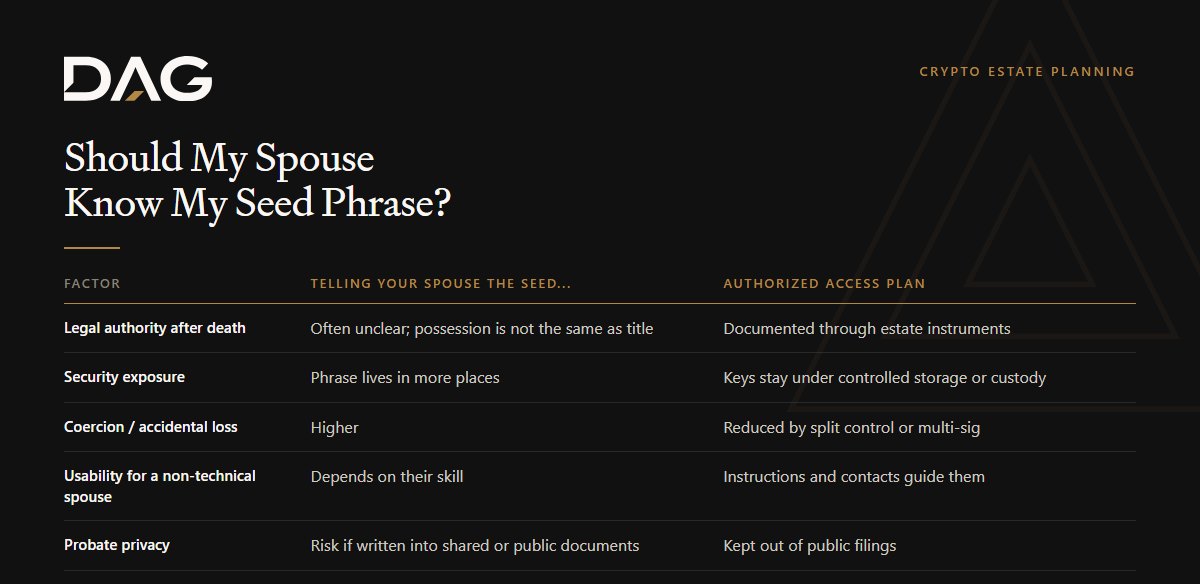
Whether your spouse should know your seed phrase depends less on the phrase itself than on building a legally authorized, secure path to your crypto if you die or become incapacitated. Handing over a seed phrase without context can create theft, loss, coercion, and estate-administration risks. A safer plan usually combines legal authority, secure instructions, custody design, and professional review.
What a Seed Phrase Is
A seed phrase (recovery phrase) is the ordered list of words that regenerates the private keys controlling a self-custodied wallet. Anyone who holds it controls the assets, with no bank, custodian, or reset process to reverse a mistake. That property makes it the single most sensitive item in a self-custody crypto estate plan, and the reason "just tell my spouse" is rarely the full answer.
Why This Matters
Many crypto holders are the only person in the household who understands where the wallets are and how they work. That concentration is itself a family risk. Solving it by handing over a seed phrase without instructions can trade one risk for another: a spouse who does not know how to use it, stores it insecurely, or accidentally exposes it. The goal is durable, authorized access, not raw key disclosure. These tradeoffs are common crypto estate planning mistakes worth reviewing early.
How to Give a Spouse Access Without Just Sharing the Phrase
A safer plan generally layers several of these elements:
- Estate documents that authorize a spouse, trustee, or fiduciary to act on digital assets.
- A digital asset letter of instruction that explains what exists and where, without exposing live keys.
- Secure, access-controlled storage of recovery materials (for example, split or sealed storage rather than a shared note).
- A custody design choice, multi-signature or a qualified custodian, that removes single-person, single-key failure.
- A clear inventory of accounts, wallets, and exchanges.
- Trusted professional contacts (attorney, adviser, tax professional).
- Periodic review and a tested recovery walkthrough.
Sharing the Phrase Directly vs. an Authorized Access Plan
| Factor | Telling your spouse the seed phrase | Authorized access plan |
|---|---|---|
| Legal authority after death | Often unclear; possession is not the same as title | Documented through estate instruments |
| Security exposure | Phrase lives in more places | Keys stay under controlled storage or custody |
| Coercion / accidental loss | Higher | Reduced by split control or multi-sig |
| Usability for a non-technical spouse | Depends on their skill | Instructions and contacts guide them |
| Probate privacy | Risk if written into shared or public documents | Kept out of public filings |
This comparison is general; the right balance depends on your wallet type and family circumstances.
Evidence Standard
This article does not use a family story or anecdote. Any example should be cited or labeled hypothetical.
When It May Help
- Your spouse does not know where crypto is held.
- You self-custody meaningful assets.
- Estate documents do not mention digital assets.
- You want access continuity without unsafe key sharing.
For deeper coordination on this, see guidance for when your spouse does not understand your crypto and on who should know the seed phrase in an estate plan.
When It May Not Be Enough
The right solution depends on wallet type, custody model, marriage and property laws, your estate plan, and family circumstances. Sharing access does not remove market, custody, or tax risk, and no arrangement guarantees that funds can be recovered if records are lost. These structures connect to the broader Crypto Wealth Management Hub; work them through with a qualified professional.
Related Questions
Should a seed phrase be in a will?
Generally no. A will can become a public record in probate, so writing a live seed phrase into it can expose the keys. A will can instead point to where secure instructions are kept.
Should my spouse know where instructions are kept?
Often yes. Knowing how to locate a sealed, access-controlled set of instructions is usually safer than memorizing or storing the raw seed phrase, though the right setup depends on your custody model.
Can a custodian help?
A qualified custodian can provide account-recovery and successor processes, which can reduce single-key risk. Custody alone is not a complete plan; it still needs estate documents and successor authorization. Registration or custody arrangements do not by themselves guarantee any outcome.
Bottom Line
Your spouse needs a documented path, not necessarily the raw seed phrase. Good crypto estate planning preserves authorized access without creating new security risks, and the details should be confirmed with qualified legal, tax, and security professionals.
Sources
Compliance Note
This article is for general educational purposes and is not legal, tax, custody, or security advice.