
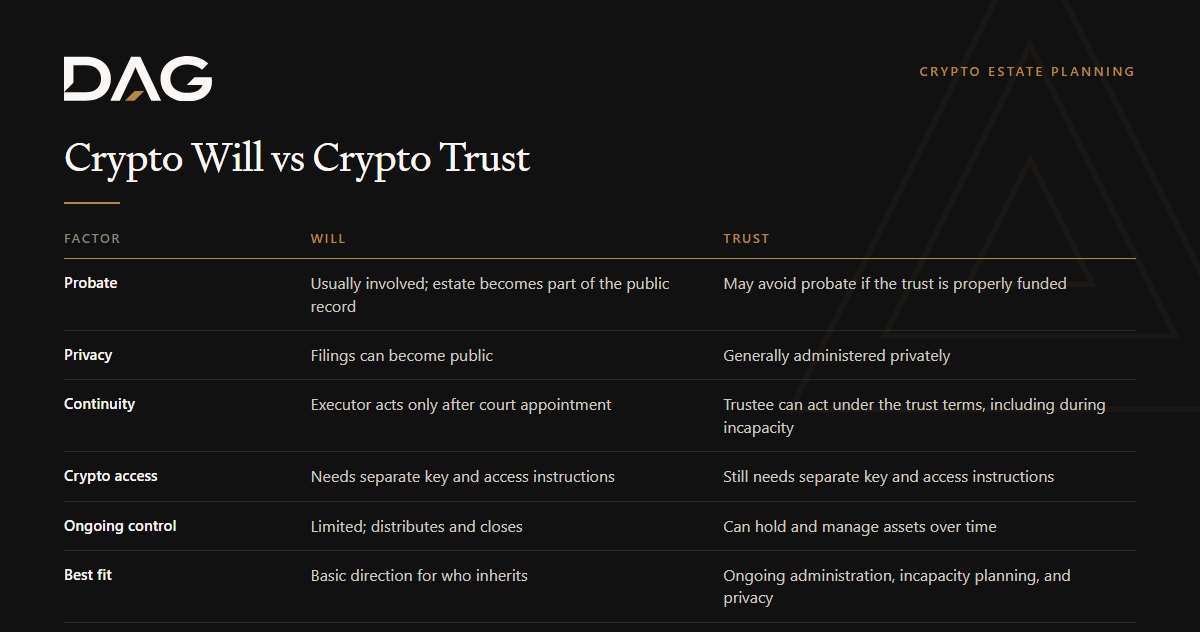
In the crypto will vs crypto trust comparison, a will directs who inherits your digital assets but usually passes through public probate, while a properly funded trust can avoid probate and add privacy and continuity. Neither tool, on its own, gives a fiduciary the keys or access instructions needed to actually move the crypto, so both require separate secure access planning.
What These Terms Mean
A will is a probate document that states who receives your property after death; a court typically appoints an executor and supervises distribution on the public record. A revocable living trust is a private arrangement you fund during life, where a trustee holds and administers assets under the trust's terms, often without court involvement. For digital assets, the choice between them sits inside the broader discipline of crypto estate planning, which most families coordinate under a crypto wealth management plan.
Why This Matters
Crypto inheritance is not only about who receives the asset. It is about whether the fiduciary can find, access, value, and transfer it. A will can create legal direction and still leave operational gaps, because a private key or seed phrase is what actually controls self-custodied coins. This is why the crypto will vs crypto trust decision should be paired with an access plan, not treated as the whole plan.
How They Compare
| Factor | Will | Trust |
|---|---|---|
| Probate | Usually involved; estate becomes part of the public record | May avoid probate if the trust is properly funded |
| Privacy | Filings can become public | Generally administered privately |
| Continuity | Executor acts only after court appointment | Trustee can act under the trust terms, including during incapacity |
| Crypto access | Needs separate key and access instructions | Still needs separate key and access instructions |
| Ongoing control | Limited; distributes and closes | Can hold and manage assets over time |
| Best fit | Basic direction for who inherits | Ongoing administration, incapacity planning, and privacy |
A trust does not transfer crypto by itself. It has to be funded, the wallets, accounts, or entity interests must actually be retitled into or controlled by the trust. The mechanics of that step are covered in how to fund a trust with crypto, and some families add a Wyoming LLC owned by the trust for charging-order protection and cleaner administration.
Evidence Standard
This article compares planning tools and does not recommend a specific estate plan.
When a Trust May Help
- You own meaningful crypto and want to keep the estate off the public record.
- A spouse or trustee needs continuity, including if you become incapacitated.
- Assets are spread across wallets, qualified custodians, LLCs, or existing trusts.
- You want assets managed over time rather than distributed and closed.
When Neither Is Enough
Neither a will nor a trust can recover a lost private key or seed phrase. If the keys are gone, the legal document points to an asset no one can reach. Both approaches depend on a separate, secure plan for how heirs locate and use the access material, see seed phrase storage for estate planning. A will or trust also carries no protection against market, custody, or tax risk; the value of inherited crypto can rise or fall, and digital assets are generally treated as property for U.S. tax purposes.
Related Questions
Does a trust avoid probate for crypto?
It generally can, but only if the trust is properly funded, meaning the wallets, custody accounts, or entity interests are actually titled into or controlled by the trust before death. An unfunded trust does not avoid probate. The specifics depend on your facts and state law, so confirm with a qualified estate attorney.
Should seed phrases or private keys go in a will or trust?
Usually no. A will can become a public record through probate, and even a trust document is shared among parties you may not want holding live keys. Sensitive key material is generally better handled through separate, secured access instructions, such as a digital asset letter of instruction, rather than written into the estate document itself.
Can a will transfer self-custodied crypto?
A will can direct who inherits self-custodied crypto, but legal direction is not the same as practical access. Without the private keys and clear instructions, the executor cannot move the coins. That is why access planning is generally treated as a separate, essential layer on top of either document.
Bottom Line
A trust often offers more continuity and privacy than a will for crypto, especially across incapacity and ongoing administration, while a will can still provide basic inheritance direction. Either way, digital asset access has to be engineered separately, and the right structure depends on your facts, work with a qualified estate and tax professional before deciding.
Sources
Compliance Note
This article is for general educational purposes and is not legal, tax, custody, or investment advice.