
If your spouse does not understand your crypto, the answer is generally not to hand over seed phrases. The better goal is a secure, legally authorized access process that works if you die or become incapacitated: a path your spouse can follow with professional support, rather than a pile of secrets they must decode alone under stress.
A "spouse access path" is the documented sequence of records, contacts, and authority that lets a surviving or caretaking spouse locate digital assets and begin a controlled recovery without you present. It is not the same as sharing private keys. The aim is informed access through proper legal channels, not raw credential transfer that creates a single point of failure or a security risk while you are still alive.
What Your Spouse Should Know
Your spouse does not need to become a crypto expert. They need enough to act, and to know who to call. A practical baseline includes:
- That crypto exists, and roughly what categories you hold (for example, exchange-held assets versus self-custodied wallets).
- Where general records live, without storing the secrets themselves in the same place.
- Who the professional contacts are: your adviser, estate attorney, and any qualified custodian holding assets.
- Whether assets are held personally, in a trust, or in an LLC, since the recovery path differs for each.
- What not to share publicly, including the existence of large holdings.
- How to start the access process, and which document explains the first step.
What to Avoid
Avoid placing seed phrases in a will (a will generally becomes a public court record once probated), texting or emailing private keys, or relying on a spouse to interpret wallet instructions without support. A few specific traps:
- Putting recovery phrases in any document that can be read by third parties.
- Assuming a spouse can "figure it out" from a hardware wallet they have never used. If they find a device, what heirs should do with a hardware wallet is its own careful process.
- Storing the only copy of access information in a single location with no backup.
Better Planning Tools
The goal is structure, not secrecy. A workable plan usually combines several of these:
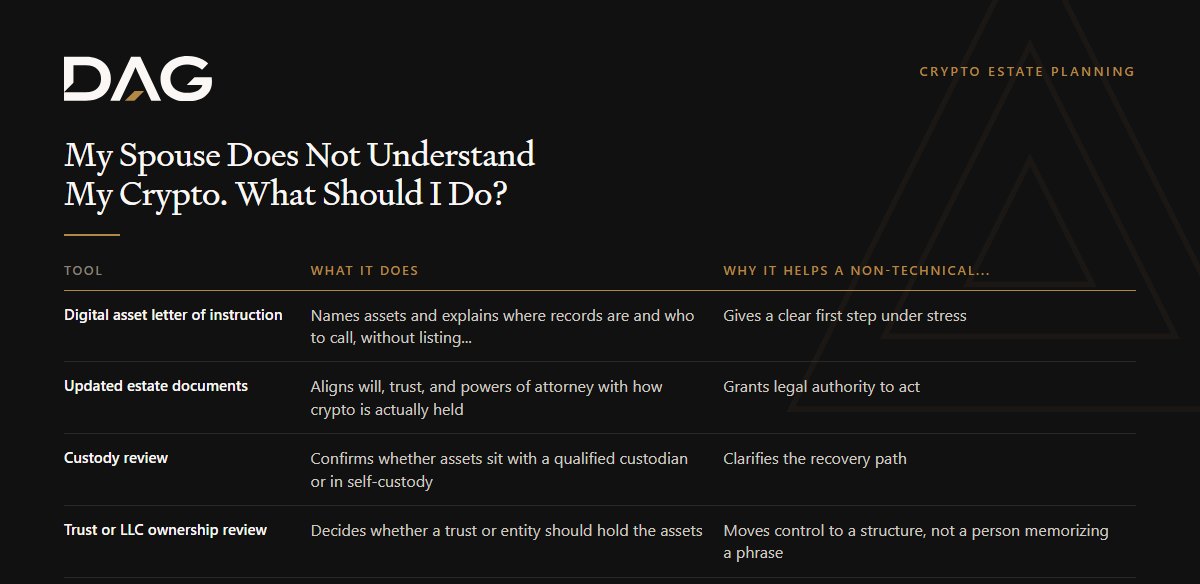
| Tool | What it does | Why it helps a non-technical spouse |
|---|---|---|
| Digital asset letter of instruction | Names assets and explains where records are and who to call, without listing secrets | Gives a clear first step under stress |
| Updated estate documents | Aligns will, trust, and powers of attorney with how crypto is actually held | Grants legal authority to act |
| Custody review | Confirms whether assets sit with a qualified custodian or in self-custody | Clarifies the recovery path |
| Trust or LLC ownership review | Decides whether a trust or entity should hold the assets | Moves control to a structure, not a person memorizing a phrase |
| Named professional contact | A single adviser or attorney the spouse can call first | Replaces panic with a phone number |
A digital asset letter of instruction is often the cornerstone document, because it tells a non-technical spouse where to start without exposing keys. Deciding between leaving instructions in a will versus a crypto will versus a crypto trust is a separate question worth reviewing with counsel. For broader context, see the Crypto Estate Planning Hub.
None of these tools removes market, custody, or tax risk, and registration of an adviser does not by itself guarantee skill or results. The point is to reduce the chance that a non-technical spouse is left with assets they cannot legally or practically reach.
Related Questions
Should my spouse know my seed phrase?
Not necessarily, and often not the full phrase by itself. A spouse generally needs a documented path to authorized access and the right professional contacts more than they need raw secrets, which create a single point of failure. The specifics depend on your custody setup and should be reviewed with a qualified professional.
What happens to my crypto if my spouse cannot access it?
Self-custodied assets with no recoverable key can become permanently inaccessible, while exchange-held assets generally pass through the platform's estate process. Outcomes depend on how assets are held, what documentation exists, and applicable state law, so confirm the facts with an estate attorney.
Does a will protect my spouse's access to crypto?
A will can direct who inherits, but listing seed phrases in it is risky because a probated will generally becomes a public record. Many families use a trust plus a separate letter of instruction instead. The right structure depends on your situation and should be set up with qualified counsel.
Sources
Compliance Note
This article is educational and does not provide legal, tax, fiduciary, investment, security, or custody advice. Spousal estate access planning should be reviewed with qualified professionals.