
When you die, your crypto generally becomes part of your estate unless it already sits in a trust, entity, or beneficiary arrangement. But what happens to crypto when you die depends as much on access as on ownership: heirs may hold legal rights yet still be unable to locate the wallet or reach the keys.
What "Crypto in an Estate" Means
A crypto holding in an estate is any digital asset, coins, tokens, NFTs, that passes to heirs or fiduciaries at death. Where it lives shapes how it transfers: self-custodied wallets controlled by a private key or seed phrase, accounts at an exchange or qualified custodian, or assets held inside a trust or LLC. Each path carries different access, probate, and reporting consequences.
Why Access Is the Real Problem
Standard estate assets sit in institutions that respond to court orders. Crypto does not always work that way. A brokerage account can usually be found through statements and transferred through established procedures. A self-custodied wallet may have no statements, no customer service desk, and no password reset. If a family cannot find the wallet, prove ownership, or access the signing credentials, the asset may be practically unreachable even when the documents say who should inherit it.
Good planning coordinates two layers: the documents that say who receives the asset, and the secure operational instructions that let a fiduciary actually reach it. Skipping either layer is one of the common crypto estate planning mistakes that leaves heirs locked out.
What Happens If You Have No Will
Dying without a will, called dying intestate, triggers state intestacy laws that distribute your estate according to a statutory formula rather than your intent. Courts typically prioritize spouses and children; if neither exists, assets may pass to parents or more distant relatives. This is the legal answer.
The practical answer is worse. Your heirs may have legal rights to your Bitcoin and still not be able to access it. Courts cannot compel a blockchain to release assets. If no one has your seed phrase or hardware wallet access, that crypto stays locked regardless of what any probate order says. Blockchain does not recognize court jurisdiction over private keys.
Intestate estates also move slowly. Probate takes six months at minimum, often longer for contested situations or complex asset mixes. During that period your crypto sits frozen. Markets move. Your heirs may watch a position rise or fall while waiting for judicial permission they may not even be able to act on once it arrives.
Even when keys are found, your heirs face a tax reconstruction problem. Without documentation showing acquisition dates and prices, cost basis becomes guesswork, and the IRS may challenge it. Heirs accessing wallets before probate closes are technically moving estate assets without court approval.
How the Transfer Process Works
- The estate plan identifies digital assets and the legal structure holding them.
- The fiduciary, trustee, or successor manager receives authority under the documents.
- Access instructions explain where assets are held, typically through a separate digital asset letter of instruction, without exposing private keys in an unsafe way.
- The fiduciary coordinates with custodians, exchanges, counsel, tax professionals, and beneficiaries.
- The estate or trust values assets, reports transactions (the IRS treats digital assets as property, and dispositions are generally reportable), and transfers ownership as directed.
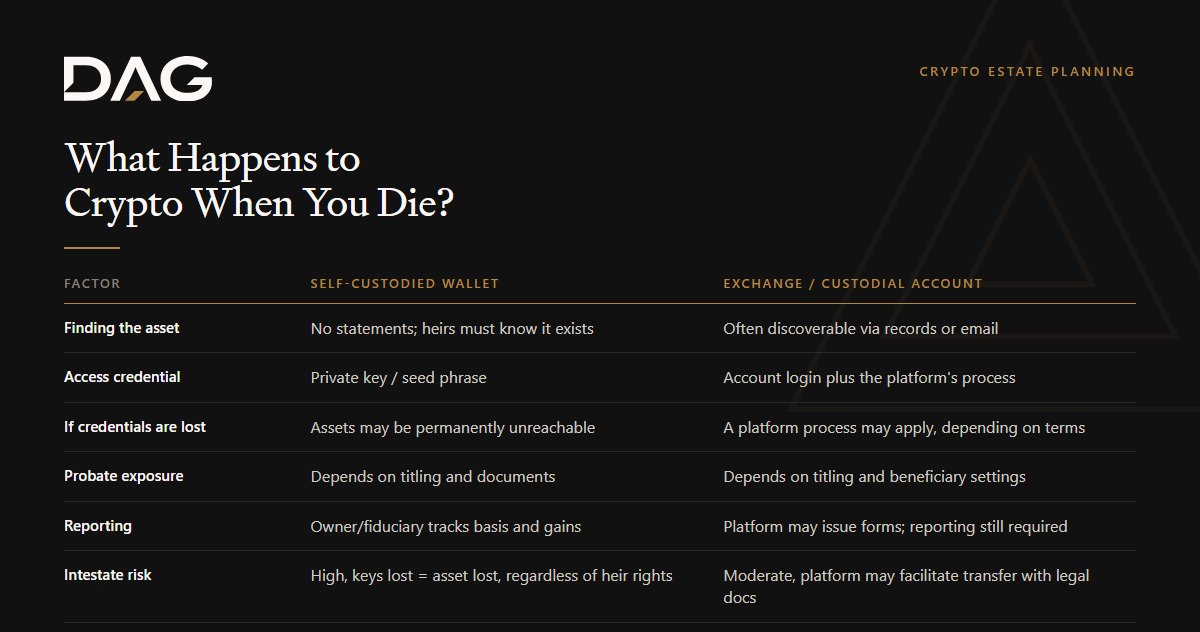
Self-Custody vs. Custodial: How Access Differs at Death
| Factor | Self-custodied wallet | Exchange / custodial account |
|---|---|---|
| Finding the asset | No statements; heirs must know it exists | Often discoverable via records or email |
| Access credential | Private key / seed phrase | Account login plus the platform's process |
| If credentials are lost | Assets may be permanently unreachable | A platform process may apply, depending on terms |
| Probate exposure | Depends on titling and documents | Depends on titling and beneficiary settings |
| Reporting | Owner/fiduciary tracks basis and gains | Platform may issue forms; reporting still required |
| Intestate risk | High, keys lost = asset lost, regardless of heir rights | Moderate, platform may facilitate transfer with legal docs |
Neither path removes market, custody, or tax risk. Many families address discoverability and probate by using a trust, see crypto will vs crypto trust and how to fund a trust with crypto.
What Structures Help Avoid These Problems
Revocable living trust. You assign wallets and accounts to the trust during your life, name a successor trustee, and document access procedures. When you die, the successor generally steps into control based on the trust document, without the court approval and probate delay that otherwise apply. Crypto held in the trust generally avoids probate because it is trust property, though the trust must still be properly drafted, funded, and administered.
Trust-owned LLC. Cryptocurrency held inside an LLC does not pass through probate if the LLC membership interest is titled into a living trust. The successor trustee takes over the entity at death, preserving operating continuity and avoiding the statutory intestacy formulas.
Either structure requires the legal authority and documented operational procedures for access, not just documents that say who should inherit, but instructions that actually let a fiduciary reach the asset. See should crypto be held personally, in an LLC, or in a trust for a structured comparison.
When This Planning Is Most Relevant
- You hold crypto in self-custody.
- Your spouse or heirs do not know how to access wallets.
- Your estate documents do not mention digital assets.
- You hold assets across exchanges, custodians, wallets, and entities.
- Your position is large enough that probate, privacy, and valuation matter.
- You have no will, or your current will predates your crypto holdings.
What Not to Do
Listing wallet addresses in a will can create privacy and security problems. Placing seed phrases directly in estate documents is risky because court filings may become public or accessible to parties who should not control the assets. And doing nothing, relying on intestacy laws that were not written with bearer assets in mind, leaves heirs exposed on both the legal and technical fronts.
The plan needs both legal authority and secure operational instructions, reviewed by estate, tax, and custody professionals who understand how these layers interact.
Related Questions
Can a trust help with crypto inheritance?
A trust may help avoid probate and create continuity of control, but it must be drafted and administered carefully. It still needs practical access procedures and does not by itself remove custody or market risk. The value is in bypassing the probate timeline and giving your successor trustee immediate operating authority.
Should private keys go in a will?
Generally, no. A will may become part of the public probate record, so private keys placed in it could be exposed to anyone with access to court filings. Key storage and access usually belong in a secure method designed with counsel, often a separate letter of instruction referenced by but not filed with the will. See seed phrase storage for estate planning.
What if no one can access the wallet?
If no one can reach the private keys or custody account, legal ownership may not be enough to recover the assets. Courts can grant rights; they cannot override cryptographic access controls. This is why succession planning must address access, not just inheritance. See can heirs recover Bitcoin without a seed phrase.
Does naming a beneficiary cover self-custodied crypto?
Not on its own. A beneficiary designation may direct an exchange account, but self-custodied wallets generally pass under your will or trust and still require someone who can locate and access the keys. A designation without access procedures solves half the problem.
What happens to crypto if you die intestate, without a will?
Your crypto becomes subject to state intestacy formulas, which distribute it according to a statutory hierarchy regardless of your intent. Courts appoint an administrator, inventory assets, pay debts, and distribute what remains. For self-custodied crypto, the practical problem is worse: legal rights to the asset do not help heirs who do not have the keys. A trust or properly documented succession plan is designed to address this scenario before it arises.
What tax problems does dying without a will create for crypto heirs?
Heirs need to establish cost basis for any crypto they inherit to report gains and losses correctly. Without acquisition records, basis becomes unknown, and the IRS may treat that as zero basis, maximizing taxable gain. Heirs may also lack clear legal authority to move assets before probate closes, creating a compliance gap. Documented records and a clear estate structure reduce both risks.
What if I find crypto on a hardware wallet belonging to a deceased person?
As an heir or executor, you should avoid moving assets before you have legal authority to do so. Secure the device, document what you find, engage estate counsel, and then follow the probate or trust process. See what to do if heirs find a hardware wallet and I am an executor and found crypto. What do I do?.
Sources
Compliance Note
This article is for general educational purposes and is not legal, tax, or investment advice. Estate outcomes depend on documents, custody arrangements, jurisdiction, family facts, and applicable law. Consult qualified estate, tax, and custody professionals before acting.