
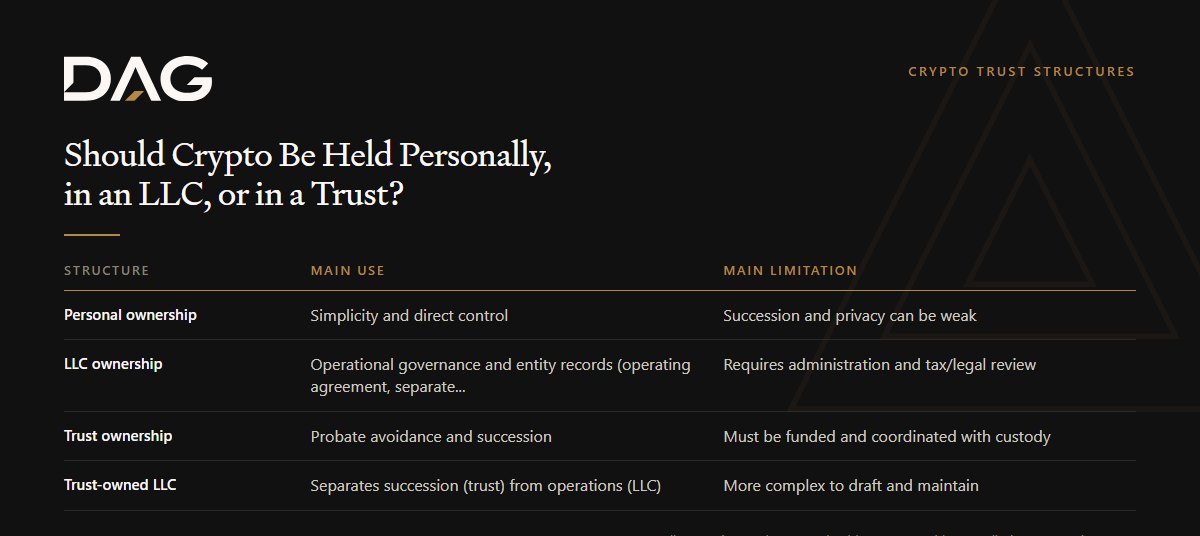
Whether crypto should be held personally, in an LLC, or in a trust depends on the holder's goals: personal ownership is simple but weak on succession and privacy, an LLC adds operational governance and entity records, and a trust supports probate avoidance and inheritance. A trust-owned LLC can combine both. The right answer depends on your facts and legal advice.
What Each Ownership Structure Means
"Personal ownership" means an individual holds digital assets directly in their own name or wallet. An "LLC" is a limited liability company that owns the assets as a separate legal entity, governed by an operating agreement. A "trust" is a legal arrangement in which a trustee holds assets for beneficiaries under the trust document. A "trust-owned LLC" combines the two: the trust owns the LLC membership interest, and the LLC holds the crypto. Each tool solves a different problem, and the choice generally turns on control, records, succession, and tax. For the broader picture, see the Crypto Trust Structures Hub.
Why This Matters
Crypto ownership is both legal and operational. A person can legally own digital assets and still leave no workable path for family, trustees, CPAs, or advisors to find or access them. Choosing personal, LLC, or trust ownership affects control, records, access, succession, and administration. None of these structures removes market, custody, or tax risk; they change how the assets are held and who can act, not whether the assets can lose value or be lost to a misplaced key.
How the Three Structures Compare
| Structure | Main Use | Main Limitation |
|---|---|---|
| Personal ownership | Simplicity and direct control | Succession and privacy can be weak |
| LLC ownership | Operational governance and entity records (operating agreement, separate books) | Requires administration and tax/legal review |
| Trust ownership | Probate avoidance and succession | Must be funded and coordinated with custody |
| Trust-owned LLC | Separates succession (trust) from operations (LLC) | More complex to draft and maintain |
An LLC can add a layer of charging-order protection in some states and a written operating agreement that names who may sign transactions. A trust can pass assets outside probate and name a successor trustee. Whether a trust holds crypto directly or through an entity is its own decision, covered in should a trust own crypto directly or through an LLC and trust-owned LLC for crypto assets.
Evidence Standard
This article explains structure types and does not recommend a specific structure for any individual.
When a Structure May Help
- Crypto is meaningful to net worth.
- Family members need future access.
- A custodian needs entity or trust documents before it will open an account.
- A CPA needs cleaner records for tax reporting (the IRS generally treats digital assets as property).
- Estate planning needs to include digital assets and private-key succession.
When It May Not Be Enough
No structure eliminates every legal, tax, custody, or creditor issue. Poor access procedures can defeat even well-drafted documents: if no one can reach the keys, the paperwork does not matter. Pairing the right entity with a documented custody and private key succession plan generally matters as much as the structure itself.
Related Questions
Is an LLC better than a trust for holding crypto?
Generally, neither is uniformly better; they solve different problems. An LLC often handles operations and governance, while a trust often handles succession and probate avoidance. Some families use both. The right combination depends on your facts and professional advice.
Should a trust own the LLC?
For some families, a trust-owned LLC creates a cleaner separation between succession and day-to-day operations, but it adds drafting and administration and requires legal and tax review.
Is personal ownership ever appropriate?
It may be reasonable for smaller or simpler holdings, but estate planning and access procedures still matter. Even directly held crypto generally needs a documented succession plan so heirs can locate and reach the assets.
Does holding crypto in a trust reduce taxes?
Not by itself. Trust structures are generally about control and succession, not tax avoidance. Any tax outcome depends on the trust type and your situation, so consult a qualified tax professional.
Bottom Line
The question is not only where crypto is held. It is who can control it, who can inherit it, who can report it, and who can administer it when the original holder cannot. Working through that with trust structures for crypto wealthy individuals and a qualified adviser generally produces a better answer than any single default.
Sources
Compliance Note
This article is for general educational purposes and is not legal, tax, custody, or investment advice.