
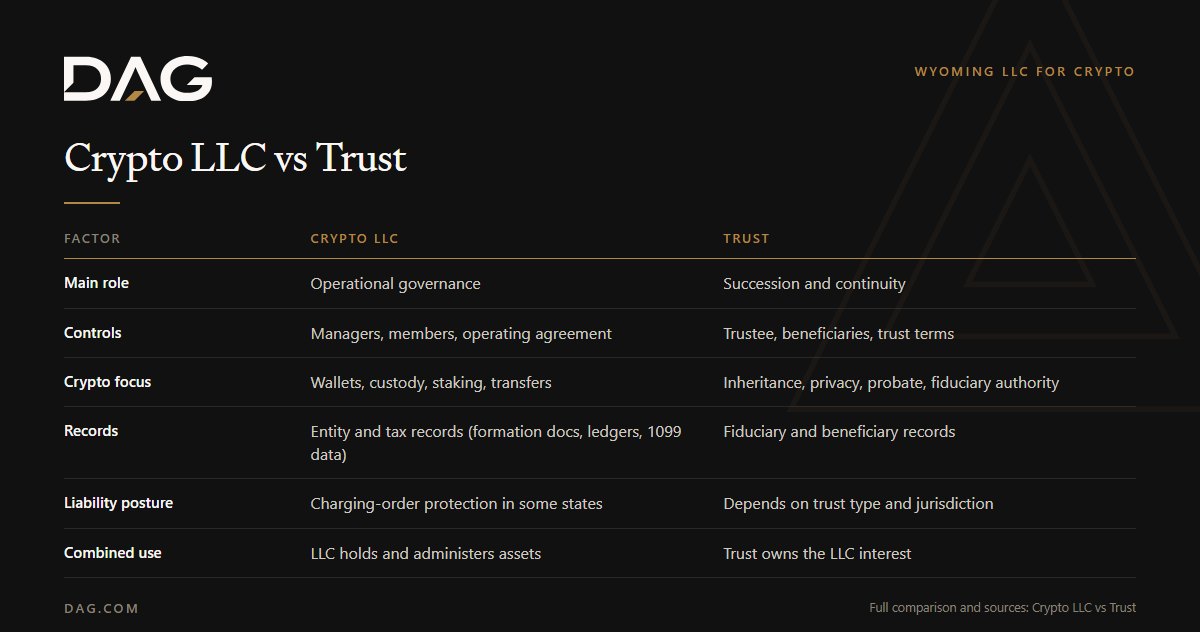
In a crypto LLC vs trust comparison, the two structures solve different problems and often work together. A crypto LLC sets operational governance for wallets, custody accounts, transfers, staking, and records. A trust addresses succession, privacy, probate avoidance, and continuity. Many families use both, with the trust owning the LLC.
What Each Structure Is
A crypto LLC is a limited liability company whose operating agreement defines who can move assets, sign with custodians, manage keys, and keep records. A trust is a fiduciary arrangement where a trustee holds and administers assets for beneficiaries under the trust terms. The two answer different questions, which is why a Wyoming digital asset LLC and a trust are frequently paired rather than chosen against each other.
Why This Matters
Crypto planning often breaks when one document is asked to solve every problem. An LLC governs day-to-day operations. A trust governs estate and succession. Digital asset wealth generally needs both layers coordinated, a theme that runs across our Crypto Trust Structures Hub.
How It Works
| Factor | Crypto LLC | Trust |
|---|---|---|
| Main role | Operational governance | Succession and continuity |
| Controls | Managers, members, operating agreement | Trustee, beneficiaries, trust terms |
| Crypto focus | Wallets, custody, staking, transfers | Inheritance, privacy, probate, fiduciary authority |
| Records | Entity and tax records (formation docs, ledgers, 1099 data) | Fiduciary and beneficiary records |
| Liability posture | Charging-order protection in some states | Depends on trust type and jurisdiction |
| Combined use | LLC holds and administers assets | Trust owns the LLC interest |
A common layered design has a trust own the membership interest in the LLC, while the LLC handles the operational mechanics. Custody still runs through a qualified custodian or a documented self-custody policy, and the crypto LLC operating agreement checklist is where signing authority and key control get written down. If asset protection is the driver, review whether a Wyoming LLC protects crypto from lawsuits before assuming either structure does the work alone.
Evidence Standard
This article compares structures and does not recommend a specific design. It does not state or imply that either structure is superior; the right fit depends on the facts.
When Each May Help
- The family needs both wallet governance and estate continuity.
- A custodian needs entity documentation to open or maintain an account.
- A trustee needs clearly stated authority over digital assets.
- Assets are large enough to justify formal records and controls.
- The owner wants both privacy and a succession plan.
When It May Not Be Enough
Neither an LLC nor a trust automatically solves taxes, custody, asset protection, or private key access. The IRS generally treats digital assets as property regardless of the holding entity, market risk remains, and a lost key is still a lost key. Implementation, documentation, and the question of whether you put crypto in a Wyoming LLC in the first place all matter more than the label on the structure.
Related Questions
Should a trust own the LLC?
Often worth evaluating. In a layered design the LLC handles operations while the trust handles succession. Whether it fits depends on your goals, state law, and tax situation, so confirm the structure with a qualified professional.
Can a trust hold crypto directly?
Possibly. Direct trust ownership still requires custody arrangements and documented access procedures, because a trustee cannot administer assets they cannot reach. The right setup depends on the facts.
Is an LLC better for asset protection?
It may help in some structures, and some states offer charging-order protection. Outcomes depend on the facts, the jurisdiction, and how the entity is maintained, so this is not a guarantee.
How do a crypto LLC and trust work together?
Commonly the trust owns the LLC interest, separating who operates the assets from what happens to them on incapacity or death. Coordination between the two documents matters more than either alone.
Bottom Line
The LLC answers "who can operate the crypto structure?" The trust answers "what happens when the owner cannot?" Crypto wealth often needs both answers, and getting them to work together is the planning task.
Sources
Compliance Note
This article is for general educational purposes and is not legal, tax, asset-protection, custody, or investment advice.