
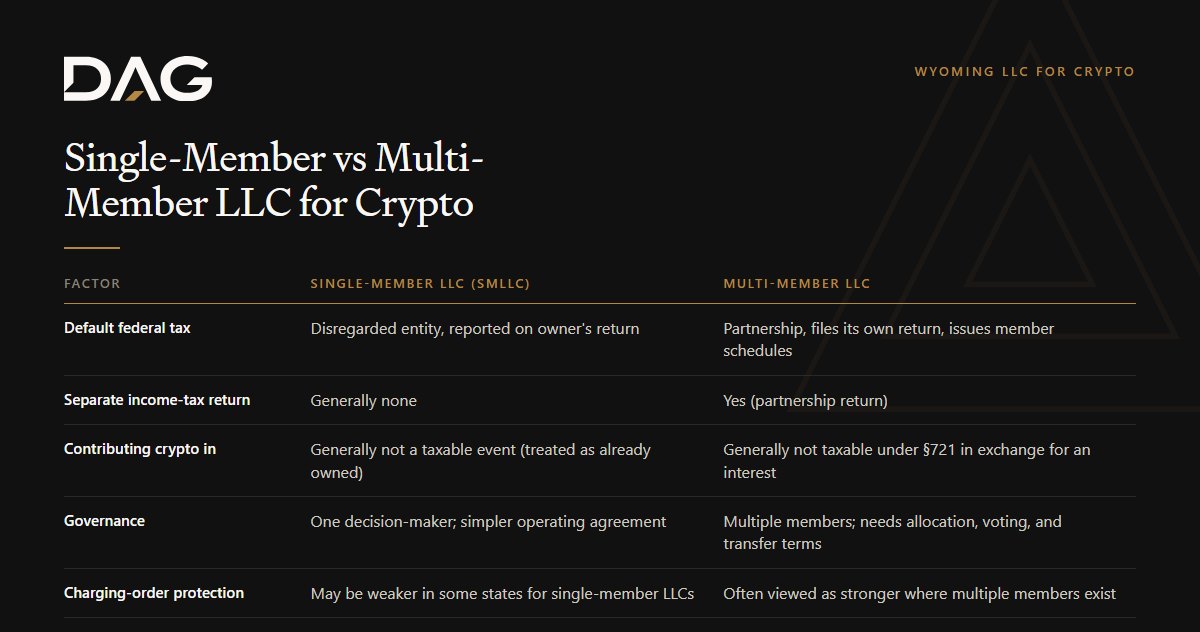
The single-member vs multi-member LLC choice for crypto is mainly a choice between two default tax treatments and two governance models. A single-member LLC (SMLLC) is generally a disregarded entity taxed on the owner's own return, while a multi-member LLC is taxed as a partnership filing its own return. Each affects taxes, recordkeeping, and how strong the asset-protection shield is.
The Core Difference: Disregarded Entity vs Partnership
For federal income tax, the number of members usually sets the default classification:
- A single-member LLC is by default a disregarded entity. The IRS looks through it as if it does not exist for income-tax purposes, so the owner reports the crypto activity directly on their own return. No separate federal income-tax return for the LLC.
- A multi-member LLC is by default a partnership. It files its own partnership return and issues each member a schedule reporting their share of income, gain, and loss, which the members then report individually.
Both are pass-through structures, so neither pays federal income tax at the entity level by default, and neither makes the crypto itself tax-free. The difference is in how the tax is reported, not whether it is owed. Either default can be overridden by a tax election; whether to do that is its own analysis, covered in the crypto LLC formation hub.
Single-Member vs Multi-Member: Side-by-Side
| Factor | Single-member LLC (SMLLC) | Multi-member LLC |
|---|---|---|
| Default federal tax | Disregarded entity, reported on owner's return | Partnership, files its own return, issues member schedules |
| Separate income-tax return | Generally none | Yes (partnership return) |
| Contributing crypto in | Generally not a taxable event (treated as already owned) | Generally not taxable under §721 in exchange for an interest |
| Governance | One decision-maker; simpler operating agreement | Multiple members; needs allocation, voting, and transfer terms |
| Charging-order protection | May be weaker in some states for single-member LLCs | Often viewed as stronger where multiple members exist |
| Recordkeeping burden | Lower | Higher (partnership accounting, capital accounts) |
The contribution row matters for crypto specifically: moving coins into either structure is generally not a taxable sale, but the mechanics differ. Document it either way, see how should a crypto LLC document contributions and how to transfer crypto into an LLC.
Governance Implications
A single-member LLC has one decision-maker, so the operating agreement is simpler and authority is clear, useful for solo holders who still want entity separation. A multi-member LLC has to resolve questions a solo entity never faces: how profits and losses are allocated, who can sign crypto transactions, what happens when a member wants out, and how interests transfer. These belong in a crypto-aware operating agreement; the baseline items are in the crypto LLC operating agreement checklist, and management structure is addressed in should a crypto LLC be manager-managed.
The Asset-Protection Nuance
A frequent reason families add a second member is asset protection. In some states, charging-order protection, the rule that a creditor of a member generally can reach distributions but not seize control of the LLC, has been applied less protectively to single-member LLCs, on the theory that there are no other members to protect. Courts and statutes vary by state, and this is not settled or uniform. It is one input, not a reason by itself to add a member who has no real economic role. Charging-order and veil protection are never absolute regardless of member count, and depend on maintaining clean separation. For where this sits among ownership options, compare crypto LLC vs trust.
Related Questions
Is a single-member crypto LLC taxed differently than a multi-member one?
By default, yes. A single-member LLC is a disregarded entity, so its crypto activity is reported on the owner's personal return with no separate LLC income-tax return. A multi-member LLC is a partnership that files its own return and issues schedules to members. Both are pass-through, so the tax is still owed by the owners; only the reporting differs. Confirm with a tax professional.
Does adding a second member make my crypto LLC more protected?
It can affect charging-order analysis in some states, where single-member LLCs have sometimes been treated as less protective, but this varies and is not guaranteed. Adding a member purely on paper, without a real economic interest, may not help and can complicate taxes and governance. Protection ultimately depends on maintaining separation and formalities, not member count alone.
Can I convert a single-member crypto LLC to multi-member later?
Generally yes, admitting a member changes the federal classification from disregarded to partnership, which has tax and filing consequences from that point forward. The operating agreement and tax filings need to reflect the change. Review the timing and basis effects with a tax professional, and update governance per the crypto LLC operating agreement checklist.
Sources
- IRS: Single Member Limited Liability Companies
- IRS: Limited Liability Company (LLC) classification
- IRS Publication 541, Partnerships
Compliance Note
This article is for general educational purposes and is not legal, tax, or investment advice. Choosing an entity structure, drafting operating agreements, and determining tax classification are professional services that Digital Ascension Group coordinates with qualified attorneys and tax professionals; the firm does not provide legal or tax advice. Advisory services are provided through DAG Wealth. Tax classification and asset-protection outcomes depend on state law and individual facts, charging-order protection is not absolute, and an LLC does not make crypto gains tax-free. Confirm your situation with qualified professionals before acting. Registration does not imply a certain level of skill or training.