
If you mix personal and LLC crypto, you blur the line between you and the entity. Commingling can create ownership confusion, tax reporting errors, recordkeeping gaps, custody mismatches, and governance problems, and it may give a court reason to disregard the LLC. Clean separation is what makes the structure hold up.
Commingling, in the LLC context, means treating entity assets and personal assets as one pool: paying personal costs from an LLC wallet, holding LLC tokens in your own name, or moving funds without documenting why. Courts and the IRS both look at whether an entity is run as a genuine separate business or merely as an extension of its owner. That distinction sits at the center of what a Wyoming digital asset LLC is meant to accomplish.
Why Separation Matters
An LLC generally works as a liability shield only when its assets are kept clearly apart from the owner's personal holdings. When the two are mixed, an opposing party in litigation may argue the entity is a sham and ask a court to "pierce the veil," reaching personal assets that the structure was supposed to insulate. Whether that argument succeeds depends on the facts, but sloppy separation makes it easier to raise. Asset protection is qualitative, not guaranteed, and the outcome depends on jurisdiction, conduct, and how the entity is actually operated. For the protection side specifically, see does a Wyoming LLC protect crypto from lawsuits.
Common Commingling Problems
- Personal wallets or exchange accounts used to hold LLC assets.
- LLC expenses paid from personal crypto, or personal expenses paid from LLC crypto.
- Member contributions moved in without a documented capital contribution.
- Distributions taken without a recorded resolution or entry.
- Cost basis blended across personal and entity holdings, making per-lot accounting unreliable.
- Custody or exchange accounts not legally titled to the LLC.
- The operating agreement on file not actually followed in day-to-day transfers.
Specific Consequences
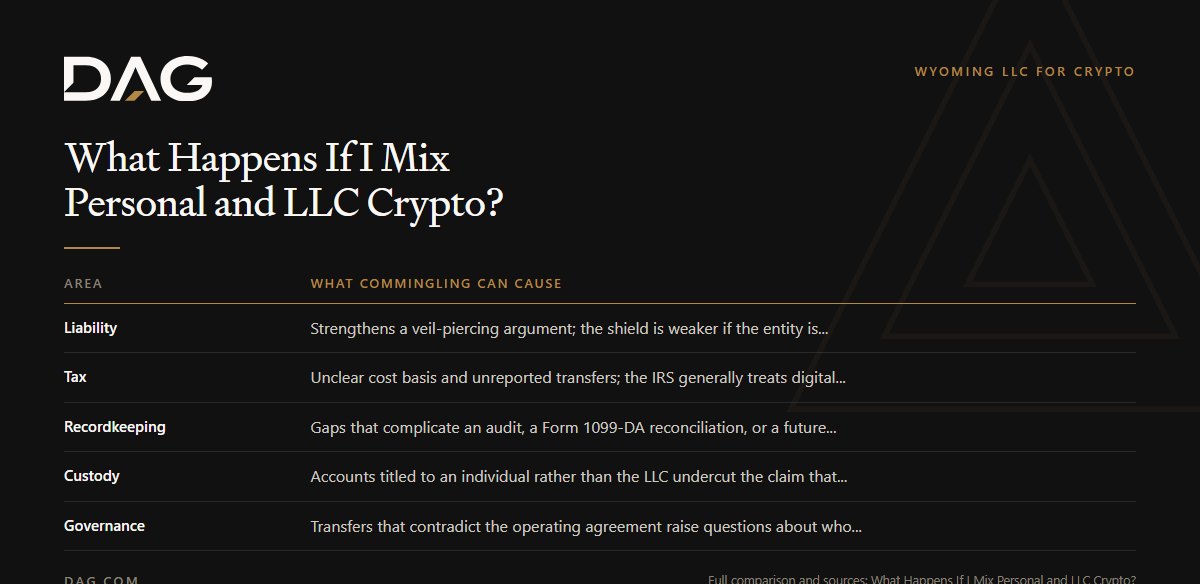
| Area | What commingling can cause |
|---|---|
| Liability | Strengthens a veil-piercing argument; the shield is weaker if the entity is run as a personal pocketbook. |
| Tax | Unclear cost basis and unreported transfers; the IRS generally treats digital assets as property, so each disposal is a potential taxable event that must be traced. |
| Recordkeeping | Gaps that complicate an audit, a Form 1099-DA reconciliation, or a future sale of the entity. |
| Custody | Accounts titled to an individual rather than the LLC undercut the claim that the entity owns the assets. |
| Governance | Transfers that contradict the operating agreement raise questions about who actually controls the assets. |
How to Keep Personal and LLC Crypto Separate
- Hold LLC assets only in wallets and accounts legally titled to the LLC, never in a personal wallet. See whether an LLC can own a crypto wallet.
- Document every capital contribution and every distribution as a dated, signed record, consistent with how a crypto LLC should document contributions.
- Pay LLC expenses only from LLC funds, and reimburse rather than pay personal costs directly from entity wallets.
- Preserve full transaction records, including on-chain transaction IDs, dates, fair market value at transfer, and counterparties, so cost basis stays traceable per lot.
- Follow the operating agreement you actually filed, and update it when practice changes.
- Coordinate with qualified tax, legal, and custody professionals before moving assets in or out.
Related Questions
Can mixing personal and LLC crypto void the liability protection?
Not automatically, but it can. Commingling is one of the factors a court weighs when deciding whether to disregard an entity. The more an LLC looks like a personal account, the easier it is for an opposing party to argue the shield should not apply. The result depends on the facts and the jurisdiction; consult a qualified attorney.
Does the IRS care if I mix personal and LLC crypto?
It can matter. The IRS generally treats digital assets as property, so transfers and disposals can be taxable events that need clear records. Blended cost basis and undocumented movements make accurate reporting harder and can complicate an examination. A qualified tax professional should review your specific situation.
How do I fix crypto that has already been commingled?
Generally, you reconstruct the records: identify which assets belong to the entity, document the contributions and distributions that should have been recorded, retitle accounts to the LLC, and separate going forward. Because retroactive cleanup can have tax and legal consequences, work with qualified professionals rather than reorganizing on your own.
Sources
Compliance Note
This article is educational and does not provide legal, tax, accounting, entity, investment, or custody advice. LLC asset separation should be reviewed with qualified professionals.