
You can hold digital assets in an existing out-of-state LLC. Whether to instead form a Wyoming LLC for digital assets depends on your position size, your current operating agreement, and whether Wyoming's digital-asset statutes matter for your facts, all questions covered in crypto LLC formation. Many holders with material cryptocurrency positions form a separate Wyoming entity, but it is not always necessary.
What Makes Wyoming Different for Digital Assets?
Wyoming digital asset LLC refers to an LLC formed under Wyoming's digital-asset-specific statutory framework (Wyoming Title 17, Chapter 31). Wyoming was among the first states to explicitly classify cryptocurrency as property, codify legal treatment for digital-asset custody, and extend its charging-order-only remedy to LLCs holding intangible assets.
Other states. California, Delaware, Texas, have general LLC statutes written before cryptocurrency existed. Courts in those states are still resolving how traditional property and creditor-remedy rules apply to digital assets. Wyoming has already answered many of those questions by statute.
Should I Use My Existing LLC or Form a New Wyoming Entity?
What does your existing operating agreement actually cover?
An operating agreement written for a real-estate investment LLC or a small-business holding company almost certainly lacks provisions for:
- Multi-signature wallet governance
- Fork and airdrop handling
- Staking and DeFi participation authority
- On-chain transfer authorization procedures
- Key-custody and succession protocols
Operating without those provisions means the entity's governance is silent on the most operationally significant aspects of cryptocurrency ownership. You can amend the existing agreement, but if the rewrite is substantial, most of the "convenience" of keeping the existing entity disappears.
How does charging-order protection compare?
Charging-order protection generally limits a personal-judgment creditor to a lien on your distributions from an LLC, the creditor typically cannot seize LLC assets directly or force the LLC to distribute. Wyoming statute frames the charging order as the exclusive remedy against an LLC interest (Wyo. Stat. § 17-29-503). How fully that exclusivity holds can depend on the jurisdiction hearing the dispute and the facts, so confirm current Wyoming law with counsel.
Some other states allow courts to order a foreclosure sale of the LLC interest after a charging order, giving creditors a potential path to control. Wyoming's statute is generally more restrictive, though outcomes can vary by jurisdiction and facts.
Important limit: Charging-order protection is not absolute. Courts may pierce the veil for inadequate capitalization, commingling, or failure to observe formalities. Fraudulent-transfer law can reach contributions made to hinder known creditors. Protection depends on how the entity is maintained, not only where it is formed. Consult an attorney about your specific facts.
What about privacy?
Wyoming permits an LLC to list only its registered agent on publicly filed formation documents. Member names do not appear in the public record. States such as California require member or manager disclosure. For holders who prioritize operational security, Wyoming's privacy provisions are a practical advantage.
Does foreign qualification cancel the benefit?
Whether holding cryptocurrency creates enough Wyoming "nexus" to require foreign qualification is fact-specific. Depending on the facts, for example, if a California LLC's activity becomes substantially Wyoming-connected, you may need to foreign-qualify the California LLC in Wyoming. That could add a second-state filing, annual fees, and a second compliance calendar, eroding much of the simplicity you were trying to preserve. A new Wyoming entity can avoid the question, but whether qualification is triggered in any given case is something to confirm with counsel.
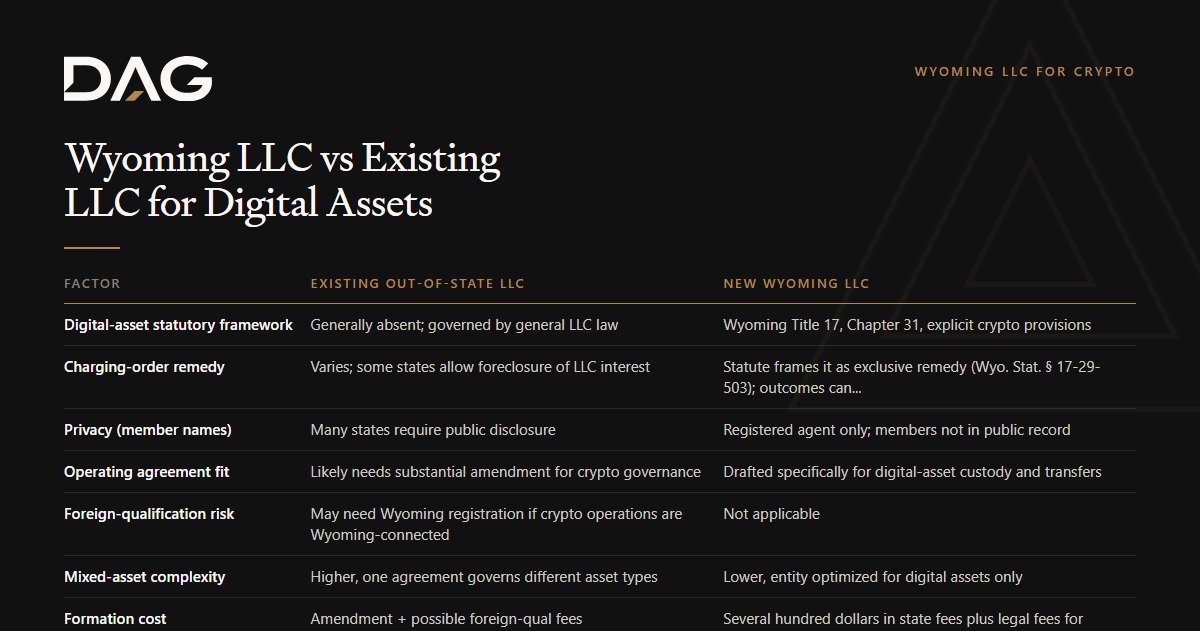
Comparison: Existing Out-of-State LLC vs. New Wyoming LLC
| Factor | Existing Out-of-State LLC | New Wyoming LLC |
|---|---|---|
| Digital-asset statutory framework | Generally absent; governed by general LLC law | Wyoming Title 17, Chapter 31, explicit crypto provisions |
| Charging-order remedy | Varies; some states allow foreclosure of LLC interest | Statute frames it as exclusive remedy (Wyo. Stat. § 17-29-503); outcomes can vary by jurisdiction/facts |
| Privacy (member names) | Many states require public disclosure | Registered agent only; members not in public record |
| Operating agreement fit | Likely needs substantial amendment for crypto governance | Drafted specifically for digital-asset custody and transfers |
| Foreign-qualification risk | May need Wyoming registration if crypto operations are Wyoming-connected | Not applicable |
| Mixed-asset complexity | Higher, one agreement governs different asset types | Lower, entity optimized for digital assets only |
| Formation cost | Amendment + possible foreign-qual fees | Several hundred dollars in state fees plus legal fees for operating agreement |
When an Existing LLC May Be Sufficient
Not every crypto holder needs a new Wyoming entity. Consider keeping an existing LLC if:
- The cryptocurrency represents a small fraction (roughly less than 10%) of total LLC value
- No complex operations, no staking, DeFi, or institutional custody relationships
- The existing operating agreement can accommodate crypto with limited, targeted amendments
- No Wyoming-connected activities that would trigger foreign-qualification requirements
- The entity's state of formation has adequate digital-asset property law for your needs
If most of these apply, the administrative overhead of a separate Wyoming entity may exceed its benefit.
What About Tax Treatment?
LLC tax classification does not change based on which state formed the entity. A single-member LLC disregarded for federal tax purposes remains disregarded whether formed in Wyoming or California. A multi-member LLC taxed as a partnership remains a partnership.
Contributing cryptocurrency to a wholly owned single-member LLC that is disregarded for tax purposes is generally not a taxable event, you are moving property between yourself and an entity the IRS treats as yourself. Contributions to a multi-member LLC are generally tax-free under IRC § 721. Converting or domesticating an existing LLC to Wyoming is generally not itself a taxable event, though it can have tax consequences depending on the facts. These are general principles, actual tax treatment depends on your specific structure and should be confirmed with a qualified CPA.
What does change is accounting clarity. Separate entities with separate wallets make crypto cost basis cleanup and crypto tax reporting for LLCs significantly cleaner. Mixing crypto with real estate and stock positions in one LLC creates reconciliation work at tax time.
Related Questions
Can I foreign-qualify my existing LLC in Wyoming instead of forming a new one?
Yes. Wyoming accepts foreign-qualification filings (Wyo. Stat. § 17-29-1003). The foreign-qualified LLC operates under Wyoming law for activities in Wyoming but remains subject to its home-state formation law. You gain some Wyoming-connected credibility but do not fully convert the entity to Wyoming's statutory framework. For most holders with material digital-asset positions, a new Wyoming domestic LLC is cleaner and more straightforward.
Does a Wyoming LLC protect crypto from all lawsuits?
No. A Wyoming LLC can reduce certain creditor-access vectors through charging-order protection and separate legal personhood, but it does not provide absolute protection. Courts can pierce the veil for formality failures or inadequate capitalization. Fraudulent-transfer law applies to contributions made with intent to hinder creditors. Wyoming's framework is generally considered favorable, not impenetrable. See Does a Wyoming LLC Protect Crypto From Lawsuits? for a fuller treatment.
Should a trust own the Wyoming LLC rather than holding it personally?
For many holders, a trust-owned LLC structure adds a second layer: the LLC handles operational and custody governance while the trust handles estate planning, succession, and potential estate-tax considerations. Whether that layered structure is appropriate depends on the size of the position and your estate-planning goals. See Should a Trust Own a Wyoming LLC for Crypto Assets? and Trust-Owned LLC for Crypto Assets.
What should the operating agreement cover for a crypto LLC?
A crypto-specific operating agreement should address wallet-ownership language, transfer-authorization procedures, multi-sig thresholds, fork and airdrop treatment, staking authority, and key-custody succession. The Crypto LLC Operating Agreement Checklist covers the full list of provisions.
For a broader view of how LLC structure fits into the overall digital-asset ownership decision, see Should Crypto Be Held Personally, in an LLC, or in a Trust? and What Is a Wyoming Digital Asset LLC?
Sources
- Wyoming Uniform Limited Liability Company Act, Wyo. Stat. § 17-29-101 et seq., https://law.justia.com/codes/wyoming/title-17/chapter-29/ (current)
- Wyoming Digital Asset Statutes, Wyo. Stat. § 34-29-101 et seq. (digital assets as property), https://law.justia.com/codes/wyoming/title-34/chapter-29/ (current)
- Wyoming Charging Order (exclusive remedy), Wyo. Stat. § 17-29-503, https://law.justia.com/codes/wyoming/title-17/chapter-29/section-17-29-503/ (current)
- Wyoming Foreign LLC Registration, Wyo. Stat. § 17-29-1003, https://law.justia.com/codes/wyoming/title-17/chapter-29/ (current)
- IRS, "Limited Liability Company (LLC)", classification and single-member disregarded-entity treatment, https://www.irs.gov/businesses/small-businesses-self-employed/limited-liability-company-llc (current)
- IRC § 721, nonrecognition of gain or loss on contribution to a partnership, https://uscode.house.gov/view.xhtml?req=granuleid:USC-prelim-title26-section721 (current)
Compliance Note
This page is educational only and does not constitute legal, tax, or investment advice. Entity formation, foreign qualification, operating-agreement drafting, and tax treatment of LLC contributions involve facts specific to each situation. Consult a qualified attorney and CPA before making entity-structure decisions. DAG coordinates wealth-management services; legal and tax implementation requires engagement with licensed attorneys and CPAs.