
The crypto LLC portfolio threshold where formation typically starts to pay off falls in the $50,000–$100,000 range, where setup and annual maintenance costs become a small percentage of assets and the liability separation, succession planning, and tax clarity begin to outweigh the fees, core considerations in any crypto LLC formation decision. Your personal situation can shift that threshold in either direction.
What Is a Crypto LLC and Why Does the Math Change at Scale?
A crypto LLC (often a Wyoming single-member LLC) is a separate legal entity that holds digital assets on behalf of its owner. It creates a layer of separation between personal assets and the entity's holdings, provides a documented structure for succession, and may enable legitimate business-expense deductions.
The formation cost is largely fixed regardless of portfolio size. As an illustrative example only, professional formation with a crypto-specific operating agreement might run in the low thousands of dollars, plus several hundred dollars per year in maintenance (registered agent, state filing, basic accounting). Actual costs vary widely by state, attorney, and service provider, and these ranges are not quotes, confirm current pricing directly with the providers you engage.
Below roughly $50,000, those fixed costs represent a disproportionate share of portfolio value. Above $100,000, the same costs become a small fraction and the protection risk of not having structure grows.
At What Portfolio Value Does a Crypto LLC Start to Pay for Itself?
The breakeven depends on three variables: total one-time and annual costs, portfolio size, and the specific benefits you need.
Cost-to-portfolio percentage benchmarks
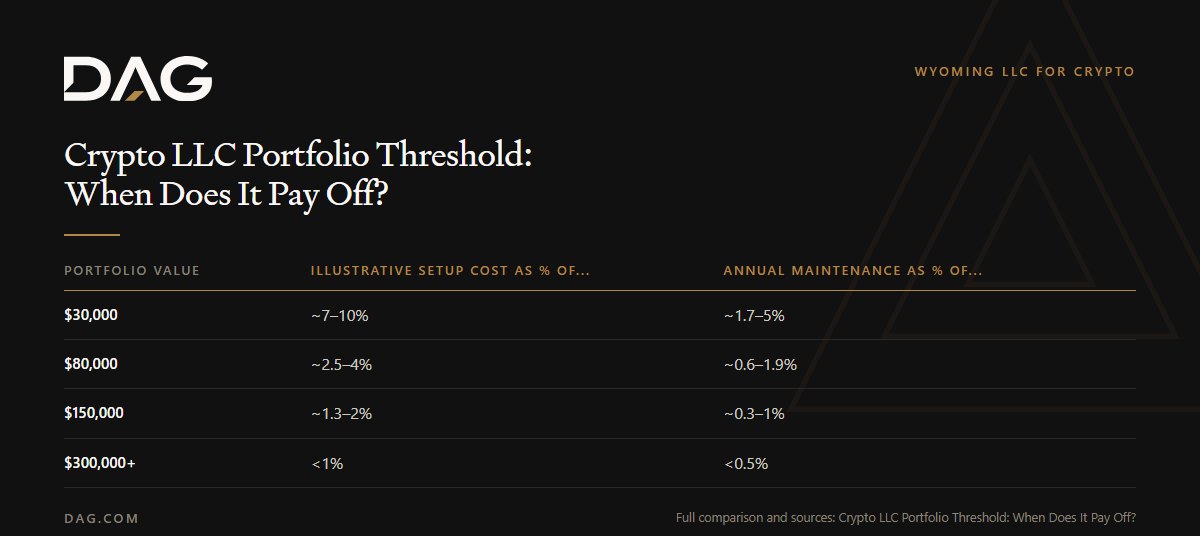
| Portfolio value | Illustrative setup cost as % of holdings | Annual maintenance as % of holdings |
|---|---|---|
| $30,000 | ~7–10% | ~1.7–5% |
| $80,000 | ~2.5–4% | ~0.6–1.9% |
| $150,000 | ~1.3–2% | ~0.3–1% |
| $300,000+ | <1% | <0.5% |
The dollar figures and percentages above are illustrative only, rough guidance to show how the cost-to-portfolio ratio shifts with scale, not firm quotes or guaranteed outcomes.
At the low end, spending a high single-digit percentage of net worth on entity formation is generally hard to justify unless a specific risk factor (see below) makes it urgent. In the middle of the range, the percentages become more reasonable and the benefits start to outweigh the costs for many holders. At larger portfolio sizes, many practitioners would consider some form of entity structure common practice, though it remains a personal decision, not a requirement.
What Factors Move the Threshold Lower?
High personal liability exposure
A physician, contractor, business owner, or anyone facing meaningful malpractice or litigation risk may benefit from forming an LLC at $40,000–$60,000 rather than waiting. Charging-order protection and the liability firewall matter more when the underlying personal liability exposure is larger.
Asset protection through an LLC is not absolute. Courts can pierce the corporate veil for commingling assets or failing to maintain formalities, fraudulent transfer rules can unwind recent contributions, and charging-order protections vary by state and are not guaranteed in every jurisdiction. Consult a qualified attorney before relying on an LLC for asset protection.
Active trading
A high volume of transactions per year may support business-expense deductions and can make clean LLC-level bookkeeping worth the overhead even at lower portfolio sizes. Costs such as hardware wallets, security software, accounting fees, and professional services may be deductible when incurred by an entity that the IRS treats as operating a trade or business, but deductibility depends on the specific facts, the entity's tax classification, and how the activity is characterized. A CPA should review your situation before you rely on any deduction.
Dependents and succession need
If family members depend on crypto wealth and lack the technical knowledge to access it, the structure risk, permanent loss of assets due to inaccessible wallets, can justify formation at $50,000 or less. An LLC paired with a trust structure for crypto assets creates a documented chain of access and succession that personal holdings cannot provide. Unstructured holdings with no documented private key succession plan carry meaningful inheritance risk regardless of portfolio size.
Plans to borrow against crypto
Banks and institutional lenders generally require a properly structured entity before extending crypto-backed loans. If collateralized borrowing is part of the plan, the LLC becomes necessary at whatever portfolio size triggers that need.
What Factors Allow Waiting Longer?
- Simple long-term holding, no active trading: Fewer transactions mean fewer potential deductions, lower accounting complexity, and less urgency for formal structure.
- Single individual, no dependents: Succession planning is less time-sensitive when there are no immediate heirs who need clear access procedures.
- Low personal liability exposure: A salaried employee with no business liability and no professional-license exposure faces lower urgency than someone in a high-liability profession.
- Smaller portfolio in a volatile market: The opportunity cost of deploying formation and maintenance dollars into the LLC rather than into assets is more significant when total holdings are small and the market is favorable.
How Does Succession Risk Factor In?
Succession risk is consistently underestimated. A holder with $70,000–$80,000 in self-custodied cryptocurrency who dies without documented access instructions creates a realistic risk that those assets become permanently inaccessible. An LLC with a properly drafted operating agreement, combined with trust ownership of the LLC, provides a clear path for heirs or successor trustees.
The relevant comparison is not "LLC cost vs. more crypto", it is "LLC cost vs. the probability-weighted risk of permanent asset loss." For anyone with dependents, that framing generally favors earlier formation. See also how to fund a trust with crypto for the mechanics of moving assets into the structure once it is in place.
Does Transferring Crypto Into an LLC Trigger a Tax Event?
Generally, no, but the answer depends on the entity's tax classification:
- Single-member LLC (disregarded entity): Contributing crypto to a wholly owned single-member LLC that is disregarded for federal tax purposes is generally not a taxable event, because the IRS treats the LLC as the same taxpayer as the owner.
- Multi-member LLC taxed as a partnership: A contribution of appreciated crypto to a partnership is generally tax-free under IRC §721, though specific facts and holding-period rules apply.
- Revocable trust: Funding a revocable trust is generally not a taxable event because the grantor retains control and the trust is treated as a grantor trust for tax purposes.
The taxable event in crypto is generally selling or exchanging the asset, not moving it into a structure you still control. That said, this area turns on specific IRC provisions and IRS guidance that can change, and the result depends on your facts and the entity's classification. A tax attorney or CPA should review any specific transfer before you execute it.
For an overview of how the LLC interacts with crypto tax reporting, see crypto tax reporting for LLCs.
Should I Form a Wyoming LLC Specifically?
Wyoming is a common choice for crypto LLCs because the state has enacted digital asset statutes under Wyoming Title 17 that explicitly recognize LLC ownership of digital assets, provide strong charging-order protection, and impose no state income tax. Delaware LLCs offer legal precedent advantages but do not have the same statutory recognition of digital assets. See Wyoming LLC vs. Delaware LLC for crypto for a side-by-side comparison.
LLC vs. Just Continuing to Accumulate: A Decision Checklist
Use this checklist to evaluate readiness, not as a substitute for professional advice.
- Portfolio is above $50,000 (or above your personal liability-adjusted threshold)
- You have dependents or family members who would need to access assets
- You lack a documented private key succession plan
- You trade actively (50+ transactions per year) or have meaningful business expenses
- You face personal liability exposure above average (professional license, business ownership)
- You plan to borrow against the portfolio or establish institutional banking relationships
- Annual maintenance cost is under 1% of projected portfolio value
If three or more boxes apply, the LLC case is generally strong regardless of exact portfolio size.
Related Questions
Can a Wyoming LLC hold crypto at any portfolio size?
Yes, there is no statutory minimum. Wyoming law under Title 17 allows an LLC to hold, manage, and transact in digital assets regardless of portfolio size. The question is whether the legal and operational benefits justify the cost at a given portfolio level, not whether it is technically permissible.
Does an LLC eliminate personal liability for crypto losses?
No. An LLC can separate entity-level liabilities from personal assets in certain circumstances, but it does not protect against losses from market volatility, exchange failures, or self-custody errors. It also does not protect against personal guarantees, veil-piercing claims, or fraudulent transfer challenges if assets were moved to the LLC in anticipation of known claims.
What happens if I hold crypto in my personal name at $200,000?
Personal holdings remain exposed to personal creditors in most states, absent specific state exemption statutes. There is no automatic entity-level separation, no documented succession structure, and no ability to deduct entity-level business expenses. At that portfolio size most practitioners would consider the absence of structure a meaningful unmitigated risk, though the specific risk profile depends on jurisdiction and individual circumstances.
Is a single-member LLC sufficient, or do I need a trust as well?
For succession planning and estate-tax positioning, an LLC alone is generally not sufficient. A trust owning the LLC allows the interest to pass outside of probate, establishes trustee duties for ongoing management, and may provide additional asset-protection and tax-planning benefits depending on the trust type. Many practitioners recommend a trust-owned LLC structure once total digital asset holdings justify the additional complexity, typically $100,000 or above, though family situation can pull that number lower.
Sources
- Wyoming Statutes Title 17 (Corporations, Partnerships, and Associations), Chapter 29 (Wyoming Limited Liability Company Act) and Chapter 31 (Wyoming Blockchain Act / Digital Asset provisions): https://wyoleg.gov/statutes/compress/title17.pdf
- IRS, "Virtual Currencies," IRS.gov: https://www.irs.gov/businesses/small-businesses-self-employed/virtual-currencies
- IRC §721 (nonrecognition of gain or loss on contribution to partnership): https://www.law.cornell.edu/uscode/text/26/721
- IRS Rev. Rul. 99-5 (conversion of single-member LLC to multi-member): https://www.irs.gov/pub/irs-drop/rr-99-5.pdf
- Wyoming Secretary of State, Business Division (formation fees and requirements): https://sos.wyo.gov/Business/
Compliance Note
This page is for educational purposes only and does not constitute legal, tax, investment, or financial advice. LLC formation, asset-protection strategies, and digital asset tax treatment involve complex legal and factual questions that vary by jurisdiction, entity structure, and individual circumstances. Consult a qualified attorney and CPA before forming an entity, transferring digital assets, or making any structural decisions based on this content. Asset protection through an LLC is not absolute and is subject to charging-order limits, veil-piercing risk, fraudulent-transfer rules, and jurisdictional variation. Past cost estimates and portfolio thresholds cited are illustrative and may not reflect current market rates.