
Trust structures for crypto wealthy individuals are legal arrangements, revocable trusts, irrevocable trusts, directed trusts, and trust-owned LLCs, used to address probate, privacy, succession, and fiduciary authority over digital assets. The right structure generally depends on the assets, family, tax goals, state law, and custody model, and usually pairs documents with a workable private key access plan.
What a Crypto Trust Structure Is
A trust is a legal relationship in which a trustee holds title to assets for beneficiaries under written terms. For digital assets, a trust addresses the legal ownership and succession layer, while custody, signing rights, and tax reporting sit alongside it. No single structure fits every holder; the choice connects to broader crypto wealth management decisions about control, protection, and continuity.
Why This Matters
Digital assets create two linked problems. The legal owner must be clear, and the person responsible for the assets must be able to control or transfer them securely. A trust can help with the legal and succession layer, but it does not by itself solve private key access, custody account administration, tax reporting, or security.
For crypto wealth, trust planning should answer:
- Who has legal authority?
- Who can access the assets?
- Who understands the custody setup?
- How are private keys or signing rights handled, including private key succession?
- How are assets valued and reported?
- What happens if the original holder is incapacitated?
Comparing the Common Structures
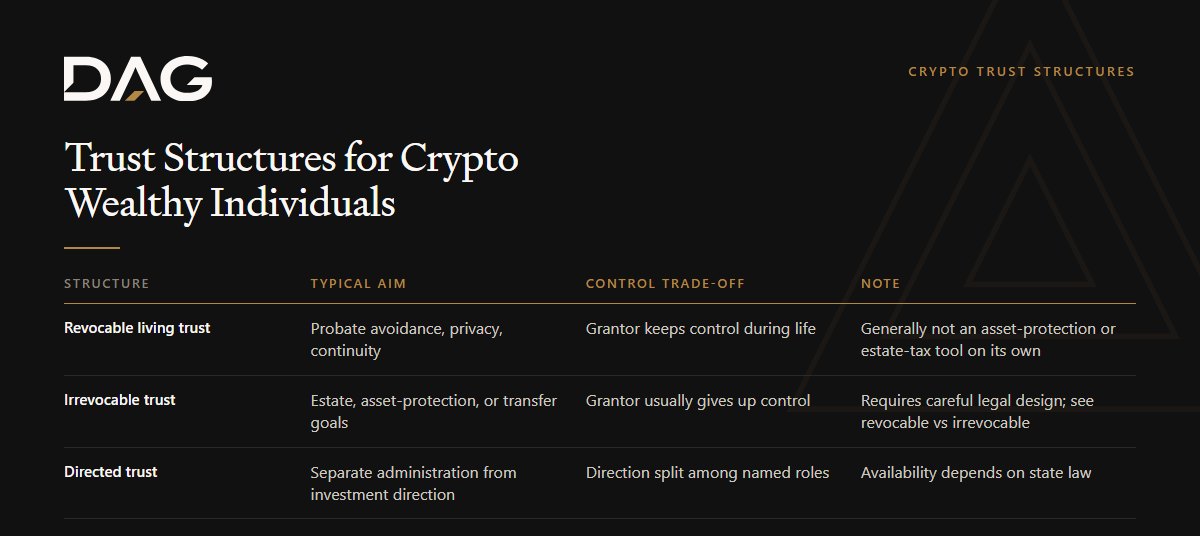
Each structure trades control for different planning benefits. None removes market, custody, or tax risk.
| Structure | Typical aim | Control trade-off | Note |
|---|---|---|---|
| Revocable living trust | Probate avoidance, privacy, continuity | Grantor keeps control during life | Generally not an asset-protection or estate-tax tool on its own |
| Irrevocable trust | Estate, asset-protection, or transfer goals | Grantor usually gives up control | Requires careful legal design; see revocable vs irrevocable |
| Directed trust | Separate administration from investment direction | Direction split among named roles | Availability depends on state law |
| Trust-owned LLC | Place the operational crypto layer in an entity | Trust owns the entity interest | May add charging-order protection under state law; see trust-owned LLC |
A directed trust may separate administrative trustee duties from investment or distribution direction, which some families prefer when the person making crypto decisions is not the institutional trustee.
Evidence Standard
This article uses general structural concepts, not client stories. Any case study or example added later must be cited from a public source, approved internally, or labeled hypothetical.
When It May Help
- Crypto wealth is large enough that probate and privacy matter.
- The family needs continuity if the holder dies or becomes incapacitated.
- Wallets, custody accounts, LLCs, and advisors need to be coordinated.
- The family wants multi-generational governance.
- A professional trustee or family office needs clear authority and defined trustee duties.
When It May Not Be Enough
A trust does not automatically reduce taxes, protect assets, or make crypto accessible. Funding matters: the trust must actually take ownership of the assets. Custody accounts and wallets must be coordinated with the documents, often using a qualified custodian with SOC 1 or SOC 2 reporting. Private key instructions must be secure and usable, whether through multi-sig, cold storage, or institutional custody. Tax and legal consequences, the IRS generally treats digital assets as property, must be reviewed with a qualified professional.
Related Questions
Should crypto go in a revocable or irrevocable trust?
It depends on the planning goal. Revocable trusts are generally used for control and probate avoidance. Irrevocable trusts are more advanced and may involve asset protection, estate tax, or transfer planning, usually at the cost of giving up control. Consult a qualified estate planning attorney for your facts.
Can a trust own a crypto LLC?
Often, yes. A trust-owned LLC can separate the operational layer from the succession layer, though the operating agreement and trust documents must be coordinated. Whether it suits a given family depends on state law and the assets involved.
What is a directed trust for digital assets?
A directed trust generally allows one party to handle trustee administration while another directs investment or asset decisions. Whether that split is appropriate depends on state law and family needs; see directed trust vs delegated trustee.
Does a trust protect crypto from market or custody risk?
No. A trust addresses legal ownership and succession, not price volatility or the security of the underlying wallet. Market risk, custody risk, and tax exposure remain and should be managed separately.
Bottom Line
Trust structures for crypto wealthy individuals should be designed around both documents and access. A workable plan coordinates the trust, any LLC, the custody model, tax reporting, and private key succession, and it should be reviewed by qualified legal and tax professionals.
Sources
Compliance Note
This article is for general educational purposes and is not legal, tax, or investment advice. Trust structures require qualified legal and tax review.