
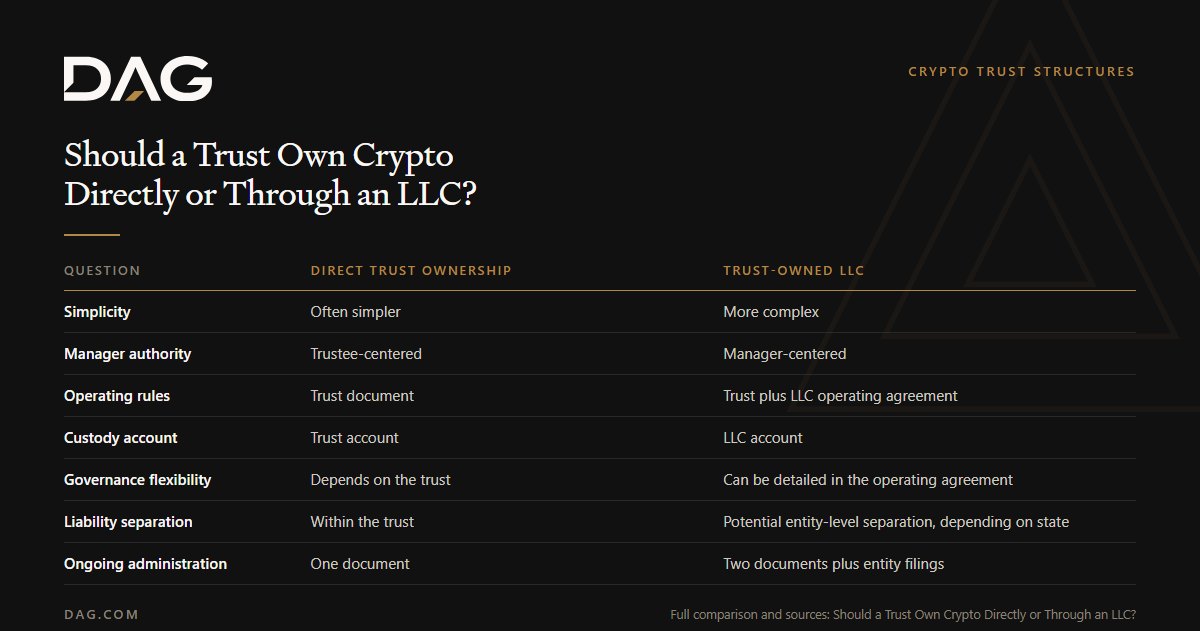
Whether a trust should own crypto directly or through an LLC depends on the family's legal, tax, custody, fiduciary, and governance goals. Direct ownership is often simpler when a custodian supports trust accounts. A trust-owned LLC adds a management layer and operating agreement that can give families more control. There is no universal best answer.
What These Two Structures Mean
Under direct trust ownership, the trust itself holds the digital assets, and the trustee administers them under the terms of the trust document. With a trust-owned LLC, the trust owns the membership interest in a limited liability company, and the LLC holds the crypto under its own operating agreement and account. The choice generally turns on how much operational structure and liability separation a family wants, and it should be reviewed with qualified counsel. For broader context, see our Crypto Trust Structures Hub.
Direct Trust Ownership
Direct trust ownership can be simpler when the custodian supports trust accounts and the trustee can administer digital assets under the trust document. With this approach:
- The trustee holds signing and custody authority directly under the trust.
- Assets sit in a trust account with a qualified custodian where one is used, or under documented self-custody arrangements.
- There is one governing document to administer, which can reduce administrative overhead.
Simplicity does not remove risk. Direct ownership still exposes the trust to market volatility, custody and key-loss risk, and tax-reporting obligations, and the trustee carries fiduciary responsibility for the assets either way.
Trust-Owned LLC
A trust-owned LLC creates a separate management layer with an operating agreement, defined manager authority, and a distinct account structure. Families sometimes prefer this when they want:
- A documented chain of manager authority separate from the trustee's role.
- An operating agreement that spells out governance, signing thresholds, and who can move assets (for example, multi-sig approval rules).
- Potential charging-order protection at the entity level, depending on the formation state and facts.
These benefits come with added cost and complexity: a second governing document, separate recordkeeping, and entity-level tax filings. The Should a Trust Own Crypto Directly or Through an LLC tradeoffs overlap with the broader question of whether crypto should be held personally, in an LLC, or in a trust.
Comparison Table
| Question | Direct Trust Ownership | Trust-Owned LLC |
|---|---|---|
| Simplicity | Often simpler | More complex |
| Manager authority | Trustee-centered | Manager-centered |
| Operating rules | Trust document | Trust plus LLC operating agreement |
| Custody account | Trust account | LLC account |
| Governance flexibility | Depends on the trust | Can be detailed in the operating agreement |
| Liability separation | Within the trust | Potential entity-level separation, depending on state |
| Ongoing administration | One document | Two documents plus entity filings |
Related Questions
Does a trust-owned LLC reduce trustee liability?
It may add a layer of liability separation at the entity level, but it generally does not eliminate the trustee's fiduciary duty over the trust's investment in the LLC. The effect depends on the formation state and the facts. See whether a trustee can be liable for crypto losses and consult counsel.
Is direct trust ownership cheaper than using an LLC?
Often, yes, because there is one governing document and no separate entity filings. But cost is only one factor; governance needs, liability concerns, and custody options also matter, and the cheaper structure is not automatically the right one.
Can the structure be changed later?
In many cases a trust can contribute crypto to a newly formed LLC, or wind an LLC down, but doing so can have tax and titling consequences. The mechanics depend on the trust terms and applicable law, so review any change with a qualified tax and legal professional before acting.
Sources
Compliance Note
This article is educational and does not provide legal, tax, fiduciary, investment, entity, or custody advice. No structure removes market, custody, or tax risk. Trust and LLC structures should be reviewed with qualified professionals.