
A trust can generally own a Bitcoin ETF when the trust document, the brokerage platform, the trustee's fiduciary duties, the investment policy, and applicable law all permit it. Because a spot Bitcoin ETF trades as a security in a standard brokerage account, it can be simpler to hold than direct Bitcoin, but it still requires the same investment suitability and fiduciary review.
What Is a Bitcoin ETF in a Trust Context?
A Bitcoin ETF is an exchange-traded fund that gives shareholders exposure to Bitcoin's price without holding the underlying coins directly. The fund sponsor arranges custody of the Bitcoin; the trust simply owns fund shares inside a securities account. That structure separates Bitcoin exposure from the operational job of holding private keys, which is the central difference for a trustee weighing an ETF against direct ownership. Whether either approach fits depends on the facts of the specific trust.
This question sits within the broader topic of trust structures for crypto, and the ETF-versus-direct decision often runs alongside the more general question of whether a trust can hold Bitcoin, Ethereum, or other digital assets at all.
Bitcoin ETF vs Direct Bitcoin in a Trust
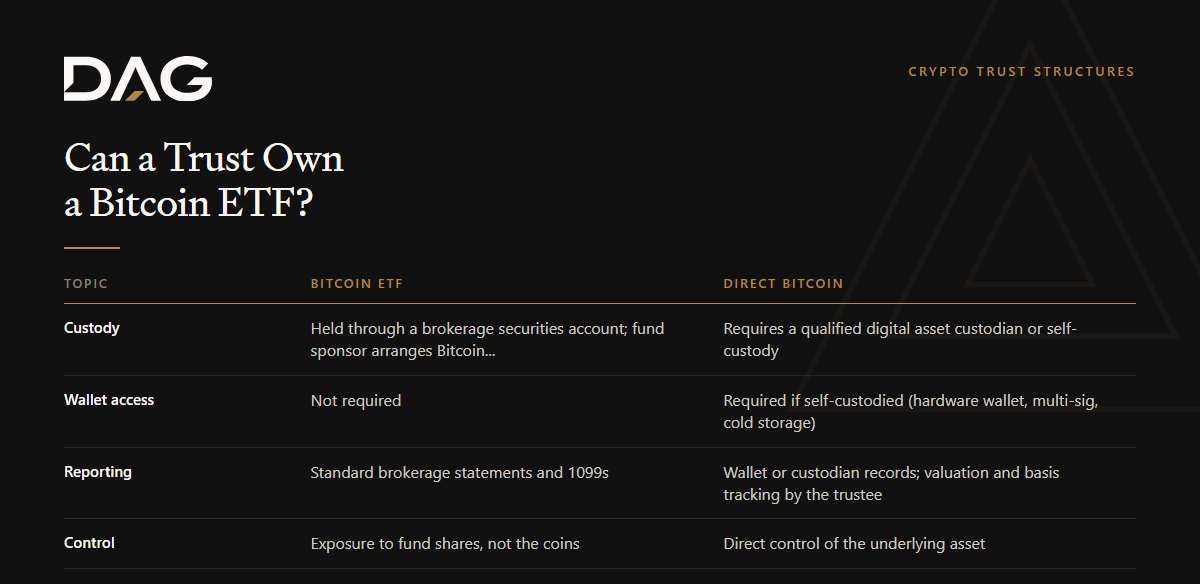
Both routes give a trust Bitcoin exposure, but they differ in custody, reporting, and administrative burden. Neither removes market risk, and the price of Bitcoin can fall sharply regardless of how it is held.
| Topic | Bitcoin ETF | Direct Bitcoin |
|---|---|---|
| Custody | Held through a brokerage securities account; fund sponsor arranges Bitcoin custody | Requires a qualified digital asset custodian or self-custody |
| Wallet access | Not required | Required if self-custodied (hardware wallet, multi-sig, cold storage) |
| Reporting | Standard brokerage statements and 1099s | Wallet or custodian records; valuation and basis tracking by the trustee |
| Control | Exposure to fund shares, not the coins | Direct control of the underlying asset |
| Estate and succession | Often lower; no private key to pass on | Often higher; requires private key succession planning |
A trust can hold either, or both. The trade-off is operational simplicity versus direct control. For a deeper comparison of holding the asset itself, see should a trust own crypto directly or through an LLC, and for the key-management side of direct ownership, see private key succession planning.
Trustee Checklist Before Buying a Bitcoin ETF in a Trust
Work through these before placing a trade. The first three are gating items; if any fails, stop and seek counsel.
- Authority. Confirm the trust document and applicable state law permit ETF or digital asset exposure. Silence is not the same as permission.
- Investment policy. Check that the investment policy statement allows the position size and asset class, and document the suitability rationale.
- Fiduciary duty. Apply the prudent investor standard, including diversification and the trust's risk tolerance and time horizon, and record how Bitcoin exposure fits.
- Platform. Verify the brokerage or custodian will hold the ETF in the trust's name and supports trust accounts.
- Reporting. Plan how you will report performance, risk, and tax to beneficiaries on the schedule the trust requires.
- Documentation. Keep a written record of the decision and its basis. See how a trustee should document crypto decisions.
A trustee who is not equipped to evaluate digital asset exposure can bring in help; whether and how to do that is covered in can a trustee hire a crypto advisor.
Related Questions
Is a Bitcoin ETF safer than holding Bitcoin directly in a trust?
An ETF removes the private key custody burden, which can lower one category of operational risk, but it does not remove market risk, and the value can still fall. "Safer" depends on the trust's facts and the trustee's ability to manage each structure. ETF shares are not FDIC- or SIPC-insured against a decline in Bitcoin's price.
Does owning a Bitcoin ETF require the trustee to hold a crypto wallet?
Generally no. A Bitcoin ETF trades as a security in a brokerage account, so the trustee does not need to manage a wallet or private keys. Direct Bitcoin ownership is where wallet and key management come in. Confirm with the platform before assuming it supports a trust account.
How is a Bitcoin ETF taxed inside a trust?
Treatment depends on the facts and the ETF's structure, and the IRS generally treats digital assets as property. ETF shares typically generate brokerage tax reporting rather than the wallet-level basis tracking that direct holdings require. A trustee should confirm the specifics with a qualified tax professional.
Sources
Compliance Note
This article is educational and does not provide legal, tax, fiduciary, investment, ETF, or custody advice. Trustees should consult qualified professionals before investing trust assets. No structure removes market, custody, or tax risk, and no Bitcoin exposure is guaranteed, insured, or free from loss.