
A crypto SMA is a separately managed account holding digital assets in your name, with portfolio decisions handled by an adviser. A crypto ETF is a pooled exchange-traded product you buy as shares through a securities account. The crypto SMA vs crypto ETF choice turns on custody, customization, tax control, reporting, and governance.
What Each One Is
A crypto SMA (separately managed account) is an account that holds digital assets attributable to a single investor, managed under a defined mandate. Positions sit in the account holder's name, which can allow position-level tax decisions, restrictions, and adviser oversight tailored to one client.
A crypto ETF (exchange-traded fund) is a pooled vehicle whose shares trade on an exchange. You buy and sell shares through a brokerage account; the fund holds the underlying assets, and you own fund shares rather than the assets directly.
Why This Matters
Family offices and RIAs often decide whether to access digital assets through direct ownership, separately managed accounts, private funds, ETFs, or a mix. ETFs can simplify exposure, but they generally do not offer direct ownership, wallet-level control, or the same customization. SMAs can offer more tailored management, though they typically require more operational and custody review. The right structure usually depends on the facts of each portfolio, so this is often a question for crypto wealth management planning rather than a one-size answer.
How They Compare
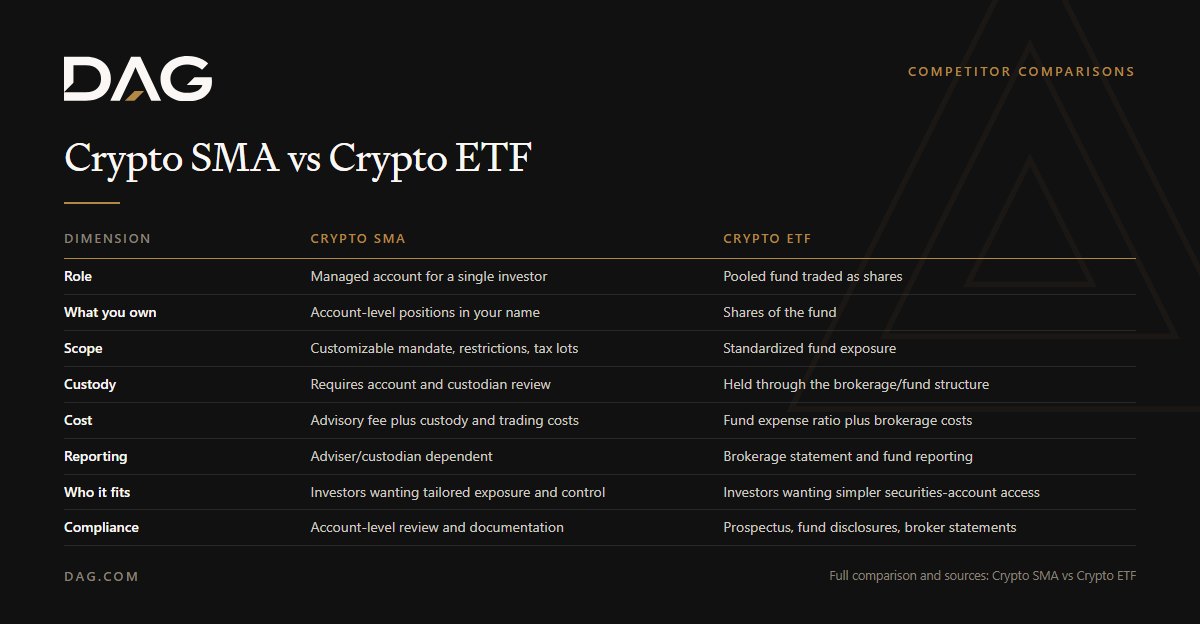
| Dimension | Crypto SMA | Crypto ETF |
|---|---|---|
| Role | Managed account for a single investor | Pooled fund traded as shares |
| What you own | Account-level positions in your name | Shares of the fund |
| Scope | Customizable mandate, restrictions, tax lots | Standardized fund exposure |
| Custody | Requires account and custodian review | Held through the brokerage/fund structure |
| Cost | Advisory fee plus custody and trading costs | Fund expense ratio plus brokerage costs |
| Reporting | Adviser/custodian dependent | Brokerage statement and fund reporting |
| Who it fits | Investors wanting tailored exposure and control | Investors wanting simpler securities-account access |
| Compliance | Account-level review and documentation | Prospectus, fund disclosures, broker statements |
Specific fees, tax outcomes, and features vary by provider and by the facts of each account; treat the table as a framework, not a quote.
Evidence Standard
This comparison is general and does not recommend a specific product. Any product comparison should use current prospectuses and provider materials. Neither structure is presented as superior; each can fit different goals.
When Each May Help
- An adviser wants customized digital asset exposure for one client.
- A family office needs tax-lot awareness or position restrictions.
- A client prefers exposure through a familiar securities account.
- An investment committee is comparing implementation vehicles.
How an SMA or fund is custodied is its own decision; the trade-offs sit alongside the broader crypto custody options review.
When It May Not Be Enough
Neither structure solves estate planning, entity titling, trust ownership, or private key succession on its own. Product exposure is not the same as wealth structure. Choosing a vehicle is also distinct from choosing who manages it, which is closer to the crypto custodian vs crypto wealth manager question, and the SMA-versus-fund decision parallels the crypto family office vs crypto fund comparison.
Related Questions
Is a crypto ETF safer than direct ownership?
It changes the risk profile rather than removing risk. An ETF can simplify access and custody, but it still carries market, product, fee, and tracking risks. Crypto ETF shares are not FDIC- or SIPC-insured against market losses, and no structure guarantees a return. The right read depends on your facts.
Why use a crypto SMA instead of an ETF?
An SMA may allow customized allocation, position restrictions, tax-lot management, or direct adviser oversight, depending on the platform and manager. Those features come with account-level due diligence and typically an advisory fee, so the value depends on whether the customization matters for your situation.
Can a family office use both?
Often, yes. A family office may use ETFs for some exposure and direct or SMA structures for other goals, coordinated within an overall plan. How the pieces fit usually depends on tax, custody, and governance facts, which is worth reviewing with qualified professionals.
Bottom Line
Crypto ETFs can make access simpler. Crypto SMAs can make exposure more customized and account-specific. Neither should be evaluated without weighing custody, tax, estate, and governance needs, and neither is inherently better than the other.
Sources
Compliance Note
This article is for general educational purposes and is not investment advice. Investors should review product documents, fees, risks, custody, and tax treatment with qualified professionals.