
When crypto custody options are compared, the practical choices are self-custody, qualified custody, institutional custody, exchange accounts, multi-signature wallets, MPC custody, and indirect exposure through ETFs. Which one fits depends on who holds legal ownership, the advisory and reporting context, your risk tolerance, and how tightly transfers need to be controlled.
What "custody" means here
Custody describes who holds the private keys (or the legal title) to a crypto asset and who can authorize a transfer. The options below differ along a few axes: whether you or a third party controls the keys, whether the holder is a regulated qualified custodian, how transfers get approved, and whether you own the asset directly or hold a security that tracks it. Definitions in brief:
- Self-custody, you control the keys directly, with no intermediary.
- Qualified custody, a regulated custodian holds client assets, a structure that matters for registered investment advisers under the SEC custody framework.
- Institutional custody, a custody platform built for organizational governance, often used by family offices and funds.
- Exchange account, assets held in an account at a trading venue.
- Multi-signature (multi-sig), transfers require more than one independent key to sign.
- MPC custody, multi-party computation splits signing across parties without ever assembling a full private key in one place.
- ETF, a brokerage security that tracks crypto, without direct ownership of the underlying asset.
Side-by-side comparison
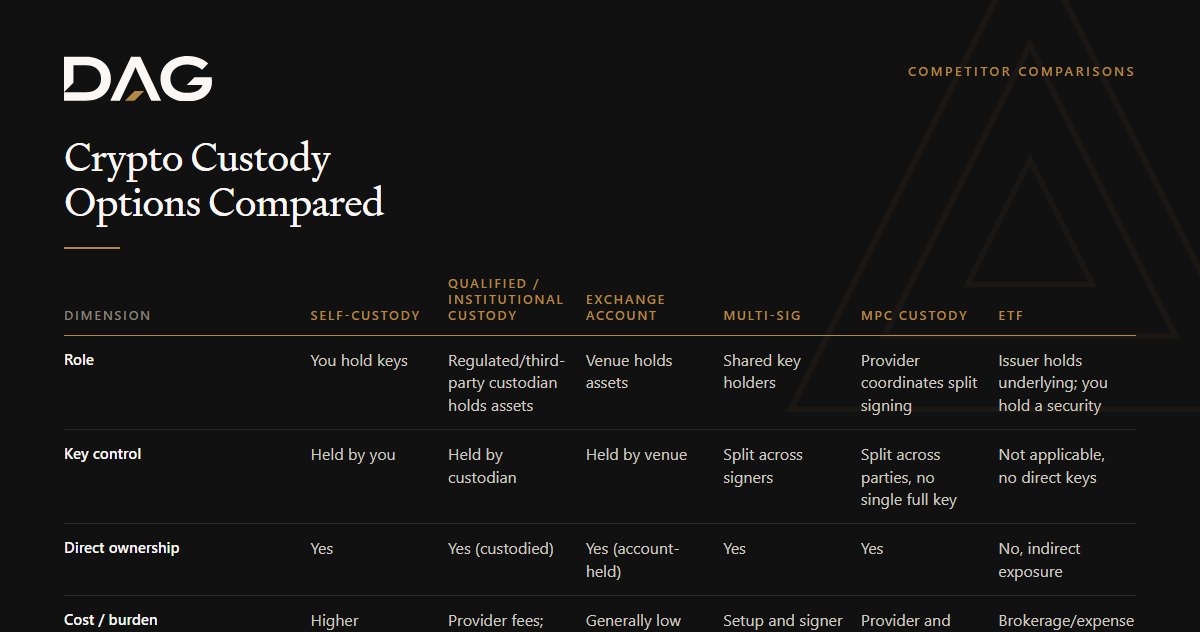
The dimensions that usually decide the choice are the holder's role, the scope of what's covered, who controls keys, the cost and operational load, who it tends to fit, and the compliance considerations. The table is a starting point for a conversation, not a recommendation.
| Dimension | Self-custody | Qualified / Institutional custody | Exchange account | Multi-sig | MPC custody | ETF |
|---|---|---|---|---|---|---|
| Role | You hold keys | Regulated/third-party custodian holds assets | Venue holds assets | Shared key holders | Provider coordinates split signing | Issuer holds underlying; you hold a security |
| Key control | Held by you | Held by custodian | Held by venue | Split across signers | Split across parties, no single full key | Not applicable, no direct keys |
| Direct ownership | Yes | Yes (custodied) | Yes (account-held) | Yes | Yes | No, indirect exposure |
| Cost / burden | Higher operational burden | Provider fees; due diligence required | Generally low friction | Setup and signer governance | Provider and technical review | Brokerage/expense costs; no custody to run |
| Who it tends to fit | Hands-on holders | RIAs, institutions, family offices | Those wanting simple access | Groups needing shared approval | Institutional signing workflows | Investors wanting brokerage exposure |
| Compliance considerations | Self-managed controls | Maps to SEC custody-rule expectations for advisers | Counterparty and control review | Approval-policy governance | Provider/architecture review | Securities account; no asset-level custody |
A custodian's regulatory status is one input among several; due diligence on any provider, including its controls, insurance posture, and track record, still falls to the adviser and client. For how these formats sit inside a broader plan, see the Crypto Wealth Management Hub, and for a focused look at the custody decision, the Digital Asset Custody Hub.
Related Questions
Is qualified custody required for an RIA holding crypto?
It depends on the facts. Where an adviser has custody of client assets, the SEC custody framework generally points toward holding those assets with a qualified custodian and meeting related requirements. Whether a specific arrangement triggers those obligations is fact-specific, and the rules continue to evolve. Confirm your situation with qualified compliance counsel. The Crypto Custodian vs Crypto Wealth Manager page explains how custody and advice differ.
How do MPC and multi-signature custody differ?
Both spread signing authority so no single party can move assets alone, but they get there differently. Multi-sig uses several distinct on-chain keys, while MPC splits a single signing operation cryptographically so a full private key is never assembled in one place. The right fit depends on the chains involved, provider support, and your governance needs, a technical and operational review is warranted.
Does an ETF give the same control as holding crypto directly?
No. An ETF is a brokerage security that tracks a crypto asset; you do not hold the keys or the underlying coin, so you cannot transfer it on-chain. That can simplify access and reporting for some investors while removing direct ownership and self-directed transfer control. Whether direct holding or ETF exposure suits you depends on your goals, tax situation, and operational preferences.
Can a family office mix several custody approaches?
Often, yes. A family office may use institutional or qualified custody for core holdings while reserving other methods for specific needs, subject to its governance and risk policies. The mix depends on the entity structure, the people authorized to transact, and reporting obligations. Compare the surrounding tradeoffs in what is a crypto family office.
Sources
- SEC: Custody rule compliance guide
- SEC: Custody rule FAQs
- MPC Alliance: Introduction to MPC for digital asset custody
Compliance Note
This comparison is educational and does not provide legal, tax, investment, fiduciary, compliance, or custody advice. Crypto assets carry risk, including the potential loss of principal; no custody method eliminates that risk, guarantees safety or yield, or carries FDIC or SIPC coverage for the underlying crypto. A custodian's regulation or registration alone does not guarantee skill, performance, or a particular outcome. Custody options should be reviewed with qualified professionals. Registration does not imply a certain level of skill or training.