
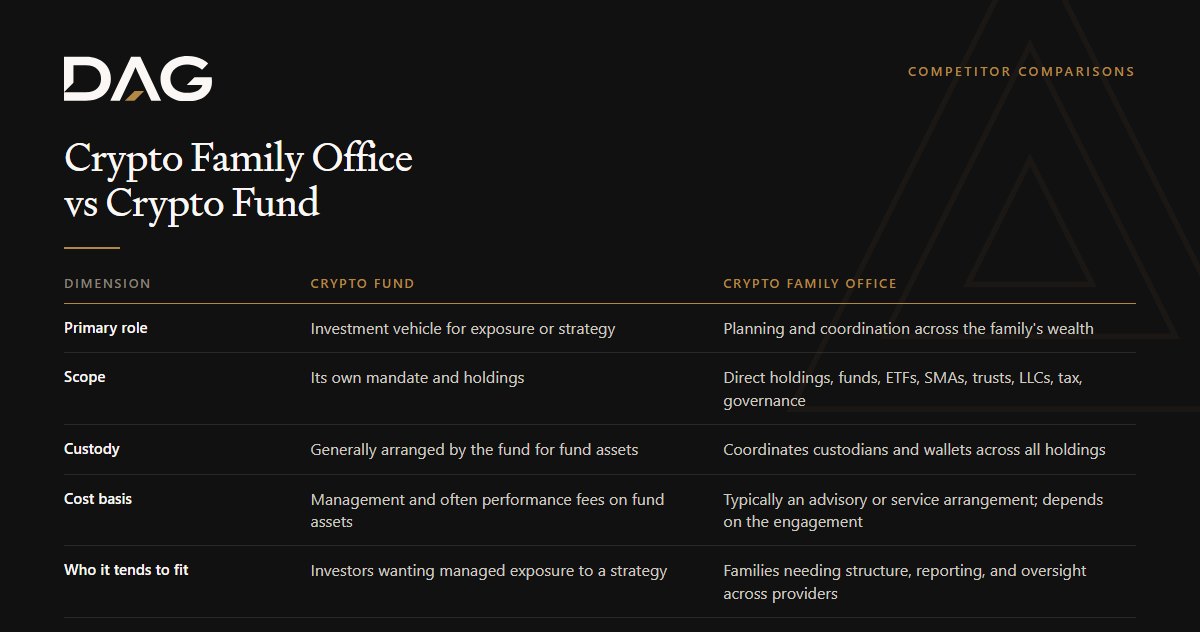
In the crypto family office vs crypto fund comparison, the two answer different questions. A crypto fund is an investment vehicle that gives a family exposure to digital assets or strategies. A crypto family office is the planning and coordination function around that wealth, spanning custody, reporting, taxes, estate planning, governance, and provider oversight. A family may hold a fund inside a wider structure the family office manages.
What Each One Is
A crypto fund is a pooled or managed investment vehicle. It may offer exposure to digital assets, a defined trading strategy, or venture-stage opportunities, and it operates under its own investment mandate, fee schedule, and investor reporting. The fund's job ends at the boundary of its mandate.
A crypto family office is a coordination layer that sits across a family's whole balance sheet. It may oversee direct holdings, funds, ETFs, separately managed accounts, custodians, wallets, trusts, LLCs, tax records, and family governance. Rather than supplying a single product, it organizes how digital assets fit alongside everything else the family owns. For a fuller picture of how that function is built, see the Crypto Family Office Hub.
Crypto Family Office vs Crypto Fund: Comparison
| Dimension | Crypto Fund | Crypto Family Office |
|---|---|---|
| Primary role | Investment vehicle for exposure or strategy | Planning and coordination across the family's wealth |
| Scope | Its own mandate and holdings | Direct holdings, funds, ETFs, SMAs, trusts, LLCs, tax, governance |
| Custody | Generally arranged by the fund for fund assets | Coordinates custodians and wallets across all holdings |
| Cost basis | Management and often performance fees on fund assets | Typically an advisory or service arrangement; depends on the engagement |
| Who it tends to fit | Investors wanting managed exposure to a strategy | Families needing structure, reporting, and oversight across providers |
| Compliance posture | Disclosed in fund offering documents | Coordinated against the family's legal, tax, and fiduciary needs |
A fund and a family office are not mutually exclusive. A family office may select one or more funds as part of an allocation, then handle the custody, tax, and governance work that a fund does not.
Key Difference
A fund answers a narrow question: what investment exposure should the investor access? A family office answers a broader one: how does digital asset wealth fit into the family's total financial, legal, tax, and operational structure? If the decision is mainly which vehicles to hold, that question often gets worked product by product, for example weighing a crypto SMA against a crypto ETF. When the question is how a family office differs from the firms that custody assets directly, a crypto custodian vs crypto wealth manager view, or a crypto family office vs a traditional family office view, can help.
Related Questions
Can a family own both a crypto fund and a crypto family office?
Generally yes. A fund can sit inside the broader structure a family office coordinates. The fund handles its mandate; the family office handles custody, reporting, tax records, and governance around it. The right mix depends on the family's assets, goals, and circumstances, so this is best confirmed with a qualified professional.
Does a crypto fund handle estate planning or tax records?
Usually not beyond its own investor reporting. A fund issues statements and tax documents for its holdings, but estate planning, multi-provider tax reconciliation, and entity structuring generally fall outside a fund's mandate and are areas a family office may coordinate. Specific tax and estate questions depend on the facts and should go to a licensed tax or legal professional.
Is a crypto family office regulated the same way as a crypto fund?
They sit under different frameworks, and the details depend on how each is structured. A fund and its manager operate under their own disclosures; a family office that provides investment advice may do so as a registered investment adviser. Registration alone does not guarantee skill or a particular outcome, and any specific arrangement should be reviewed against current disclosures.
Sources
Compliance Note
This article is educational and does not provide legal, tax, investment, fiduciary, fund, or custody advice. Digital assets carry risk, including loss of principal; nothing here implies guaranteed yield, a stable value, or FDIC or SIPC coverage. Fund and family office services should be reviewed against current disclosures, and decisions should be made with a qualified professional based on your own circumstances. Registration does not imply a certain level of skill or training.