
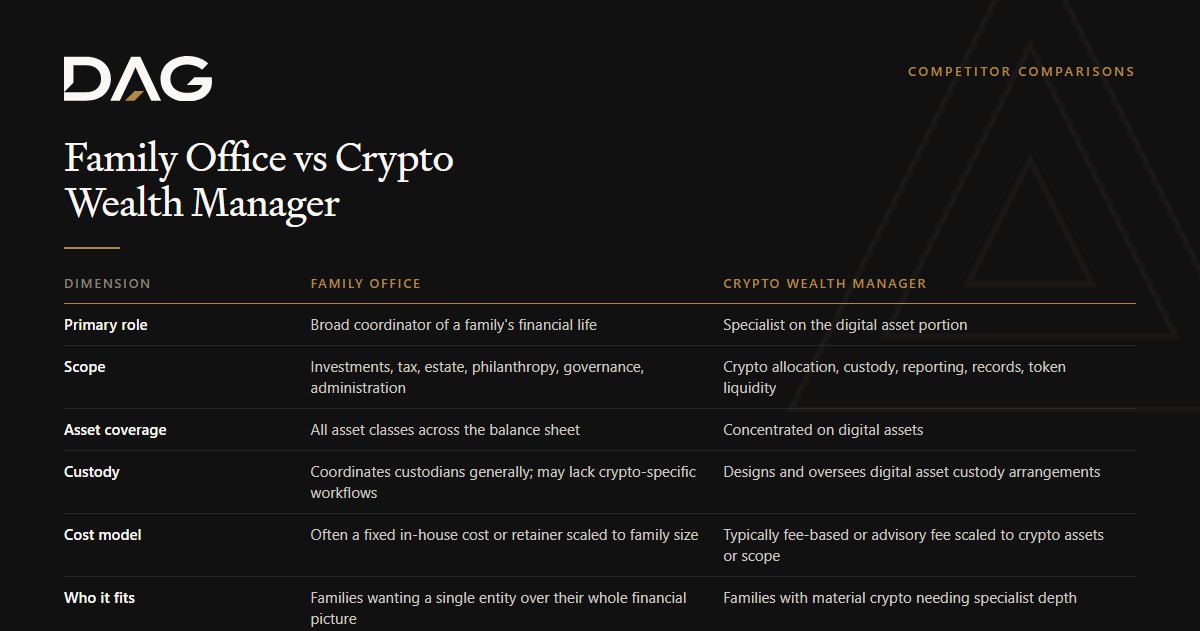
In the family office vs crypto wealth manager comparison, a family office coordinates a wealthy family's broad affairs across investments, tax, estate, and governance, while a crypto wealth manager focuses on digital asset strategy, custody coordination, reporting, and tax records. The two roles often overlap, and for families with meaningful crypto, they frequently work together rather than compete.
These are different jobs, not competing products. Many families end up using both, and understanding where each one's responsibilities begin and end is the first step in crypto wealth management planning.
Family Office
A family office is the entity, in-house team, or outsourced arrangement that oversees the wider financial life of a wealthy family. Its scope can include investment oversight, tax coordination, estate planning, philanthropy, consolidated reporting, governance, and day-to-day family administration. A family office is generally a generalist coordinator: it sees the whole balance sheet and brings in specialists where deeper expertise is needed.
Crypto Wealth Manager
A crypto wealth manager is a specialist focused on the digital asset slice of a family's wealth. The work may cover digital asset allocation, custody architecture, wallet inventory, tax records, token liquidity planning, trust and LLC coordination, and educating other advisers. Where a family office is broad, a crypto wealth manager is deep on one asset class, including the operational details, like custody and on-chain record-keeping, that traditional advisers may not handle in-house.
Family Office vs Crypto Wealth Manager: Side by Side
| Dimension | Family Office | Crypto Wealth Manager |
|---|---|---|
| Primary role | Broad coordinator of a family's financial life | Specialist on the digital asset portion |
| Scope | Investments, tax, estate, philanthropy, governance, administration | Crypto allocation, custody, reporting, records, token liquidity |
| Asset coverage | All asset classes across the balance sheet | Concentrated on digital assets |
| Custody | Coordinates custodians generally; may lack crypto-specific workflows | Designs and oversees digital asset custody arrangements |
| Cost model | Often a fixed in-house cost or retainer scaled to family size | Typically fee-based or advisory fee scaled to crypto assets or scope |
| Who it fits | Families wanting a single entity over their whole financial picture | Families with material crypto needing specialist depth |
| Compliance posture | Depends on structure; may or may not be a registered adviser | May be a registered investment adviser; verify registration and disclosures |
Cost and registration structures vary by firm and arrangement, so treat the rows above as general patterns rather than fixed facts. Registration, where it applies, indicates a regulatory status, not a guarantee of skill or results.
When Both Are Useful
Both roles tend to be useful together when a family office has crypto exposure but lacks internal digital asset expertise, custody workflows, or tax-record processes. In that setup, the family office keeps the wide view, and the crypto wealth manager fills the specialist gap, similar to how families weigh a crypto family office against a traditional family office. Families also weigh where a crypto custodian ends and a crypto wealth manager begins and how a crypto wealth manager compares to a conventional financial advisor when deciding who owns which task.
Related Questions
Do I need both a family office and a crypto wealth manager?
Not necessarily. It depends on the size and complexity of your digital asset holdings and whether your existing team already covers custody, reporting, and crypto tax records. Some families consolidate both functions; others keep a generalist coordinator and add specialist depth. A qualified adviser can help map the gaps to your facts.
Can a family office handle crypto on its own?
It can, where the in-house team has the relevant custody, on-chain reporting, and tax-record capabilities. Many family offices do not, which is often why a specialist is brought in. The right answer depends on your team's existing expertise and how your assets are structured.
Is a crypto wealth manager a fiduciary?
That depends on the firm and how it is registered. Some operate as registered investment advisers with associated duties; others may not. Registration alone does not guarantee skill or outcomes, so confirm a firm's status, disclosures, and the standard of care it owes before engaging. The distinction also shapes how a crypto wealth manager differs from a crypto tax CPA in the roles each can take.
Sources
Compliance Note
This article is educational and does not provide legal, tax, investment, fiduciary, family office, or custody advice. Service comparisons should be verified against current disclosures. Registration does not imply a certain level of skill or training.