
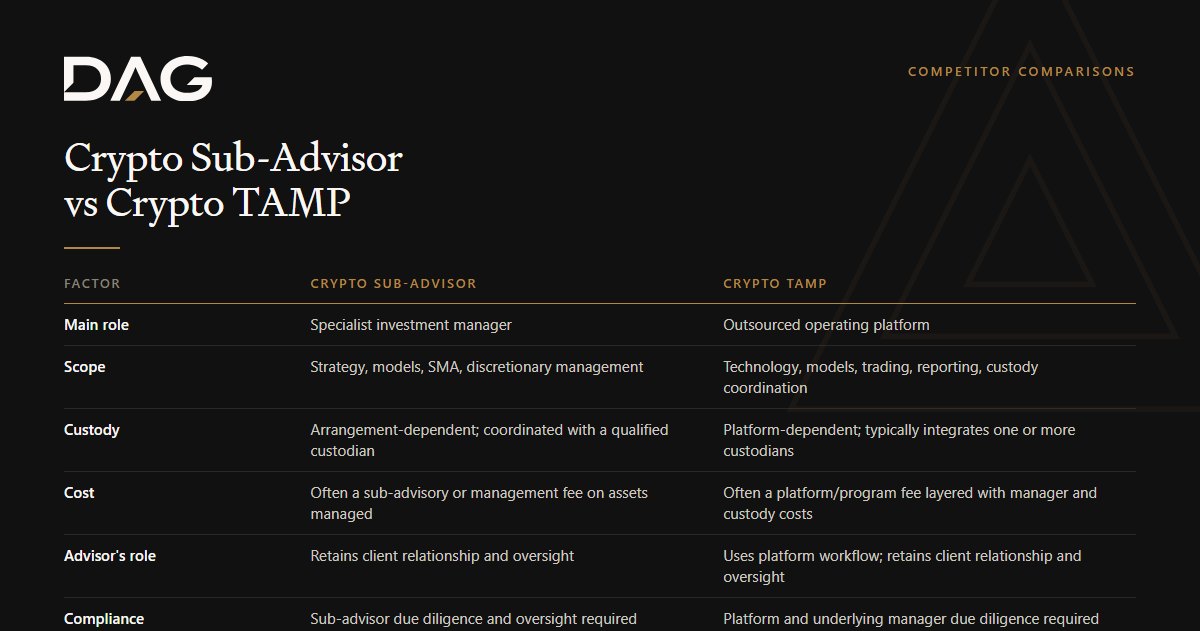
In the crypto sub-advisor vs crypto TAMP decision, a crypto sub-advisor is a specialist manager that supports another adviser with digital asset strategy or portfolio management, while a crypto TAMP (turnkey asset management platform) is a broader outsourced platform spanning models, trading, reporting, and custody coordination. The right fit depends on whether an RIA needs a manager, a platform, or both.
Why This Matters
Many RIAs would rather not build digital asset infrastructure in-house, and outsourcing can take more than one form. A platform helps with operations; a sub-advisor brings investment expertise. Either way, the firm needs clarity on custody, fees, discretion, disclosures, and who is responsible for what. These choices sit alongside the broader questions covered in our Crypto Services for RIAs Hub.
Definitions
A crypto sub-advisor is an investment manager engaged by a primary adviser to provide digital asset strategy, models, or discretionary management for that adviser's clients. The primary adviser usually keeps the client relationship.
A crypto TAMP is a turnkey platform that bundles technology, model portfolios, trading workflows, reporting, and custody coordination so an adviser can deliver a managed program without assembling each piece separately.
How It Works
| Factor | Crypto Sub-Advisor | Crypto TAMP |
|---|---|---|
| Main role | Specialist investment manager | Outsourced operating platform |
| Scope | Strategy, models, SMA, discretionary management | Technology, models, trading, reporting, custody coordination |
| Custody | Arrangement-dependent; coordinated with a qualified custodian | Platform-dependent; typically integrates one or more custodians |
| Cost | Often a sub-advisory or management fee on assets managed | Often a platform/program fee layered with manager and custody costs |
| Advisor's role | Retains client relationship and oversight | Uses platform workflow; retains client relationship and oversight |
| Compliance | Sub-advisor due diligence and oversight required | Platform and underlying manager due diligence required |
| Who it fits | Firm wanting investment expertise, less platform tooling | Firm wanting end-to-end operations and reporting |
Crypto Sub-Advisor
A crypto sub-advisor may support:
- Portfolio management.
- Model development.
- Research.
- Allocation guidance.
- Client-specific or program-level advice.
This role is closest to the manager side of the spectrum. For how a dedicated manager compares with a custody-only provider, see Crypto Custodian vs Crypto Wealth Manager.
Crypto TAMP
A crypto TAMP may support:
- Model portfolios.
- Trading workflows.
- Reporting.
- Custody coordination.
- Billing and operational support.
- Advisor-facing platform services.
A TAMP packages the operations; the investment decisions may come from the platform's own models or from a manager that sits on top of it. A related distinction shows up when an adviser also weighs a crypto asset manager, which we cover in Crypto Asset Manager vs Crypto Wealth Manager.
RIA Due Diligence Questions
- Who has investment discretion?
- Who communicates with clients?
- How are assets custodied?
- How are fees disclosed?
- Is the provider registered, or operating under another model?
- What reports and compliance materials are available?
Evidence Standard
This article compares service models and does not recommend a provider. Naming a provider is not an endorsement, and not naming one is not a criticism.
When It May Help
- An RIA wants to offer crypto without building infrastructure.
- The firm needs custody and reporting workflows.
- The firm wants digital asset investment expertise.
- Clients need managed crypto exposure.
When It May Not Be Enough
Outsourcing does not remove the RIA's own diligence, disclosure, and supervision obligations. A sub-advisor without platform tooling may leave reporting gaps; a platform without a dedicated manager may leave strategy gaps. The choice between an asset manager and a full-service adviser comes up again in Crypto Wealth Manager vs Financial Advisor.
Related Questions
Can a firm use both a crypto sub-advisor and a crypto TAMP?
Often, yes. A TAMP can supply platform infrastructure while a sub-advisor supplies strategy or discretionary management. The right combination depends on the firm's existing tooling, custody arrangements, and compliance program.
Which is better for crypto SMAs?
It depends on the platform, custodian, manager, account structure, and the firm's compliance requirements. Neither model is categorically better; the answer turns on the specific facts of the program.
Does a crypto sub-advisor or TAMP solve custody?
Only if the arrangement includes an approved custody workflow with a qualified custodian. Custody is a separate decision, and the SEC custody rule generally still applies regardless of which outsourcing model is used.
How are fees typically structured between the two?
A sub-advisor is generally compensated for management; a TAMP generally charges a platform or program fee that may sit on top of manager and custody costs. Confirm the full fee stack and how it is disclosed before relying on either model.
Bottom Line
Crypto sub-advisors and crypto TAMPs solve different pieces of the RIA crypto problem. Map the responsibilities for discretion, custody, and client communication before choosing one, the other, or both.
Sources
Compliance Note
This article is educational and does not provide legal, compliance, investment, tax, or custody advice. Outsourcing arrangements carry their own risks, and digital assets can lose value; nothing here implies guaranteed returns, yield, a stable price, or FDIC or SIPC protection. Registration with the SEC or a state does not imply a particular level of skill or training. RIAs should review provider agreements and consult compliance counsel. Registration does not imply a certain level of skill or training.