
Crypto sub-advisory is an arrangement where a digital asset specialist supports another adviser or platform with crypto portfolio management, model design, allocation guidance, or implementation. It lets an RIA serve clients with crypto exposure while relying on a specialist for digital asset expertise, with the primary adviser keeping the client relationship and overall fiduciary duty.
What Crypto Sub-Advisory Means
A sub-advisor is a second adviser engaged to manage, or help manage, a portion of a client's portfolio under the primary adviser's program. In a crypto context, that specialist focuses on digital assets: building models, guiding allocation, coordinating with a qualified custodian, and supporting implementation. The primary RIA still owns suitability, disclosure, and the client relationship. This is one route among several for crypto services for RIAs, alongside referrals and in-house buildout.
Why This Matters
Most advisory firms were built around traditional assets. Digital assets raise different questions around custody, liquidity, 24/7 trading hours, forks, staking, tax lots, volatility, and operational controls. A sub-advisory relationship can give an RIA access to specialized digital asset knowledge while the client relationship stays with the primary firm. It does not remove market, custody, or tax risk, and it does not guarantee any return.
How It Works
- The primary adviser defines the client relationship and advisory scope.
- The crypto sub-advisor provides specialized digital asset strategy or implementation.
- Custody, trading authority, fees, reporting, and disclosures are documented, including which firm has authority and how assets sit with a qualified custodian.
- The firms coordinate compliance, investment committee review, and client communication; the relationship is generally disclosed in Form ADV.
- The structure is monitored over time, with periodic due diligence on the sub-advisor.
Sub-Advisor vs. Other Models
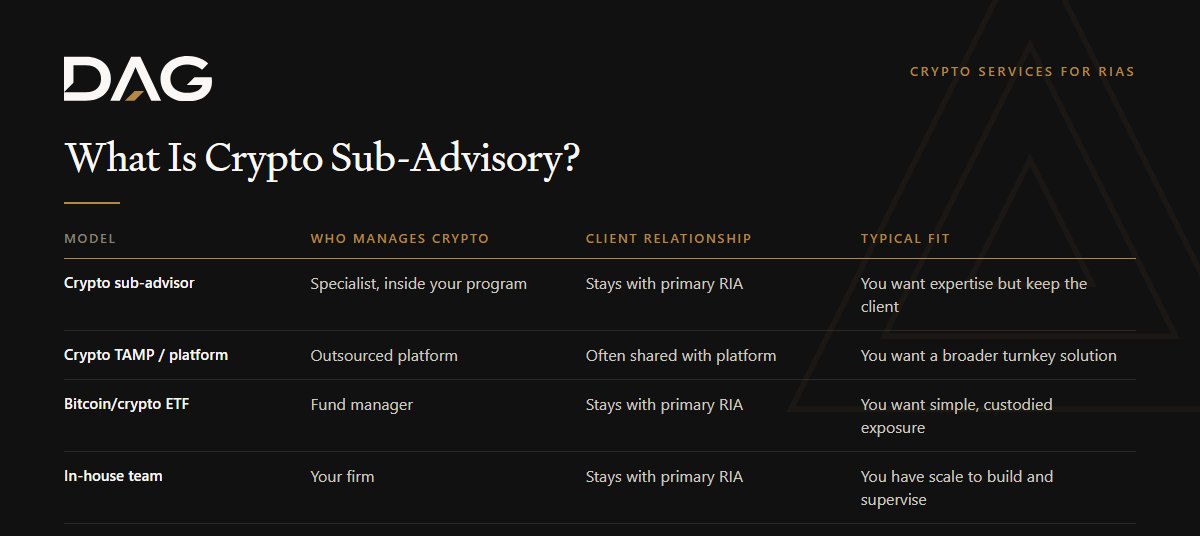
| Model | Who manages crypto | Client relationship | Typical fit |
|---|---|---|---|
| Crypto sub-advisor | Specialist, inside your program | Stays with primary RIA | You want expertise but keep the client |
| Crypto TAMP / platform | Outsourced platform | Often shared with platform | You want a broader turnkey solution |
| Bitcoin/crypto ETF | Fund manager | Stays with primary RIA | You want simple, custodied exposure |
| In-house team | Your firm | Stays with primary RIA | You have scale to build and supervise |
For the trade-offs of building versus outsourcing, see crypto outsourcing for RIAs and the practical view of how RIAs should choose a crypto sub-advisor.
Evidence Standard
This article explains a service structure, not a specific provider arrangement. Any example should be approved or labeled hypothetical.
When It May Help
- An RIA wants crypto expertise without hiring an internal team.
- Clients hold crypto away from the firm.
- The firm wants an approved allocation process.
- The firm needs digital asset models or SMAs.
- The firm wants specialist support for investment committee review.
When It May Not Be Enough
Sub-advisory does not eliminate the need for due diligence. The primary adviser still reviews fees, conflicts, custody, disclosures, authority, supervision, and client fit. A useful baseline:
- Confirm custody sits with a qualified custodian and request SOC 1 / SOC 2 reports.
- Review the sub-advisor's Form ADV, conflicts, and disciplinary history. Registration alone does not guarantee skill or results.
- Document who holds trading authority and how it is supervised.
- Map fee layering so the client understands total cost.
- Reconcile reporting and tax-lot data against custodial records.
A fuller version lives in the crypto due diligence checklist for RIAs.
Related Questions
Is crypto sub-advisory the same as a crypto TAMP?
Not exactly. A TAMP is usually a broader outsourced platform. A sub-advisor generally provides investment expertise or portfolio management inside a specific advisory relationship. The right label depends on the contract and authority involved.
Can a sub-advisor custody client assets?
Custody depends on the arrangement and the authority granted. In most cases assets are held with a qualified custodian rather than the sub-advisor. Advisers should review custody implications under applicable SEC rules with qualified counsel. For more, see qualified custody for RIAs managing digital assets.
Why not just use a crypto ETF?
An ETF can provide exposure, but it may not address direct digital asset custody, tax-lot tracking, client-wallet, estate, or broader allocation questions. The choice depends on the client's facts. See spot Bitcoin ETF vs direct Bitcoin for advisors for the comparison.
Bottom Line
Crypto sub-advisory can help RIAs build a digital asset capability without pretending crypto is just another ticker. The arrangement still needs careful compliance, custody, and disclosure review, and it does not remove market, custody, or tax risk.
Sources
Compliance Note
This article is for general educational purposes and is not legal, compliance, tax, custody, or investment advice. Advisory arrangements should be reviewed by qualified counsel and compliance professionals.