
An advisor should refer a crypto client to a specialist when the client's digital assets raise custody, tax, estate, trust, LLC, liquidity, or compliance questions that fall outside the advisor's normal process. Self-custodied holdings, missing cost-basis records, large unrealized gains, founder token unlocks, and crypto held in a trust or LLC are common signals that specialized help is warranted.
A referral can be a sign of sound process rather than a failure. Knowing where your firm's competence ends, and documenting that boundary, is part of meeting a fiduciary duty of care.
What "Refer to a Specialist" Means
A crypto specialist referral routes a discrete part of a client's digital-asset situation to a professional with deeper subject-matter expertise, while the primary advisor generally keeps the broader relationship. Depending on the issue, that specialist might be a crypto sub-advisor, a qualified custodian, a digital-asset tax preparer, or estate counsel. Referral does not, by itself, transfer fiduciary responsibility for the advice your firm continues to give, so scope should be defined in writing.
Referral Triggers
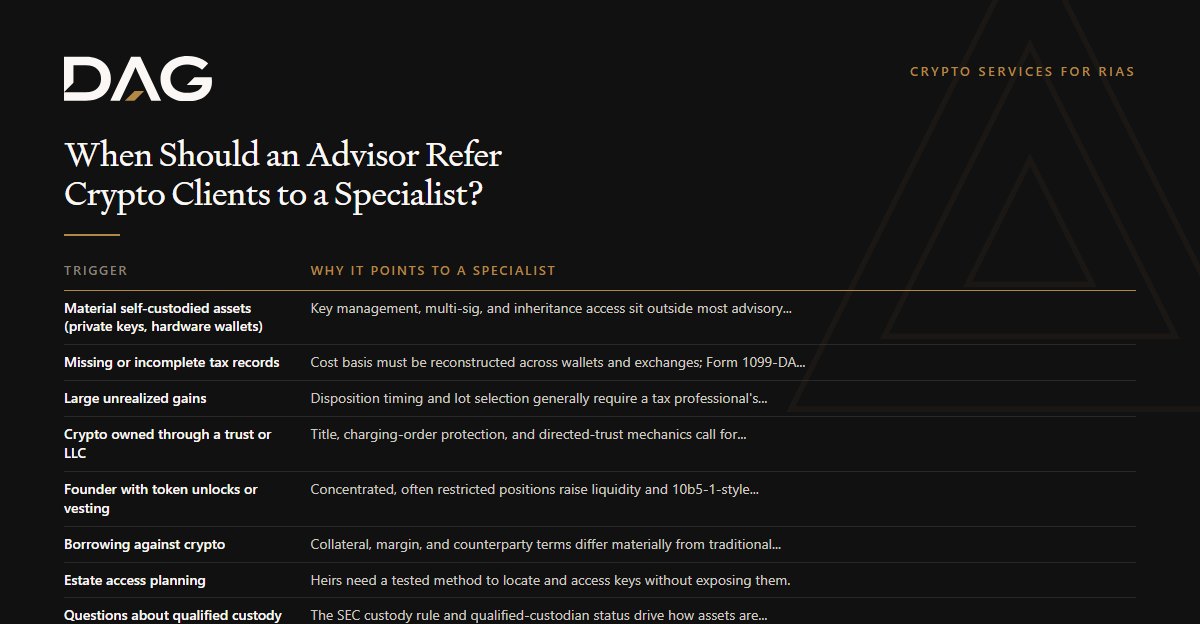
Consider a referral when any of the following appear. Each maps to a recognized area where digital assets behave differently from traditional securities.
| Trigger | Why it points to a specialist |
|---|---|
| Material self-custodied assets (private keys, hardware wallets) | Key management, multi-sig, and inheritance access sit outside most advisory workflows. See advising on self-custodied crypto. |
| Missing or incomplete tax records | Cost basis must be reconstructed across wallets and exchanges; Form 1099-DA reporting is still maturing. |
| Large unrealized gains | Disposition timing and lot selection generally require a tax professional's input. |
| Crypto owned through a trust or LLC | Title, charging-order protection, and directed-trust mechanics call for counsel. |
| Founder with token unlocks or vesting | Concentrated, often restricted positions raise liquidity and 10b5-1-style planning questions. |
| Borrowing against crypto | Collateral, margin, and counterparty terms differ materially from traditional lending. |
| Estate access planning | Heirs need a tested method to locate and access keys without exposing them. |
| Questions about qualified custody | The SEC custody rule and qualified-custodian status drive how assets are held. See qualified custody for RIAs. |
| Assets spread across multiple wallets or chains | Aggregation, reconciliation, and reporting grow complex. |
A single trigger does not force a referral; the question is whether the issue exceeds your firm's documented process and competence.
Specialist Roles
Depending on the facts, the right specialist may be a crypto wealth manager or sub-advisor, a qualified custodian, a digital-asset tax professional, estate or securities counsel, a security (key-management) professional, or a family office advisor. Many situations involve more than one. Firms that field these questions regularly sometimes formalize the relationship through crypto outsourcing for RIAs rather than building the capability in-house.
How to Document the Referral
When you refer, record the decision so the file reflects your process:
- State why the referral was made and which trigger prompted it.
- Identify what your firm will continue to advise on.
- Identify what is now outside your scope and who is handling it.
- Note any conflicts of interest or compensation tied to the referral, consistent with your Form ADV disclosures.
- Confirm the client understands the division of responsibilities.
This mirrors the discipline covered in how RIAs should document crypto recommendations.
Related Questions
Is referring a crypto client a sign the advisor lacks competence?
Generally no. Recognizing the limits of your firm's expertise and routing specialized work to a qualified professional is consistent with a fiduciary duty of care. The advice your firm continues to give still carries its own obligations, so define scope clearly.
Does a referral remove the advisor's responsibility for the client?
Not necessarily. Referral typically narrows scope rather than ending the relationship. The primary advisor generally remains responsible for the advice it continues to provide and for disclosing any related conflicts. Confirm the arrangement with compliance counsel.
Who is considered a crypto specialist for advisory clients?
It depends on the issue. Custody questions may point to a qualified custodian; tax questions to a digital-asset tax professional; structuring questions to estate or securities counsel; and ongoing management to a sub-advisor. No single credential covers every digital-asset need, so match the specialist to the specific problem.
Sources
Compliance Note
This article is educational and does not provide legal, compliance, tax, investment, fiduciary, or custody advice. Crypto assets carry market, custody, liquidity, and tax risks; referring a client to a specialist does not remove those risks or guarantee any outcome. Registration with the SEC does not imply a particular level of skill or training. Referral practices, scope, and any related compensation should be reviewed with compliance counsel. Registration does not imply a certain level of skill or training.