
Crypto services for RIAs help advisory firms address client digital asset exposure across six areas: custody review, sub-advisory, model portfolios, reporting, compliance workflows, and client education. They let a registered investment adviser bring crypto holdings into a documented, fiduciary process rather than leaving them outside the engagement.
What "Crypto Services for RIAs" Means
For a registered investment adviser, "crypto services" describes the operational and compliance scaffolding that lets the firm advise on digital assets within its fiduciary duty. That scaffolding spans where assets are held (a qualified custodian versus self-custody), who manages the strategy (the RIA directly or a crypto sub-advisor), how holdings are reported and reconciled, and how the firm documents recommendations under the SEC custody rule and Form ADV. None of these services remove market, custody, or tax risk; they organize how the firm manages it. This hub maps the building blocks and links to the detailed pages for each.
The RIA should define advisory scope before recommending or managing any crypto position.
Core Questions
- Can RIAs recommend crypto?
- Can RIAs recommend Bitcoin ETFs?
- Can RIAs advise on self-custodied crypto?
- How should RIAs review held-away crypto?
- How should RIAs choose a crypto sub-advisor?
- What crypto questions should advisors ask clients?
Service Areas
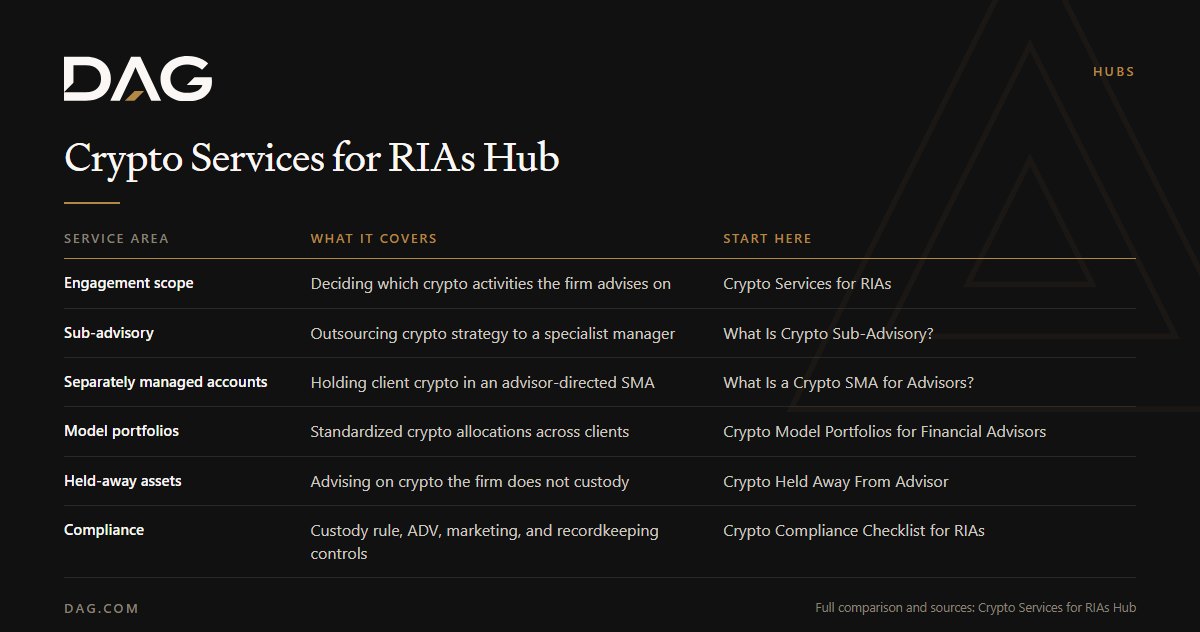
| Service area | What it covers | Start here |
|---|---|---|
| Engagement scope | Deciding which crypto activities the firm advises on | Crypto Services for RIAs |
| Sub-advisory | Outsourcing crypto strategy to a specialist manager | What Is Crypto Sub-Advisory? |
| Separately managed accounts | Holding client crypto in an advisor-directed SMA | What Is a Crypto SMA for Advisors? |
| Model portfolios | Standardized crypto allocations across clients | Crypto Model Portfolios for Financial Advisors |
| Held-away assets | Advising on crypto the firm does not custody | Crypto Held Away From Advisor |
| Compliance | Custody rule, ADV, marketing, and recordkeeping controls | Crypto Compliance Checklist for RIAs |
Custody and Sub-Advisory
Most RIA crypto engagements turn on two structural choices. The first is custody: whether client assets sit with a qualified custodian that can produce SOC 1 or SOC 2 reporting and support independent verification, or in self-custody where the firm faces different control and surprise-examination questions. The second is who runs the strategy. A firm that lacks in-house digital asset expertise can engage a crypto sub-advisor or place client assets in a crypto SMA, keeping the client relationship while delegating execution. Registration of any custodian or sub-advisor signals a regulatory baseline; it does not, on its own, guarantee skill, security, or performance, so independent due diligence still applies.
Portfolios and Held-Away Assets
When a firm advises across many clients, crypto model portfolios help apply a consistent, documented allocation rather than ad hoc positions. Building one starts with a method: RIA crypto model-portfolio construction covers asset selection, weighting, benchmark choice, and rebalancing triggers. Fitting that exposure to an individual client is its own step, addressed in how to add crypto to a client's financial plan, and keeping accounts aligned over time is the operational work of crypto rebalancing for advisor-managed accounts. Separately, many clients hold crypto the firm does not control. How a firm treats crypto held away from the advisor affects whether those assets fall inside the advisory relationship, how they are billed, and what the firm can responsibly say about them.
Compliance and Recordkeeping
Crypto advice sits inside the same regulatory frame as the rest of the practice. A crypto compliance checklist for RIAs typically covers custody-rule analysis, Form ADV disclosures, marketing-rule review of any crypto claims, and recordkeeping that ties recommendations to documented rationale. The filing layer has its own detail: the crypto ADV disclosure requirements for RIAs walk through what belongs in Form ADV Part 2A and 2B when a firm offers digital asset services. Because digital assets carry custody, market, and tax risk that no service structure eliminates, balanced disclosure belongs in client-facing material.
Tax and Estate Handoffs
Two coordination duties sit at the edges of the engagement. On tax, crypto tax-lot reporting for RIA clients is the workflow an advisor runs to reconcile cost basis across custodians and Form 1099-DA before it reaches the client's preparer. On wealth transfer, crypto estate planning for advisory clients is where the advisor coordinates private-key inheritance, trust alignment, and beneficiary consistency with the client's estate counsel. In both, the firm coordinates the professionals rather than giving tax or legal advice itself.
Advisor Workflow
- Ask about crypto ownership.
- Identify custody (qualified custodian vs. self-custody).
- Define advisory scope.
- Review compliance and custody-rule implications.
- Coordinate tax and estate handoffs.
- Document recommendations and their rationale.
Related Questions
Can an RIA recommend crypto to clients?
Generally an adviser can recommend digital assets where doing so is consistent with its fiduciary duty, the client's objectives, and the firm's disclosures, but the answer depends on the firm's registration, policies, and the specific facts. Confirm scope with compliance counsel before advising.
Does an RIA need a qualified custodian for client crypto?
Where the SEC custody rule applies, client assets generally must be held with a qualified custodian, and crypto raises specific questions about what qualifies. The analysis depends on the facts, so review it with compliance counsel rather than assuming a given arrangement complies.
Should an RIA use a crypto sub-advisor?
A sub-advisor can supply digital asset expertise a firm lacks, but the RIA generally retains oversight and due-diligence responsibility for the relationship. Registration of a sub-advisor does not by itself guarantee skill or results, so evaluate it on the facts.
Sources
- SEC: Investment Adviser Public Disclosure
- SEC: Custody rule compliance guide
- SEC: Commission Interpretation Regarding Standard of Conduct for Investment Advisers
Compliance Note
This hub is educational and does not provide legal, compliance, tax, investment, fiduciary, or custody advice. RIAs should consult compliance counsel. Registration does not imply a certain level of skill or training.