
Crypto banking and exchange setup is the work of connecting a digital-asset entity, usually an LLC, to the traditional financial system: opening a bank account, onboarding to exchanges, and supplying the addresses, business classifications, and documentation those institutions require. Approval is never guaranteed, and the right approach generally depends on the entity, the state, and the facts, so any plan should be reviewed with qualified professionals.
What Crypto Banking and Exchange Setup Is
Crypto banking and exchange setup is the process of giving a crypto entity the accounts it needs to send dollars, receive proceeds, and trade. Banks and exchanges apply anti-money-laundering (AML), know-your-customer (KYC), and know-your-business (KYB) checks to every applicant, and some banks decline crypto-related businesses entirely, this is a normal part of regulated finance, not an obstacle to engineer around. For how an entity fits into broader planning, see should I put my crypto in a Wyoming LLC and the Crypto LLC & Entity Formation Hub.
Core Questions
- How do I open a crypto-friendly bank account for my LLC?
- Why do some banks decline crypto-related businesses?
- Which exchanges accept LLC accounts, and what does setup cost?
- What NAICS code and business type should I select?
- What address do exchanges expect for a digital-asset LLC?
- Does an LLC make sense for a smaller crypto holder?
- What is account seasoning, and why does it come up?
Opening a Bank Account for a Crypto Entity
Most setups begin with a bank account, and the first reality is that approval is not assured. How do I open a crypto-friendly bank account for my Wyoming LLC walks through the documents and expectations involved, and why do banks refuse to open accounts for crypto-related businesses explains the risk and compliance reasons behind a decline. For the broader picture of how digital assets connect to traditional rails, see how to bridge the gap between digital assets and traditional banking and the general overview in opening bank accounts for crypto businesses.
Choosing an Exchange and Setting It Up
Exchange availability for entity accounts varies by platform and by state. In New York, for example, the BitLicense regime limits which exchanges will onboard residents and entities, so options are narrower there. Which exchanges work for LLC accounts if I'm in New York, and what are the setup fees covers that constraint, and shifting assets from exchanges to LLC accounts addresses moving holdings once an entity account is live. Before approving an entity account, a platform runs business verification: how exchanges verify business entities walks through the EIN, operating-agreement, and beneficial-ownership (FinCEN BOI) checks an exchange applies during KYB.
Beyond the Traditional Bank: Credit Unions and Neo-Banks
A traditional bank is not the only route to a dollar account. Many crypto operators look at fintech providers and member-owned institutions instead. Open a crypto business account at a credit union or neo-bank covers the application steps and documents for crypto-friendly banks and fintechs, where deposits sit at an FDIC-insured partner bank and availability for crypto activity varies by provider. As with any institution, approval depends on the provider's risk policy and is never assured.
Business Classification and Onboarding Details
Exchange and bank applications ask for a business type, a NAICS code, and an operating address, details that trip up many first-time entity owners. What business type should I select on a crypto exchange for a digital-asset LLC, and what NAICS codes are appropriate and what address do I give exchanges when they ask for principal operating address versus business address handle the two most common questions. Classification should describe the business accurately; NAICS codes are descriptive, not a way to obscure activity from a bank or exchange.
Is an Entity Worth It, and the Seasoning Question
Not every holder needs an entity, and the answer depends on portfolio size, goals, and cost. Setting up an LLC for small crypto holders: is it worth it weighs the trade-offs. A related question is account seasoning, letting an account establish a transaction history before large deposits. Why do I need to season my bank accounts before price appreciation explains the practical reasons. Seasoning is about a verifiable banking relationship and clean records; it is not a method to avoid AML, KYC, or reporting, and it does not change what must be disclosed.
Large Conversions, Reporting, and Recordkeeping
Once an account is live, the friction usually shifts from opening it to moving money through it. Large crypto-to-fiat conversions draw their own scrutiny: wire-transfer limits for large crypto-to-fiat conversions explains the bank and exchange limits, correspondent-bank friction, and the source-of-funds documentation and CTR/SAR review that a $500k-plus wire typically prompts. Behind that scrutiny are the federal rules themselves; FinCEN / BSA recordkeeping for crypto businesses covers MSB status, the AML-program basics, and what records a crypto business should keep and for how long. Reporting and recordkeeping are normal compliance, not something to engineer around.
When a Bank Closes the Account
Crypto-related accounts are sometimes frozen or closed, a pattern often called de-banking. What to do when a bank freezes or closes a crypto-business account covers why it happens, the SAR context that keeps a bank from explaining the reason, the remediation steps, and how to set up alternatives, without ever restructuring transactions to evade AML or reporting, which is itself unlawful.
How Banking Connects to Custody
A bank account moves dollars, but it does not hold the assets, that is the custodian's role. Where an entity holds significant digital assets, families often pair banking with qualified custody rather than leaving holdings on an exchange. See qualified custodian vs crypto exchange for the distinction, the crypto account opening checklist for trusts and LLCs for the documents involved, and the Crypto Custody Hub for the full custody picture.
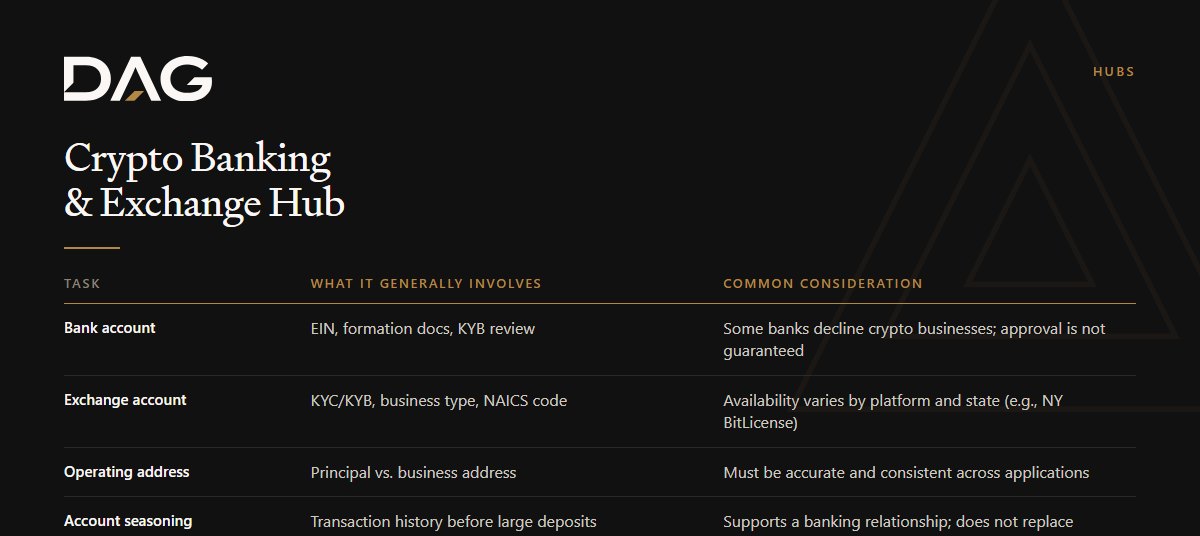
| Task | What it generally involves | Common consideration |
|---|---|---|
| Bank account | EIN, formation docs, KYB review | Some banks decline crypto businesses; approval is not guaranteed |
| Exchange account | KYC/KYB, business type, NAICS code | Availability varies by platform and state (e.g., NY BitLicense) |
| Operating address | Principal vs. business address | Must be accurate and consistent across applications |
| Account seasoning | Transaction history before large deposits | Supports a banking relationship; does not replace AML/KYC |
Related Questions
Can a crypto LLC always get a bank account?
No. Banks set their own risk policies, and some decline crypto-related businesses outright. A complete application. EIN, formation documents, and an accurate business description, improves the odds, but no entity is guaranteed approval at any particular bank.
Why do banks and exchanges ask so many questions?
AML, KYC, and KYB requirements apply to regulated financial institutions, so they verify who owns and controls an entity and what it does. Expecting these checks and answering them accurately is the normal path to an open account.
Does where I live affect which exchanges I can use?
Yes. State rules matter. New York's BitLicense regime, for instance, limits which exchanges serve residents and entities there, so available platforms and setup costs differ by state. Confirm current availability with the exchange.
Sources
- FinCEN: Money Services Business (MSB) information
- NYDFS: Virtual currency businesses (BitLicense)
- U.S. Census Bureau: NAICS
Compliance Note
This hub is educational and does not provide legal, tax, banking, or investment advice. Bank and exchange approval is never guaranteed, and AML/KYC/KYB requirements apply. Account setup should be reviewed with qualified professionals.