
Seasoning bank accounts for crypto deposits means building consistent transaction history before large crypto-derived funds arrive, so those deposits fit an established pattern and clear routine AML review faster, a critical step in crypto banking and exchange setup. It is not about avoiding scrutiny. It is about documenting your legitimate source of funds so expected compliance checks proceed transparently and smoothly.
What Does "Seasoning" a Bank Account Mean?
Bank compliance systems monitor accounts using behavioral algorithms that learn what "normal" looks like for each account. An account that receives a $3,000 monthly payroll deposit and pays routine bills has a distinct pattern. A sudden six-figure wire from a crypto exchange breaks that pattern entirely, regardless of whether the funds are legitimate.
When a deposit falls outside an account's established pattern, the bank's automated systems flag it for Anti-Money Laundering (AML) review. That review may result in:
- A temporary account hold while compliance staff request documentation
- A formal source-of-funds investigation
- Demands for exchange statements, wallet transaction histories, and tax records
- In some cases, account closure if the bank decides the compliance burden is too high
Seasoning does not prevent the bank from reviewing your deposit. It gives compliance staff the transaction history and context they need to clear the deposit quickly.
What Triggers AML Review on a Large Deposit?
U.S. banks are required under the Bank Secrecy Act (BSA) to monitor for suspicious activity and file Currency Transaction Reports (CTRs) on cash transactions over $10,000. For non-cash deposits such as wire transfers from crypto exchanges, banks file Suspicious Activity Reports (SARs) when a transaction appears inconsistent with the account's established pattern or purpose.
A large crypto-derived deposit into a low-activity personal checking account will commonly trigger enhanced review because:
- The deposit amount is dramatically higher than the account's typical activity
- The source (a crypto exchange) may be unfamiliar to the bank's compliance system
- The account has no prior history of receiving funds of this type or size
CTR and SAR filings are a routine, expected part of how the banking system works. They are not an accusation, and they are not something a legitimate depositor needs to avoid. The same review applies to any sudden large deposit with no prior context. Seasoning helps the bank clear that review faster, it does not, and should not, reduce the bank's reporting obligations.
Important: Structuring deposits specifically to avoid CTR or SAR filing thresholds is a federal crime under 31 U.S.C. § 5324, even when the underlying funds are entirely legitimate. The goal of seasoning is the opposite of structuring: a transparent, documented account history that helps expected reporting proceed normally, never splitting deposits to dodge a threshold.
How Seasoning Reduces AML Friction
A seasoned account has an established pattern that a large deposit can fit into. A business account opened through a properly formed Wyoming LLC for crypto assets and used for regular business-related transactions over several months gives compliance staff:
- Transaction history demonstrating the account's legitimate business purpose
- A prior pattern of handling larger or irregular deposits
- An entity structure (the LLC) that contextualizes variable-income deposits
When crypto proceeds eventually deposit into that account, the bank's compliance system has context. The deposit looks like a business revenue event, not an unexplained windfall.
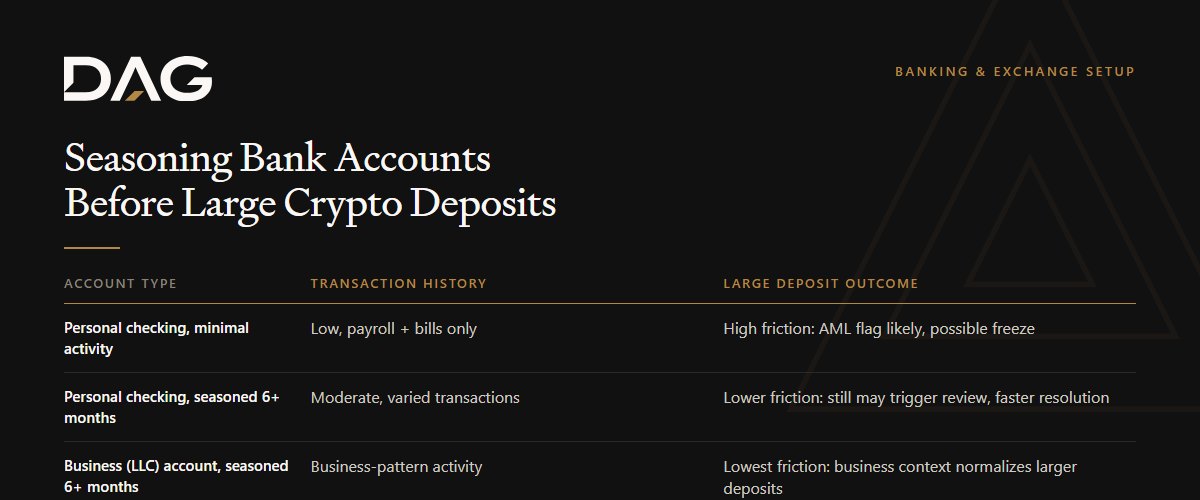
| Account Type | Transaction History | Large Deposit Outcome |
|---|---|---|
| Personal checking, minimal activity | Low, payroll + bills only | High friction: AML flag likely, possible freeze |
| Personal checking, seasoned 6+ months | Moderate, varied transactions | Lower friction: still may trigger review, faster resolution |
| Business (LLC) account, seasoned 6+ months | Business-pattern activity | Lowest friction: business context normalizes larger deposits |
Timelines and outcomes vary by bank, deposit size, and specific transaction history. This table is illustrative only.
What Documentation Should You Prepare?
Regardless of account seasoning, anyone converting substantial crypto holdings to fiat should prepare source-of-funds documentation before the deposit arrives. This documentation supports a clean compliance review:
- Exchange account statements, full transaction history from the exchange where the sale occurred
- Original acquisition records, records showing when and at what cost you acquired the crypto
- Wallet address history, on-chain transaction records linking your wallet to the exchange
- Tax records, prior-year returns or tax planning documents showing crypto holdings were reported
- Entity formation documents, if depositing into an LLC account, operating agreement and formation documents
Assembling this documentation in advance means you can respond to a bank compliance request in days rather than weeks.
Should You Use a Business (LLC) Account?
A business account structured through a Wyoming digital asset LLC serves a different purpose than a personal account and is classified accordingly by bank compliance systems. Business accounts are designed to receive revenue deposits of varying size and timing.
A business account does not eliminate AML review. It provides a legitimate, documented context for larger and irregular deposits, the kind that large crypto-to-fiat conversions represent.
For guidance on the entity structure itself, see Should I Put My Crypto in a Wyoming LLC? and How to Transfer Crypto Into an LLC.
What Happens If You Deposit Without Seasoning?
Depositing large crypto proceeds into an unseasoned personal account does not necessarily result in permanent loss of funds, but it commonly results in:
- An account hold lasting days to several weeks while compliance review proceeds
- A formal request for source-of-funds documentation
- Potential account closure if the bank decides the compliance profile is too high-risk
Banks may legally close accounts at their discretion. If an account receives a large deposit with no prior transaction history and inadequate documentation, some banks will return the funds and close the account. This is sometimes called "debanking." The resolution process is time-consuming and stressful, and is avoidable with advance preparation.
Related Questions
Does seasoning guarantee my deposit will clear without issues?
No. Seasoning reduces AML friction by establishing transaction history, but it does not guarantee any particular outcome. Banks retain full discretion to investigate any deposit and to close accounts. Your strongest protection is documentation, clear records of where your crypto came from, when you acquired it, and that it has been reported for tax purposes.
Is it legal to open an LLC just to receive crypto proceeds?
Yes. Using a properly formed LLC to hold assets and receive business-related deposits is a legitimate and common structure. The LLC must be genuinely operational, formation documents, a real bank account, and actual business activity, not a shell created solely to disguise the source of funds. See What Is a Wyoming Digital Asset LLC? for structure requirements.
How long does it take to "season" an account?
There is no regulatory bright line. Six months of consistent, legitimate transaction activity is sometimes cited as a practical rule of thumb, it is illustrative only, not a legal standard, and the quality and variety of transactions matters as much as duration. An account that has received multiple deposits, paid regular expenses, and has a clear business purpose will receive less scrutiny than one with minimal activity regardless of age.
What if my bank asks me to explain the deposit?
Respond promptly and fully. Provide exchange statements, acquisition records, and any entity documents. Slow or incomplete responses extend holds. Banks file SARs when they cannot satisfactorily explain a transaction, full cooperation is both legally appropriate and practically faster. Consult a financial attorney if you receive a formal legal hold or if funds remain frozen beyond a few weeks.
Will the bank report my deposit to the IRS?
CTRs go to FinCEN (a U.S. Treasury bureau), not directly to the IRS, though FinCEN data can be accessed in investigations. Separately, crypto exchanges operating in the U.S. issue Form 1099-DA (beginning tax year 2025) and may report to the IRS. Large deposits are not themselves taxable events, the taxable event is the sale of crypto. See What Is Form 1099-DA? and Crypto Tax Planning for HNW Investors for tax-reporting context.
Sources
- Bank Secrecy Act, 31 U.S.C. §§ 5311–5336, https://uscode.house.gov/view.xhtml?path=/prelim@title31/subtitle4/chapter53&edition=prelim
- 31 U.S.C. § 5324 (Structuring prohibition), https://uscode.house.gov/view.xhtml?req=granuleid:USC-prelim-title31-section5324&num=0&edition=prelim
- FinCEN Currency Transaction Report (CTR) requirements, https://www.fincen.gov/resources/statutes-regulations/guidance/bank-secrecy-act
- FinCEN Suspicious Activity Report (SAR) guidance, https://www.fincen.gov/financial-institution-advisory-suspicious-activity-reports
- IRS Form 1099-DA (Digital Asset Proceeds), https://www.irs.gov/forms-pubs/about-form-1099-da (verify current availability; rule phased in starting tax year 2025)
Compliance Note
This article is educational and does not constitute legal, tax, investment, or financial advice. AML compliance obligations, bank policies, and crypto-reporting requirements change frequently; verify all details with a qualified attorney, CPA, or compliance professional before acting. DAG coordinates with licensed attorneys and tax professionals and does not itself provide legal or tax advice; entity formation and any related drafting are legal services performed by licensed counsel. Advisory services are provided by DAG Wealth, an SEC-registered investment adviser. Registration does not imply a certain level of skill or training. Nothing in this article should be construed as a guarantee that any deposit will clear, that any account structure will prevent AML review, or that any particular outcome will follow from the steps described.