
Form 1099-DA is an IRS information return that certain digital asset brokers use to report sale and exchange transactions. It reports proceeds, and in some cases cost basis, to you and to the IRS. It does not replace your own duty to keep complete records and report all income, gains, and losses accurately.
What Form 1099-DA Is
Form 1099-DA ("Digital Asset Proceeds From Broker Transactions") is the IRS information return created for digital asset brokers, modeled loosely on the 1099-B used for traditional securities. A broker generally issues one to you and files a copy with the IRS, summarizing reportable dispositions on a covered platform. It is a starting point for reconciliation, not a finished tax return. For broader context on how these forms fit together, see the Crypto Tax Records Hub.
Why This Matters
As broker reporting rules phase in, crypto investors should see more standardized forms arrive each tax season. A single form rarely captures the whole picture. Digital asset activity can span transfers between wallets, DeFi, staking, airdrops, forks, entity and trust ownership, and off-platform holdings that no broker tracks. Where a form and your records disagree, the burden to reconcile generally falls on you. The common crypto tax record mistakes page covers the gaps that surface most often.
How It Works: What to Reconcile
A 1099-DA may carry broker-reported figures, but you and your tax professional still need to confirm the underlying data. Work through each item:
- Cost basis, including lots a broker may not have.
- Acquisition dates and holding periods.
- Transfers between your own wallets, which are generally not taxable sales.
- Assets held outside any broker.
- Trust or LLC ownership and the correct taxpayer.
- Staking rewards and other income items.
- Missing or inconsistent records across sources.
A non-taxable wallet-to-wallet move can look like a disposition if records are thin; see how to separate crypto transfers from taxable sales and are crypto wallet transfers taxable?.
Form 1099-DA vs. Your Own Records
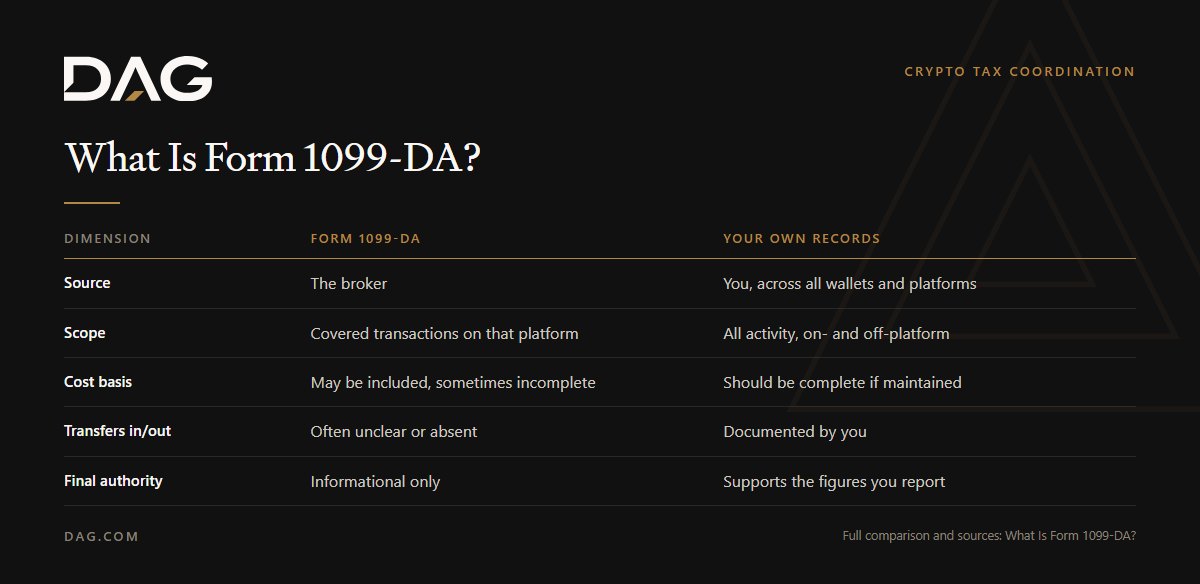
| Dimension | Form 1099-DA | Your own records |
|---|---|---|
| Source | The broker | You, across all wallets and platforms |
| Scope | Covered transactions on that platform | All activity, on- and off-platform |
| Cost basis | May be included, sometimes incomplete | Should be complete if maintained |
| Transfers in/out | Often unclear or absent | Documented by you |
| Final authority | Informational only | Supports the figures you report |
The form supports your reporting; it does not replace it. If your basis is uncertain, see how to reconstruct crypto cost basis.
Evidence Standard
This article summarizes IRS information at a high level and does not provide taxpayer-specific advice.
When It May Help
- You use brokers or platforms subject to reporting.
- You need to reconcile tax forms against your own records.
- Your CPA needs digital asset data in a consistent format.
- You hold assets across multiple accounts or wallets.
When It May Not Be Enough
Receiving a 1099-DA does not mean your return is complete, and not receiving one does not mean there is nothing to report. The form reflects what one broker saw, not your full tax position. Coordinating these forms with a complete record set is part of reporting crypto from multiple exchanges.
Related Questions
Does 1099-DA show cost basis?
It may include basis in some circumstances, but the figure can be incomplete, especially for assets transferred in from elsewhere. Verify against your own records and consult a tax professional before relying on it.
Do wallet transfers appear on 1099-DA?
It depends on the broker's activity and the facts. Transfers between your own personal wallets generally are not taxable sales, but they often require separate recordkeeping to document.
Does 1099-DA apply to trusts and LLCs?
Reporting for entities and trusts can be more complex, including which taxpayer the form names. Review these situations with a tax professional familiar with digital assets.
When does Form 1099-DA take effect?
The IRS has phased in broker reporting, with proceeds reporting beginning before cost-basis reporting. Exact timing depends on the transaction type and tax year, so confirm the current requirements for your situation.
Bottom Line
Form 1099-DA can make digital asset reporting more consistent, but it is not a substitute for complete crypto tax records and does not remove tax, custody, or market risk.
Sources
Compliance Note
This article is for general educational purposes and is not tax, legal, accounting, or investment advice.