
Crypto cost basis methods are the accounting rules that decide which tax lot you are treated as selling when you dispose of a digital asset. The three most common are FIFO (first-in, first-out), HIFO (highest-in, first-out), and Specific Identification. The method you use directly changes the gain or loss reported on each sale, so it changes the tax due. The IRS generally treats digital assets as property, and recent rules require basis to be tracked per wallet or account.
What "Cost Basis Method" Means for Crypto
Cost basis is what you paid for a unit of crypto, including acquisition fees. When you sell or trade, your gain or loss is proceeds minus the basis of the units sold. The problem: if you bought the same coin at different prices over time, which units did you sell? The cost basis method answers that question.
- FIFO assumes the oldest units are sold first.
- HIFO assumes the highest-cost units are sold first (a sub-strategy usually implemented through Specific Identification).
- Specific Identification lets you choose exactly which tax lot you are selling, provided you can substantiate the identification with adequate records.
Because crypto is treated as property, the same lot-selection logic that applies to other property generally applies here. The choice matters most for investors who bought at widely varying prices.
How Does Each Method Change the Tax Result?
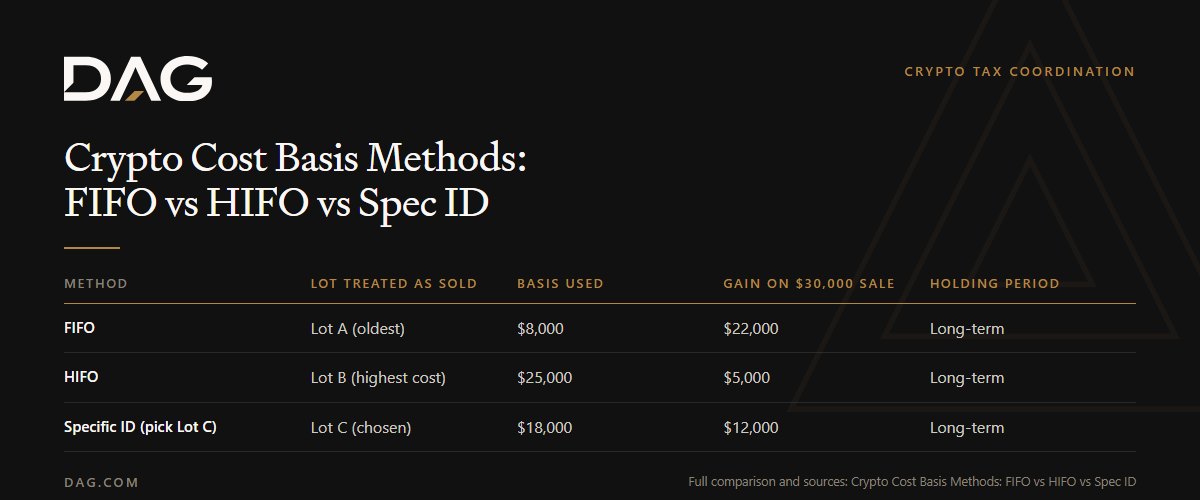
The method does not change how much you bought for in total. It changes the timing of when that basis is used, which changes the gain reported in any given year. The illustrative scenario below shows the mechanics.
Assume an investor holds three lots of the same coin and sells one unit for $30,000 in 2026. Figures are illustrative and dated 2026-06-02; verify current rules with a qualified professional.
| Lot | Acquired | Units | Cost per unit |
|---|---|---|---|
| A | Jan 2021 | 1 | $8,000 |
| B | Nov 2021 | 1 | $25,000 |
| C | Jun 2024 | 1 | $18,000 |
| Method | Lot treated as sold | Basis used | Gain on $30,000 sale | Holding period |
|---|---|---|---|---|
| FIFO | Lot A (oldest) | $8,000 | $22,000 | Long-term |
| HIFO | Lot B (highest cost) | $25,000 | $5,000 | Long-term |
| Specific ID (pick Lot C) | Lot C (chosen) | $18,000 | $12,000 | Long-term |
FIFO produces the largest current gain here because the cheapest, oldest lot is sold first. HIFO produces the smallest current gain by using the most expensive lot. Specific Identification lets the investor target a particular outcome, for example, choosing a lot to manage the size of the gain or to harvest a loss. None of these methods reduces total lifetime gain; they shift where the gain lands. A lower gain now generally means a lower remaining basis later, and a larger gain on a future sale.
Holding period also matters. Selling a lot held more than one year is generally long-term (lower rates); a lot held one year or less is short-term (ordinary rates). Specific Identification can let you favor a long-term lot, but the facts control.
The 2025 Per-Wallet / Per-Account Basis Rule
Older practice sometimes pooled basis across all of an investor's holdings (a "universal" approach). Under regulations effective beginning in 2025, basis is generally tracked on a per-wallet or per-account basis, not pooled across every venue. In practical terms, the lots available to identify on a sale are generally the lots held in that specific wallet or account. The IRS also provided transition relief allowing investors to allocate unused basis across accounts as of the start of 2025. This is a moving area; confirm the current requirement and any safe harbor with a qualified tax professional, and see how to reconstruct crypto cost basis if your historical records are incomplete.
Specific ID Substantiation: What Records You Need
Specific Identification (and HIFO implemented through it) is only respected if you can substantiate which units you sold. The identification generally must be made by the time of the sale or transfer, and your records should show, for each unit: the date and time it was acquired, your basis and the fair market value at acquisition, and the date, time, value, and proceeds at disposition. Without that contemporaneous record, the default is generally FIFO. For the deeper mechanics, see what is Specific Identification for crypto. If you cannot prove which lots you held, review what if I cannot prove my crypto cost basis.
Choosing a Method: Considerations
- Records first. Specific ID and HIFO require lot-level records and a per-wallet view; without them, FIFO applies by default.
- Consistency and software. Your method should match what your tax software and your CPA actually compute, and it must align with the per-account rule.
- Current vs future tax. Minimizing this year's gain raises future gain on the same coins. The right answer depends on rate expectations and your overall plan.
- Forms. Dispositions are generally reported on Form 8949 and Schedule D; see Form 8949 for crypto investors.
This is method selection inside a broader plan. For larger portfolios, the choice connects to crypto tax planning for HNW investors and sits within the crypto tax records discipline.
Related Questions
Is HIFO the same as Specific Identification?
Not exactly. HIFO is a way of choosing lots, sell the highest-cost units first, and it is generally implemented through Specific Identification. To use HIFO, you must meet the same substantiation standard required for Specific ID. Confirm with a qualified tax professional that your records and software support it.
What happens if I don't choose a method?
If you cannot adequately identify which units you sold, the default is generally first-in, first-out (FIFO), meaning the oldest lots are treated as sold first. That can produce a larger or smaller gain than you intended, depending on your purchase history.
Did the rules change in 2025 for crypto cost basis?
Yes. Beginning in 2025, basis is generally tracked per wallet or account rather than pooled across all holdings, and transition relief addressed how to allocate existing basis. This is a recent and evolving area; verify the current requirement with a tax professional.
Can I switch cost basis methods year to year?
Method selection is constrained by the substantiation and per-account rules, and switching can have consequences for how remaining basis is tracked. Do not assume you can freely change methods; confirm the rules with your CPA before relying on a switch.
Sources
- IRS, "Digital Assets" (guidance and FAQs). https://www.irs.gov/filing/digital-assets
- IRS Notice 2014-21 (virtual currency treated as property). https://www.irs.gov/pub/irs-drop/n-14-21.pdf
- IRS, "About Form 8949." https://www.irs.gov/forms-pubs/about-form-8949
- IRS Publication 551, Basis of Assets.
- IRS Revenue Procedure 2024-28 (per-account basis allocation / transition relief for digital assets).
Compliance Note
This article is for educational purposes only and does not constitute tax, legal, investment, fiduciary, or accounting advice. Cost basis rules, including the per-wallet basis requirement and Specific Identification substantiation, are fact-specific and a moving target that can change with new legislation or IRS guidance; the figures, lots, and scenarios shown are illustrative and dated 2026-06-02, and you should verify current law. The firm coordinates with qualified tax professionals and does not itself provide tax advice. Digital assets carry risk, including the potential loss of principal; nothing here implies guaranteed returns or tax savings. Advisory services are provided by DAG Wealth, an SEC-registered investment adviser. Consult a qualified CPA or tax attorney about your specific facts. Registration does not imply a certain level of skill or training.