
Crypto tax deferral cannot use a Section 1031 like-kind exchange: the TCJA restricted §1031 to real property only, effective 2018, so every crypto swap, sale, or use is a taxable disposition. Legitimate alternatives. Opportunity Zones, Charitable Remainder Trusts, loss harvesting, crypto-backed loans, charitable giving, each carry conditions; several of these are also covered in the context of crypto estate planning for trust and CRT structures. Educational only; consult a qualified CPA or tax attorney.
What Is Crypto Tax Deferral?
Crypto tax deferral refers to strategies that postpone, not eliminate, the recognition of capital gains on appreciated digital assets. A true deferral delays when the IRS considers a gain realized and taxable. Not all approaches marketed as "deferral" achieve this; some merely shift timing, others require irrevocable charitable commitments, and one common strategy, the §1031 exchange, has not applied to crypto since 2018.
Why Section 1031 Does Not Apply to Cryptocurrency
The IRS classifies cryptocurrency as property under Revenue Ruling 2023-14 and prior guidance. That classification matters, but it does not make crypto eligible for like-kind exchange treatment.
The TCJA (Public Law 115-97, §13303) amended Internal Revenue Code §1031 to limit like-kind exchanges to real property only, effective for exchanges completed after December 31, 2017. Crypto is not real property. No regulatory exception exists.
What this means in practice:
| Transaction | Tax treatment |
|---|---|
| BTC → ETH swap | Taxable disposition; capital gain/loss recognized |
| Crypto sold for USD | Taxable disposition |
| Crypto used to buy goods/services | Taxable disposition |
| Staking rewards received | Ordinary income when received |
| DeFi yield, airdrops, mining income | Ordinary income when received |
| Wallet-to-wallet transfer (same owner) | Generally not taxable, see Are Crypto Wallet Transfers Taxable? |
Applying §1031 to crypto swaps after 2017 creates audit exposure and potential penalties. If you received advice before 2018 suggesting crypto qualified, that window closed years ago.
Does the 1031 Exchange Defer Crypto Tax?
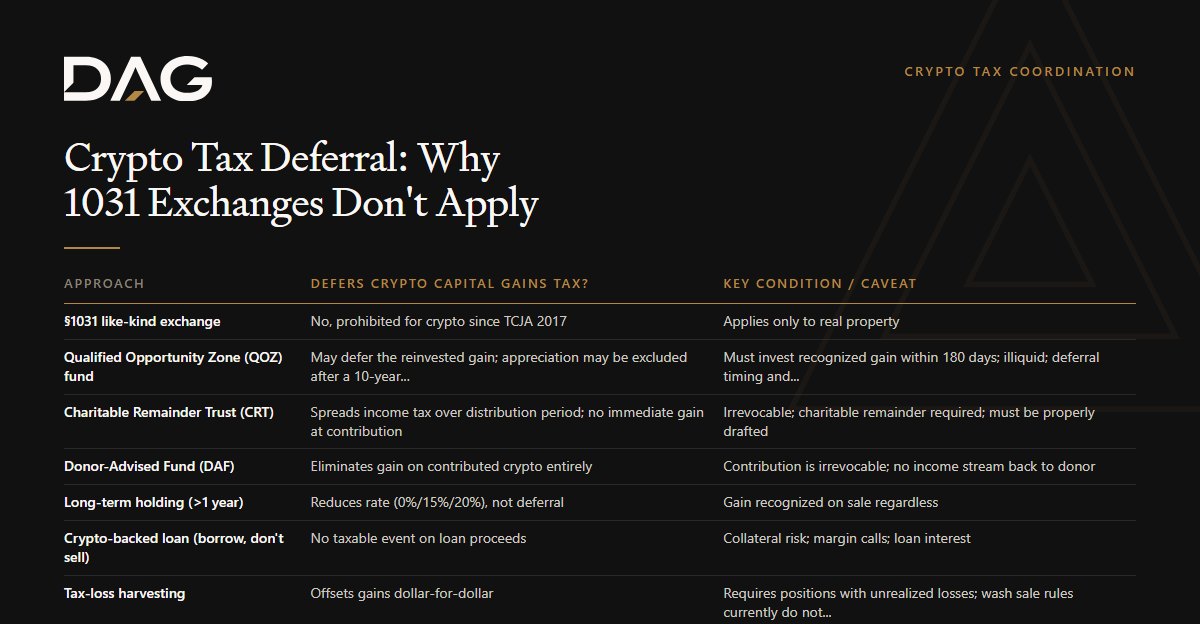
No. The following table corrects the most common myth and maps it against strategies that may actually work, depending on facts and circumstances.
| Approach | Defers crypto capital gains tax? | Key condition / caveat |
|---|---|---|
| §1031 like-kind exchange | No, prohibited for crypto since TCJA 2017 | Applies only to real property |
| Qualified Opportunity Zone (QOZ) fund | May defer the reinvested gain; appreciation may be excluded after a 10-year hold | Must invest recognized gain within 180 days; illiquid; deferral timing and QOZ rules have changed under recent legislation, verify current law |
| Charitable Remainder Trust (CRT) | Spreads income tax over distribution period; no immediate gain at contribution | Irrevocable; charitable remainder required; must be properly drafted |
| Donor-Advised Fund (DAF) | Eliminates gain on contributed crypto entirely | Contribution is irrevocable; no income stream back to donor |
| Long-term holding (>1 year) | Reduces rate (0%/15%/20%), not deferral | Gain recognized on sale regardless |
| Crypto-backed loan (borrow, don't sell) | No taxable event on loan proceeds | Collateral risk; margin calls; loan interest |
| Tax-loss harvesting | Offsets gains dollar-for-dollar | Requires positions with unrealized losses; wash sale rules currently do not apply to crypto but may change |
| Private Placement Life Insurance (PPLI) | Defers growth inside policy | High minimums; regulatory compliance required; complex |
Strategies That May Work for HNW Holders
Each strategy below requires facts-and-circumstances analysis by a qualified CPA or tax attorney. None is a guaranteed outcome.
Qualified Opportunity Zone (QOZ) Investments
After selling a crypto position, you may reinvest the recognized gain into a Qualified Opportunity Fund within 180 days, deferring tax on that gain. If the QOZ investment is held at least ten years, appreciation on the new investment may be excluded from tax.
QOZ funds typically invest in real estate development in IRS-designated census tracts, and capital is illiquid for the holding period. The deferral timeline and the rules governing new investments have changed under legislation enacted since 2017 (illustrative; verify current law), so confirm the current deferral deadline and exclusion mechanics with your tax attorney before committing. Coordination with crypto tax planning for HNW investors is advisable.
Charitable Remainder Trusts (CRTs)
A CRT allows you to contribute appreciated crypto to an irrevocable trust. The trustee sells the asset inside the trust, avoiding immediate capital gains recognition at the time of contribution, and reinvests proceeds. You receive an income stream for a set term or life; the remainder passes to a designated charity.
The income distributions are taxable as received, spread over multiple years rather than hitting in a single tax year. You also receive a partial charitable deduction based on the present value of the charitable remainder interest. CRTs work best for founders or long-term holders with very low-basis positions who have genuine philanthropic intent and want an income stream. The trust must be drafted to IRS specifications and administered correctly or it loses its tax-exempt status. See crypto charitable giving for high-net-worth investors for related detail.
Donor-Advised Funds (DAFs)
Contributing appreciated crypto directly to a DAF eliminates capital gains tax on the contributed amount entirely. You receive a fair market value deduction, and the DAF distributes grants to your designated charities over time. Unlike a CRT, a DAF provides no income stream back to you. Simpler to administer than a CRT; a good fit when philanthropic goals are clear and income is not needed.
Borrowing Against Crypto Instead of Selling
Crypto-backed loans generate no taxable event on loan proceeds, you are borrowing, not selling. For holders who want liquidity without triggering a gain, this approach may bridge a timing gap. Tradeoffs are significant: collateral liquidation risk if prices drop, margin calls, and loan interest costs. Relevant detail at crypto-backed loans for high-net-worth investors.
Tax-Loss Harvesting
Crypto's volatility creates loss harvesting opportunities rarely available in traditional asset classes. A position down significantly during the year can be sold, the loss captured, and the position repurchased. Unlike stocks, crypto is currently not subject to wash sale rules under the Internal Revenue Code, though Congress has proposed applying them, and this may change. Harvested losses offset recognized gains elsewhere in your portfolio.
This requires clean cost basis tracking: acquisition date, acquisition cost, sale date, and sale price for every transaction. See crypto tax-loss harvesting for high-net-worth investors for practical mechanics.
Long-Term Holding
Holding a position more than one year before sale qualifies gains for long-term capital gains rates (0%, 15%, or 20% depending on income), compared to ordinary income rates on short-term gains. This is rate reduction, not deferral, the gain is still recognized on sale, but for concentrated positions, the rate difference can be substantial.
Where Enforcement Risk Is Highest
IRS crypto enforcement has increased materially since 2020. Form 1040 now asks about crypto transactions directly. Exchanges are required to file Form 1099-DA beginning in 2025. On-chain data is traceable across wallets.
Common mistakes that create audit exposure:
- Treating crypto-to-crypto trades as non-taxable
- Missing staking rewards, DeFi income, or airdrops as ordinary income
- Incomplete cost basis records across multiple wallets and exchanges
- Using FIFO accounting without evaluating whether specific identification would reduce tax
- Relying on advisors who have not updated their crypto guidance since 2017
Clean transaction records are the foundation of any tax strategy. See common crypto tax record mistakes and how to prepare crypto records for a CPA.
Related Questions
Can I use a 1031 exchange on any type of cryptocurrency?
No. Since January 1, 2018, Section 1031 applies only to real property under TCJA §13303. No cryptocurrency. Bitcoin, Ethereum, stablecoins, or any other token, qualifies for like-kind exchange treatment. Every crypto-to-crypto swap is a taxable disposition in the year it occurs.
What triggers capital gains tax on crypto?
Any disposition: swapping one token for another, selling for fiat, using crypto to pay for goods or services, or transferring crypto to a third party. Receiving staking rewards, mining income, DeFi yield, or airdrops triggers ordinary income, not capital gains, in the year received. Wallet-to-wallet transfers between addresses you own are generally not taxable events, but must be documented.
Are there legitimate crypto tax deferral strategies for large positions?
Yes, depending on facts and circumstances. Qualified Opportunity Zone investments, Charitable Remainder Trusts, Donor-Advised Funds, and crypto-backed loans each address different scenarios. None eliminates tax permanently except charitable vehicles (where the charitable remainder effectively absorbs the gain). All require coordination with a qualified CPA and, for trust structures, an estate attorney. See what should I do after a large crypto gain for a broader decision framework.
Does holding crypto in a trust defer capital gains tax?
No, holding crypto in a trust does not itself defer gains. A trust is a separate taxpayer and recognizes gains when it sells. Certain irrevocable charitable trusts (CRTs) avoid immediate gain recognition at contribution, but the income is taxable as distributed. See crypto trust structures compared for how different trust forms affect tax treatment.
Sources
- IRS, "Frequently Asked Questions on Virtual Currency Transactions," updated 2024. https://www.irs.gov/individuals/international-taxpayers/frequently-asked-questions-on-virtual-currency-transactions
- Internal Revenue Code §1031 (as amended by TCJA §13303, Pub. L. 115-97, enacted December 22, 2017). https://uscode.house.gov/view.xhtml?req=granuleid:USC-prelim-title26-section1031
- IRS Revenue Ruling 2023-14 (staking income recognized when received). https://www.irs.gov/pub/irs-drop/rr-23-14.pdf
- IRS Notice 2014-21 (cryptocurrency classified as property). https://www.irs.gov/pub/irs-drop/n-14-21.pdf
- IRS, "Digital Assets," Form 1040 instructions (2024). https://www.irs.gov/businesses/small-businesses-self-employed/digital-assets
Compliance Note
This page is published for educational purposes only. It does not constitute legal, tax, or investment advice and should not be relied upon as such. Tax law is complex, changes frequently, and its application depends on individual facts and circumstances. The strategies described above may or may not be appropriate for any specific situation. Consult a qualified CPA, tax attorney, or registered investment adviser before implementing any tax strategy. Trust and estate structures (including CRTs) involve legal drafting; Digital Ascension Group (DAG) coordinates wealth planning infrastructure and does not provide tax or legal advice directly. Registration does not imply a certain level of skill or training.