
To separate crypto transfers from taxable sales, match each withdrawal to the corresponding deposit across wallets you control, flag true disposals that changed legal ownership, and keep records showing who owned the asset before and after every movement. Moving coins between your own wallets is generally not a taxable event; a sale or exchange generally is.
A self-transfer is a movement of crypto between two wallets or accounts the same taxpayer or entity controls, with no change in beneficial ownership. A taxable sale or exchange is a disposal, converting to fiat, swapping one asset for another, paying for goods or services, or sending to someone else. The IRS generally treats digital assets as property, so disposals can trigger gain or loss while internal transfers usually do not. Getting this classification right is one of the most important steps in crypto cost basis cleanup, and it underpins the wider discipline covered in the Crypto Tax Records Hub.
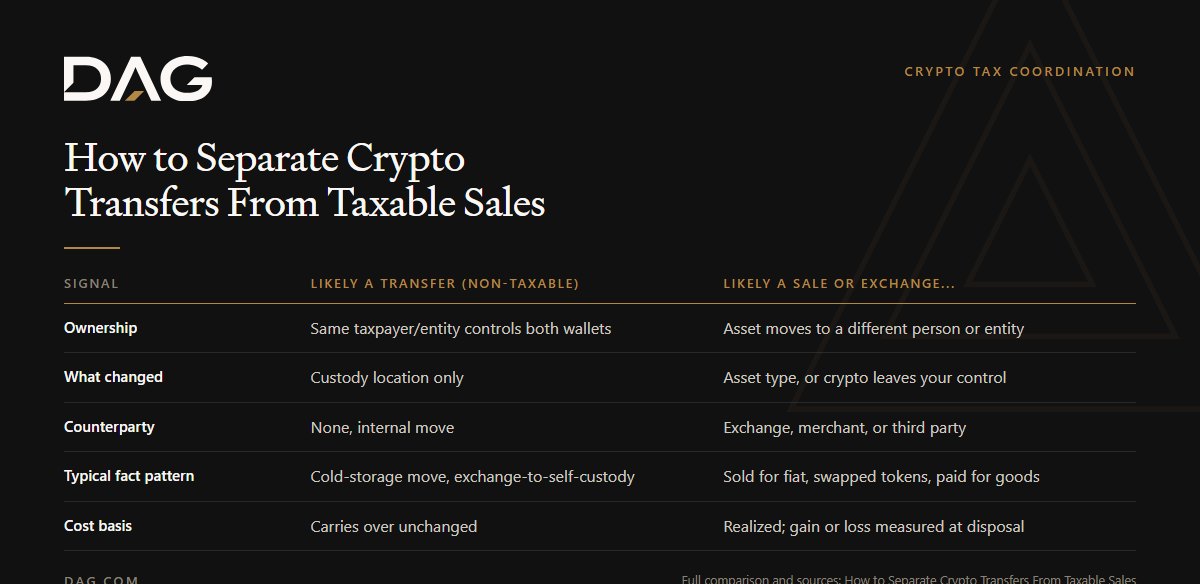
Transfer vs. Sale at a Glance
| Signal | Likely a transfer (non-taxable) | Likely a sale or exchange (taxable) |
|---|---|---|
| Ownership | Same taxpayer/entity controls both wallets | Asset moves to a different person or entity |
| What changed | Custody location only | Asset type, or crypto leaves your control |
| Counterparty | None, internal move | Exchange, merchant, or third party |
| Typical fact pattern | Cold-storage move, exchange-to-self-custody | Sold for fiat, swapped tokens, paid for goods |
| Cost basis | Carries over unchanged | Realized; gain or loss measured at disposal |
Classification depends on the facts of each transaction, so confirm edge cases with a qualified tax professional.
How to Reconcile Transfers Step by Step
- Pull the full transaction history (withdrawals and deposits) from every exchange and wallet.
- Match each outbound withdrawal to an inbound deposit of the same asset, amount (net of fees), and approximate timestamp.
- Confirm both endpoints are wallets you or your entity control, that is what makes the move a transfer rather than a disposal.
- Flag any movement you cannot pair, or where the counterparty differs, as a potential sale or exchange for closer review.
- Carry the original cost basis through matched transfers; reserve gain/loss calculations for genuine disposals.
- Document the owner and purpose of each transfer so the record stands on its own later.
For movements you cannot pair, work out first whether crypto wallet transfers are taxable, then how to reconstruct crypto cost basis for the disposals that remain.
Transfer Indicators
A transaction is generally a transfer when the same taxpayer or entity controls both the source and destination wallet and beneficial ownership does not change. Your records should support that conclusion, a matched withdrawal/deposit pair and proof of control at both ends.
Sale or Exchange Indicators
A transaction is generally a sale or exchange when crypto is converted to fiat, swapped for another asset, sent to another person, used to buy goods or services, or otherwise disposed of. These events are generally reported as disposals and may appear on Form 8949; see Form 8949 for crypto investors.
Records to Keep
- Source wallet.
- Destination wallet.
- Transaction ID (on-chain hash where available).
- Date and time.
- Asset and amount.
- Fees.
- Owner of both wallets.
- Notes explaining the purpose of the transfer.
Related Questions
Is moving crypto between my own wallets taxable?
Generally no. A move between two wallets the same taxpayer controls is not a disposal because beneficial ownership does not change, though network fees paid in crypto can themselves be small taxable events. Confirm specifics with a qualified tax professional.
What records prove a movement was a transfer and not a sale?
Keep the matched withdrawal and deposit, the transaction ID, the date, the asset and amount, and evidence that you controlled both wallets. A short note on purpose helps a reviewer or the IRS follow the trail later.
Does a self-transfer change my cost basis?
Generally not. Cost basis and holding period usually carry through a transfer between your own wallets; gain or loss is measured only when you actually dispose of the asset. The facts of each case can vary, so verify with a tax professional.
Sources
- IRS: Digital assets
- IRS: Frequently asked questions on digital asset transactions
- IRS: About Form 8949
Compliance Note
This article is educational and does not provide legal, tax, accounting, investment, or custody advice. Crypto transaction classification should be reviewed with qualified tax professionals.